
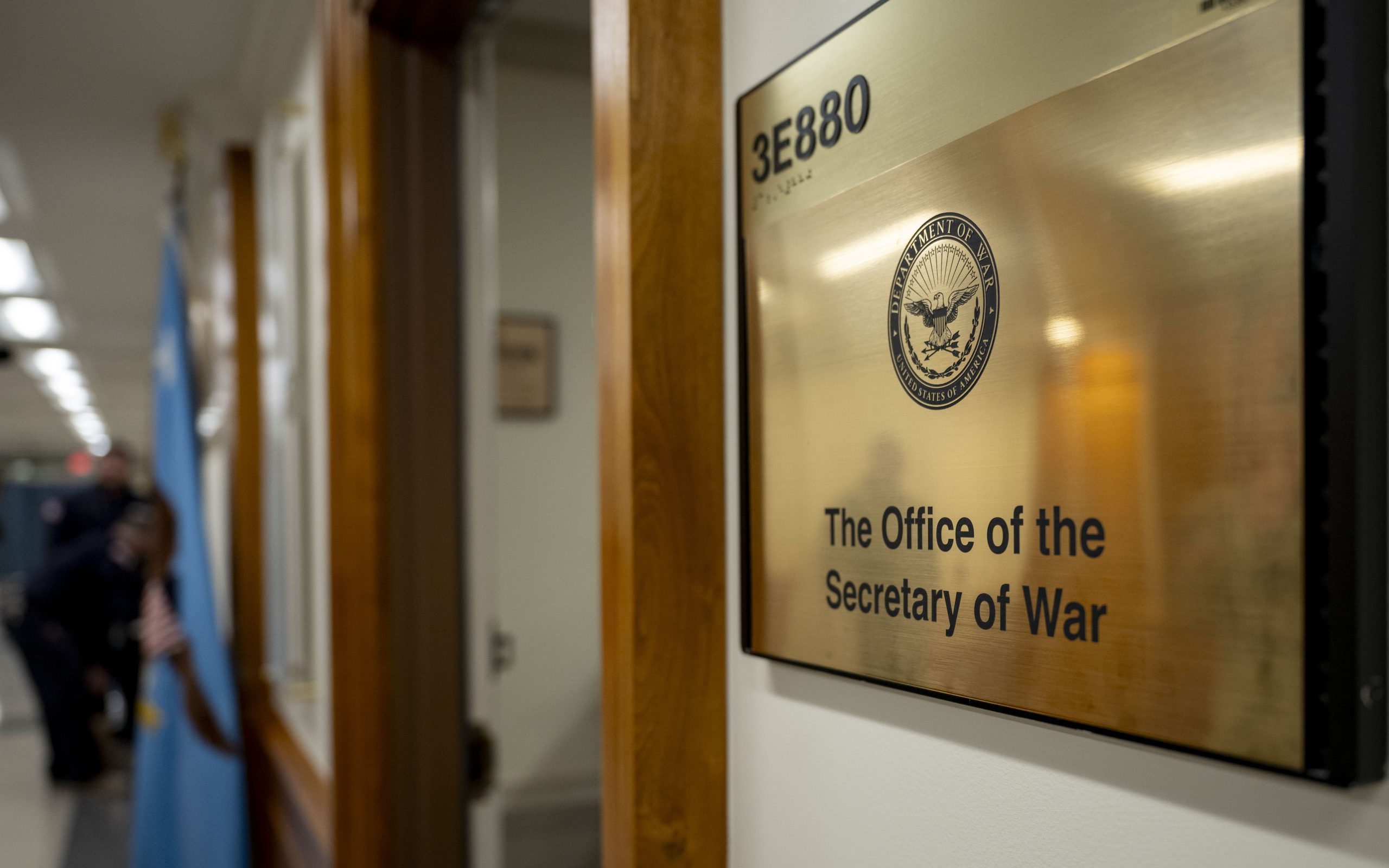
Three of the four principal congressional committees with oversight over U.S. defense policy have voted to formally rename the Department of Defense to the Department of War. While this marks a significant step, final legislative approval for the proposed rebranding of the Pentagon remains several months away and is not yet guaranteed.
The House Appropriations Committee recently approved, along party lines, an amendment to its version of the 2027 federal spending bill. This amendment seeks to eliminate all references to the Department of Defense, the Office of the Secretary of Defense, and other related entities within U.S. federal law, replacing them with the proposed “Department of War” nomenclature. This action follows similar measures previously passed by both the House Armed Services Committee and the Senate Armed Services Committee, indicating a growing momentum for the change within the legislative branch. The Senate Appropriations Committee is the remaining key committee yet to act on a similar proposal.
The Pentagon began utilizing “Department of War” as an alternative designation in September of last year, following an executive order issued by then-President Donald Trump. This executive order authorized “Secretary of War” as an acceptable secondary title for the department’s head. However, the official, statutory name in U.S. law has remained the Department of Defense. Under the U.S. constitutional system, only an act of Congress can formally alter the name of a cabinet-level department, distinguishing the executive order’s authorization of an alternative title from a complete legal rebrand.
Despite the Pentagon’s unofficial adoption of the new name, most congressional committees, federal agencies, and prominent news organizations have continued to use the official statutory name, the Department of Defense, to maintain clarity and adhere to existing law. This dual usage has created some semantic complexity in official communications.
In April, the Pentagon formally submitted a legislative proposal to Congress requesting the statutory name change. Department officials calculated that this comprehensive change would necessitate amending approximately 7,600 references across various U.S. laws and regulations. The sheer volume of required updates underscores the extensive legal and administrative implications of such a rebrand.
While some initial signage at the Pentagon’s main facility and on various departmental websites has already been updated to reflect the “Department of War” designation, the full financial implications of a global rebranding effort remain a subject of debate. The cost of updating buildings, signage, official documents, and digital assets across hundreds of U.S. military installations worldwide is substantial. The department itself projects an expenditure of $51.5 million on the name change by the conclusion of the current fiscal year, noting that precise “actual costs are being collected during implementation and will be available after FY 2026 execution is completed.” The Pentagon has stated its intention to implement these changes through “the most cost effective and noninvasive ways,” and does not anticipate additional costs in fiscal year 2027.
However, the Congressional Budget Office (CBO) provided a significantly broader cost estimate in January, ranging from $10 million to $125 million. This higher $125 million figure has frequently been cited by critics of the name change. The CBO’s analysis clarified that its estimate was not for an informal, unofficial name change, but rather for a full statutory alteration, which would entail “updating regulations, directives, doctrine, websites and digital assets, contract templates, and signage” across the entire department and its sub-agencies. The CBO report further elaborated that “If phased in gradually and limited to OSD [Office of the Secretary of Defense], incremental costs could be similar to the range of costs for an unofficial name change.” Conversely, the CBO cautioned, “If, however, implementing agencies chose to mandate an immediate change across all materials, costs could reach hundreds of millions of dollars,” highlighting the vast difference in potential expenses based on the implementation strategy.
Proponents of the name change argue that “Department of War” more accurately reflects the primary mission of the U.S. military: to fight and win the nation’s conflicts. They suggest that the name change helps to reinforce a “warrior ethos” championed by figures such as Secretary Pete Hegseth, aiming to instill a clear combat-focused identity within the armed forces. Historical precedent is also cited, noting that the U.S. War Department existed from 1789 until 1947, when it was reorganized into the National Military Establishment and subsequently the Department of Defense as part of the National Security Act. This historical connection is used to frame the change as a return to an essential organizational identity.
Critics, however, contend that the name change is an unnecessary and costly endeavor, particularly given the department’s diverse responsibilities beyond direct combat. They argue that “Department of War” fails to encompass the full spectrum of the department’s roles, which include deterrence, humanitarian aid, disaster relief, international partnerships, cybersecurity, space operations, and advanced research and development. Furthermore, critics suggest that the new name rhetorically deemphasizes the critical importance of deterring conflict and promoting stability, potentially signaling a more bellicose posture to the international community. The substantial financial cost is also a recurring point of contention, with opponents questioning the allocation of millions of dollars for a symbolic change when other critical defense needs may exist.
The legislative path for the name change appears increasingly favorable due to the current political landscape. With the Republican party maintaining control of both the House of Representatives and the Senate, and the executive branch having initiated the unofficial change, there are two primary legislative vehicles that could carry the proposal to completion: the annual National Defense Authorization Act (NDAA) and the defense appropriations bill. While neither measure is typically finalized and sent to the President’s desk before the end of the fiscal year — often not until December or later, as has been the trend since 2019 — historical patterns indicate that the NDAA is generally the more likely of the two to be successfully enacted before the conclusion of a congressional session.
Why This Matters
The potential renaming of the U.S. Department of Defense to the Department of War carries significant implications for both domestic policy and international relations, extending far beyond a simple change of title. Domestically, this rebrand touches upon several critical areas. The financial cost, potentially running into the hundreds of millions of dollars, raises questions about fiscal priorities, especially amidst ongoing debates over government spending and national debt. Critics argue these funds could be better allocated to military readiness, personnel benefits, or technological advancements. Proponents, however, view it as an investment in morale and strategic clarity, reinforcing a core mission for the armed forces.
From a strategic perspective, the name change represents a philosophical shift in how the U.S. defines and projects its national security apparatus. The creation of the Department of Defense in 1947, replacing the War Department and Navy Department, was a deliberate move to integrate military branches and emphasize a broader approach to national security encompassing deterrence, diplomacy, and collective defense alongside combat operations. Reverting to “Department of War” could be interpreted as a narrowing of this strategic focus, potentially signaling a more aggressive or solely combat-oriented posture to allies and adversaries alike. It could subtly alter the perception of the U.S. military’s role in humanitarian crises, international peacekeeping, and diplomatic efforts, which are often undertaken under the “defense” mandate.
Internationally, the rebrand could influence geopolitical dynamics. Allies might question whether the U.S. is shifting its emphasis away from collective security and deterrence towards a more unilateral or interventionist approach. Adversaries, on the other hand, might interpret the change as a hardening of U.S. military resolve, potentially escalating rhetoric or prompting a reevaluation of their own defense strategies. The language used by a nation’s defense establishment is often carefully scrutinized for its symbolic weight and underlying intent. A name change of this magnitude, particularly for a global superpower like the United States, is unlikely to be viewed merely as an administrative formality but rather as a statement of national character and strategic direction. The debate itself highlights the ongoing tension between projecting strength and fostering stability in an increasingly complex global environment.