
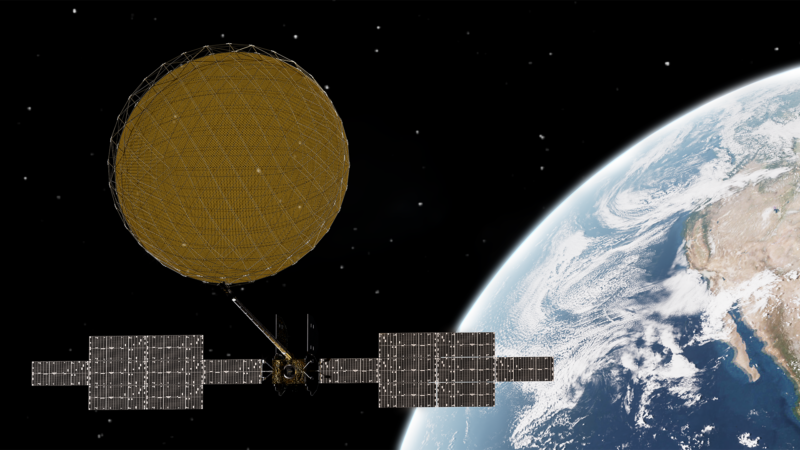
U.S. Space Force Advances Critical Space Data Network with New Viasat Contract for Central Operations Hub
In a significant move to enhance its burgeoning Space Data Network (SDN), the U.S. Space Systems Command (SSC) has awarded a pivotal contract to Viasat, a global communications company. The indefinite delivery, indefinite quantity (IDIQ) contract, boasting a ceiling of $450 million, tasks Viasat with the design and fielding of a comprehensive Mission Operations Center (MOC) for the SDN. An initial tasking order under this contract has been set at $115 million, signaling the immediate commencement of critical development work.
The establishment of this Mission Operations Center is deemed essential as it will serve as the central integration hub for the Space Data Network. According to Space Force officials, the SDN is envisioned as a robust and dynamic constellation comprising both government and commercial satellites. Its overarching objective is to fulfill the diverse tactical and enterprise communication requirements of the entire joint force, spanning across all operational domains.
At the technological heart of the SDN lies its “Backbone,” a sophisticated infrastructure designed to provide “robust, resilient, high-capacity, and low-latency data transport.” This Backbone is intended to deliver critical worldwide tactical communications and broadband communication services, ensuring seamless connectivity for U.S. military operations globally. The ability to transmit vast amounts of data swiftly and securely is paramount for modern warfare, supporting everything from intelligence gathering and reconnaissance to real-time command and control.
The development of the SDN Backbone has seen substantial investment, with industry giant SpaceX securing a $2.9 billion deal in May to contribute to this core infrastructure. SpaceX is slated to deliver an operational prototype capability by the end of next year. While initial concerns emerged regarding potential over-reliance on a single vendor, the SSC has proactively diversified its vendor base. Subsequent contracts for various components of the SDN Backbone have been awarded to a range of companies, including Rocket Lab, York Space Systems, Northrop Grumman, Lockheed Martin, and Amazon LEO for Government. This multi-vendor strategy is designed to foster competition, drive innovation, and, crucially, reduce dependency on any single constellation or system, thereby enhancing the overall resilience and flexibility of the network.
The introduction of multiple vendors, while beneficial for competition and resilience, inherently necessitates a sophisticated system for integration and management. This is precisely where the Viasat-developed Mission Operations Center becomes indispensable. It will act as the “central integration hub” across what will be a diverse array of satellite constellations and service providers, ensuring they operate as a cohesive unit.
“Establishing this Mission Operations Center is a crucial step in maturing our Space Data Network into a fully operational, multi-vendor capability,” stated Space Force Lt. Col. Alexa Eggert, materiel leader for the SDN-Backbone program, in a recent release. She emphasized the MOC’s role in orchestrating the transport of critical data seamlessly across different vendors’ satellites and to all domains, with the ability to route and reroute data in real time to optimize efficiency and maintain connectivity under various operational conditions.
Lt. Col. Eggert further elaborated on the MOC’s foundational importance: “The MOC establishes the mission operations layer needed to integrate the diverse space data transport and space exchange systems being developed across related efforts. By bringing the systems together in one place, it positions us to deliver a more integrated mission capability across multiple constellations and systems.” This integration layer is vital for achieving the “system of systems” approach that the Space Force is pursuing.
This initiative aligns with SSC’s broader open-architecture approach, which aims to deliver secure and resilient space-to-ground connectivity for joint force users across air, land, sea, and space domains. An SSC spokesperson confirmed that this open framework encourages interoperability and flexibility, preventing vendor lock-in and allowing for rapid adoption of new technologies. While the strategic intent is clear, specific technical standards, system interfaces, performance measures, operational employment concepts, and future task-order details are not available for public release, according to the spokesperson, citing security and proprietary concerns.
The Space Data Network is also closely interconnected with other strategic defense initiatives. Notably, the SDN is tied to the planned Golden Dome missile defense shield. The recent Viasat contract award was explicitly made “in partnership with Golden Dome for America,” an SSC spokesperson informed Air & Space Forces Magazine on November 9, underscoring the critical role SDN will play in supporting next-generation missile defense capabilities.
Viasat’s involvement with the U.S. Space Force extends beyond this latest contract. In August, the company secured a separate SSC contract to develop a dual-band X/Ka-band, mini-geosynchronous maneuverable satellite for the Protected Tactical SATCOM-Global (PTS-G) program. For this mission, Viasat selected Rocket Lab to construct the spacecraft, highlighting a pattern of strategic partnerships. Prior to that, in May, Viasat and Intelsat General Communications were jointly awarded a combined $437 million USSF contract to develop anti-jam communication satellites specifically for tactical SATCOM missions, demonstrating Viasat’s extensive portfolio in secure satellite communications.
The PTS-G program itself is a crucial element of the broader Protected Tactical SATCOM system, which is designed to replace the aging Advanced Extremely High Frequency constellation. This comprehensive system encompasses not only the satellites but also the PTS-W waveform, advanced ground controls, and an anti-jam modem. The Space Force has requested substantial funding for these programs, with approximately $450 million for fiscal year 2027 and a projected $2 billion through fiscal year 2031 for PTS-G, as reported by Air & Space Forces Magazine.
Viasat’s experience in securing satellite communications has been tested in real-world scenarios. In 2022, the company’s terminals were targeted by hackers in an attack that disrupted communications for thousands of European users, including a significant impact in Ukraine, coinciding with a Russian attack in February of that year. Despite the severity of the incident, which affected thousands of terminals across Europe, Viasat demonstrated significant resilience, bringing thousands of satellites back online daily. Although initial estimates suggested weeks for full resolution, the company successfully recovered and replaced the necessary nodes between late February and April, showcasing its capability to manage and mitigate complex cyber threats to its infrastructure. This experience provides a critical context for its role in developing secure systems for the U.S. military.
Looking ahead, the U.S. Space Force has outlined significant financial commitments for the SDN-Backbone program. In the current fiscal year 2027 National Defense Authorization bill, USSF has requested a substantial $1.5 billion. This funding is strategically allocated, with $685 million designated to accelerate constellation growth and an additional $800 million earmarked to integrate cutting-edge commercial technologies currently under development. These investments underscore the Space Force’s determination to rapidly field a superior and highly resilient space-based communication network.
Why This Matters
The development of the Space Data Network (SDN) and the establishment of its Mission Operations Center (MOC) represent a critical leap forward in U.S. national security and defense capabilities. In an increasingly contested space domain, the ability to ensure robust, resilient, and high-capacity communications is not merely an operational advantage but a strategic imperative. This initiative directly addresses several key challenges and opportunities:
- Enhanced Joint Force Interoperability:The SDN will provide seamless, real-time data flow across the U.S. Army, Navy, Air Force, Marine Corps, and Space Force. This integration is vital for modern, multi-domain operations, allowing for faster decision-making, improved intelligence sharing, and more effective coordination in combat and humanitarian missions alike.
- Resilience Against Adversaries:By integrating both government and a diverse array of commercial satellites, and crucially, building a central MOC that can orchestrate data across these varied systems, the Space Force is creating a network far more difficult for adversaries to disrupt. The multi-vendor approach minimizes single points of failure, making the network inherently more resilient to physical attacks, jamming, and cyber warfare—a lesson partly informed by Viasat’s own experience with cyberattacks.
- Leveraging Commercial Innovation:The significant involvement of private companies like SpaceX, Viasat, and Amazon LEO for Government highlights a strategic pivot by the Space Force to harness the rapid innovation and cost efficiencies of the commercial space industry. This partnership accelerates the development and deployment of advanced technologies that might otherwise take decades through traditional defense acquisition processes.
- Support for Next-Generation Defense Systems:The explicit link between the SDN and the “Golden Dome” missile defense shield underscores the foundational role this network will play in future U.S. defense architectures. Effective missile defense requires ultra-low-latency, high-volume data transmission to detect, track, and intercept threats, making the SDN an indispensable component.
- Maintaining U.S. Leadership in Space:These investments demonstrate the U.S. commitment to maintaining its leadership in space, not just militarily but also technologically. By pushing the boundaries of satellite communications and network integration, the Space Force is setting new standards for secure, global connectivity. This leadership has broader implications for international partnerships and deterrence in an increasingly militarized space environment.
In essence, the SDN and its MOC are not just about faster internet in space; they are about building the secure digital nervous system for the future of U.S. defense, ensuring that American forces have the communication superiority needed to protect national interests and project power globally.