
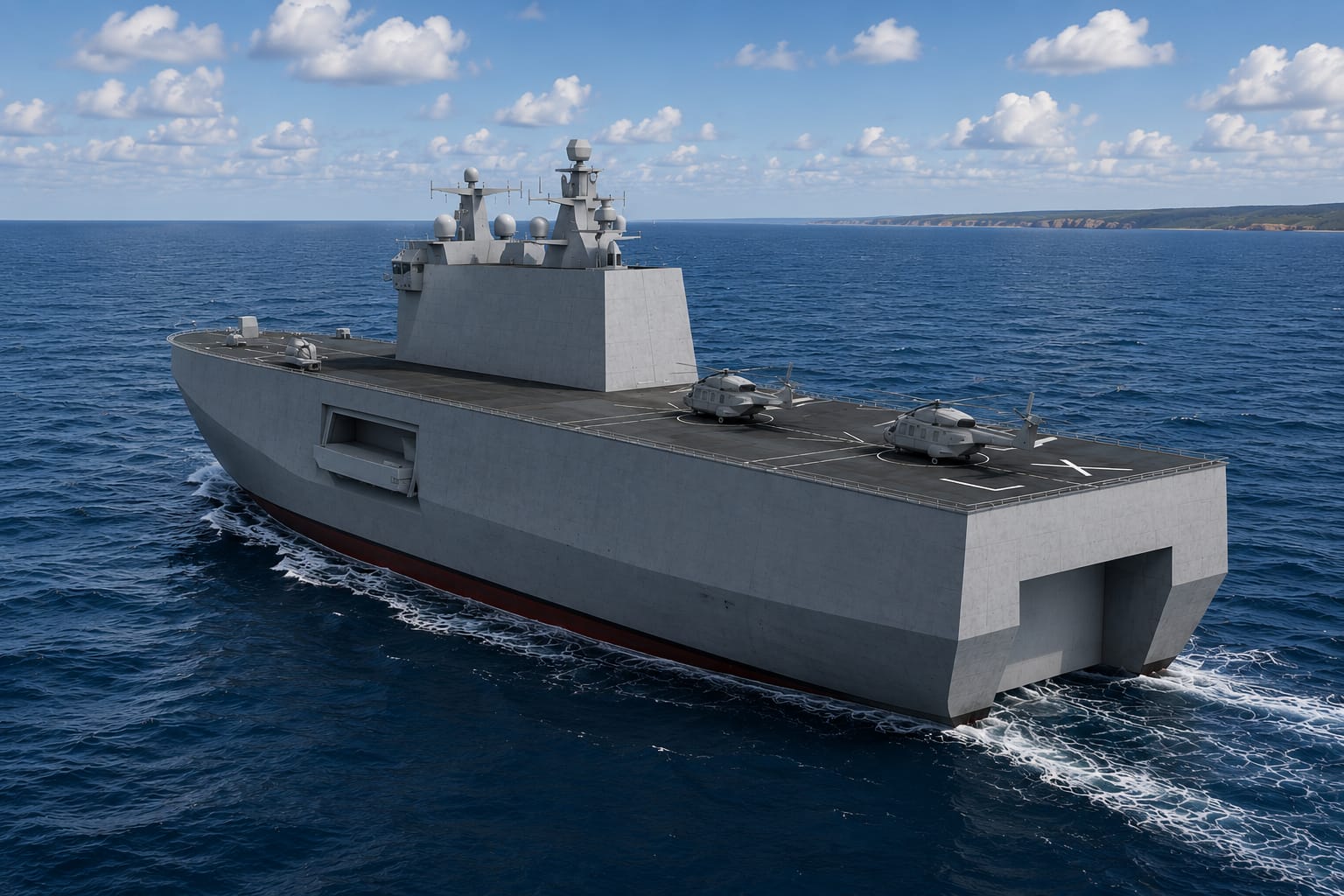
United Kingdom Announces Investment in New Amphibious Transport Ships Amidst Strategic Shift
The United Kingdom’s Ministry of Defence (MoD) has announced plans to invest in a new class of larger amphibious transport ships. These vessels are intended to bolster the capabilities of the UK Commando Force and are part of a broader strategy aimed at fostering a combined amphibious fleet with the Netherlands.
This investment forms a key component of the ongoing transformation of the UK Commando Force into what the MoD terms the “Future Commando Force.” This initiative represents a significant strategic reorientation, with a pronounced emphasis on operations in the High North. The overall programme is supported by a financial commitment exceeding £500 million. Dan Jarvis, who assumed the role of Defence Secretary earlier this month, has reportedly spent his initial weeks in office restructuring the Defence Investment Plan to prioritize equipment for frontline units. The newly announced amphibious ships are central to this revised plan, alongside other modern capabilities such as new high-speed insertion craft and uncrewed systems.
Secretary Jarvis explicitly linked the new spending to the operational requirements of the Commando Force. In a public statement, he affirmed, “We’re investing in new lethal strike drones, high-speed boats, and amphibious transport ships to give our Commandos the equipment they need to stay ahead of adversaries and defend us.” This statement underscores the perceived necessity of advanced equipment to maintain a tactical advantage in contemporary and future conflict scenarios, emphasizing rapid deployment, precision strike capabilities, and enhanced battlefield awareness through uncrewed platforms.
The announcement represents a significant step towards rebuilding the Royal Navy’s amphibious fleet, which has experienced a substantial reduction in capability in recent years. Specifically, the Royal Navy has operated without dedicated Landing Platform Docks (LPDs) since HMS Albion and HMS Bulwark, the two vessels of the Albion-class, were withdrawn from service in 2025. Their previously envisioned successor program, known as the Multi Role Strike Ship (MRSS) programme, aimed to acquire up to six new vessels. This ambitious project was designed not only to replace the Albion-class LPDs but also the three Bay-class Landing Ship Docks (LSDs) and the aviation support ship RFA Argus. Under the MRSS timeline, the first hull was anticipated in the early 2030s, with the program slated to transition from its concept phase into assessment during 2026. At present, it remains unclear whether this new investment in amphibious ships will replace or significantly alter the scope of the previously defined MRSS project.
The concept of Anglo-Dutch amphibious cooperation is not new. British and Dutch marines have maintained a joint UK/NL Amphibious Force for over fifty years, signifying a deep and enduring military partnership. In 2023, this collaboration was further formalized through a Memorandum of Understanding (MoU), referred to as Project CATHERINA. The initial objective of Project CATHERINA was to study the feasibility of a shared amphibious ship design. However, this aspiration for a joint design was subsequently abandoned in 2024. The decision was made after both navies concluded that their respective operational requirements and budgetary constraints were too divergent to accommodate a single hull design. Following this determination, efforts were redirected towards enhancing interoperability and standardizing common subsystems. This included areas such as landing craft, cranes, dock doors, and propulsion systems, thereby aiming for seamless integration of national assets rather than a shared platform.
Meanwhile, the Netherlands has its own plans for modernizing its amphibious capabilities. The Dutch navy is currently planning the acquisition of six Amphibious Transport Ship vessels, with deliveries projected to commence from 2032. These new ships are intended to replace the existing Rotterdam-class Landing Platform Docks and Holland-class patrol vessels, representing a comprehensive upgrade to their naval transport and patrol capabilities.
The current description by the UK Ministry of Defence, aiming for a “combined fleet,” suggests a closer alignment of the British and Dutch national programmes than the subsystem-level cooperation previously agreed upon. Such a combined fleet would facilitate the deployment of marine raiding forces through strategically vital and potentially contested areas, particularly NATO’s northern and Baltic approaches. This integration under a shared Anglo-Dutch design philosophy, or at least a highly collaborative operational framework, would enhance collective security and projection capabilities in a critical geopolitical region.
The refreshed Defence Investment Plan, which provides the strategic and financial framework for these new initiatives, is anticipated to be formally published prior to the upcoming NATO leaders’ summit. This summit is scheduled to take place in Ankara on July 7 and 8, where discussions are expected to be dominated by critical topics such as allied defence spending commitments and the industrial capacity of member states to meet evolving security challenges.
Why This Matters
The United Kingdom’s announced investment in new, larger amphibious transport ships signifies a multi-faceted strategic shift with profound implications for its defence posture, its alliances, and regional security. First, it directly addresses a critical capability gap in the Royal Navy, which has lacked dedicated Landing Platform Docks since 2025. Restoring and enhancing this amphibious capacity is fundamental for the projection of power, rapid response to crises, and supporting expeditionary operations globally, particularly for the commando forces. It underscores a commitment to maintaining a robust naval presence and the ability to deploy forces from sea to land.
Second, this initiative is integral to the transformation of the UK Commando Force into the “Future Commando Force,” with a strategic pivot towards the High North. This geographic focus reflects growing geopolitical competition in the Arctic region, driven by factors such as resource access, shipping routes, and military presence from nations like Russia. Equipping commandos with advanced amphibious capabilities, high-speed insertion craft, and uncrewed systems reflects a modern approach to warfare, emphasizing agility, stealth, and technological superiority in challenging environments. The £500 million commitment signals a serious intent to back this transformation with substantial resources.
Third, the stated aim of developing a combined amphibious fleet with the Netherlands carries significant weight for NATO. The long-standing UK/NL Amphibious Force is a cornerstone of European defence cooperation, and a more integrated fleet would strengthen NATO’s northern flank. This collaboration moves beyond mere interoperability of subsystems to a potential shared operational philosophy, enabling more seamless coordination and greater collective deterrence in critical areas like the Baltic Sea and the North Atlantic. In an era of renewed great power competition, such deepened alliances and shared capabilities are paramount for collective security and burden-sharing within the alliance.
Finally, the timing of this announcement, just ahead of the NATO summit in Ankara where defence spending and industrial capacity are key agenda items, is highly significant. It demonstrates the UK’s commitment to investing in its defence capabilities and potentially encourages other NATO members to meet their own defence spending targets. The investment will also have domestic implications, supporting the UK’s shipbuilding industry and fostering innovation in defence technology. This move is a clear signal of the UK’s intent to remain a leading naval and expeditionary power, adapting its forces to meet the complex and evolving security challenges of the 21st century.