
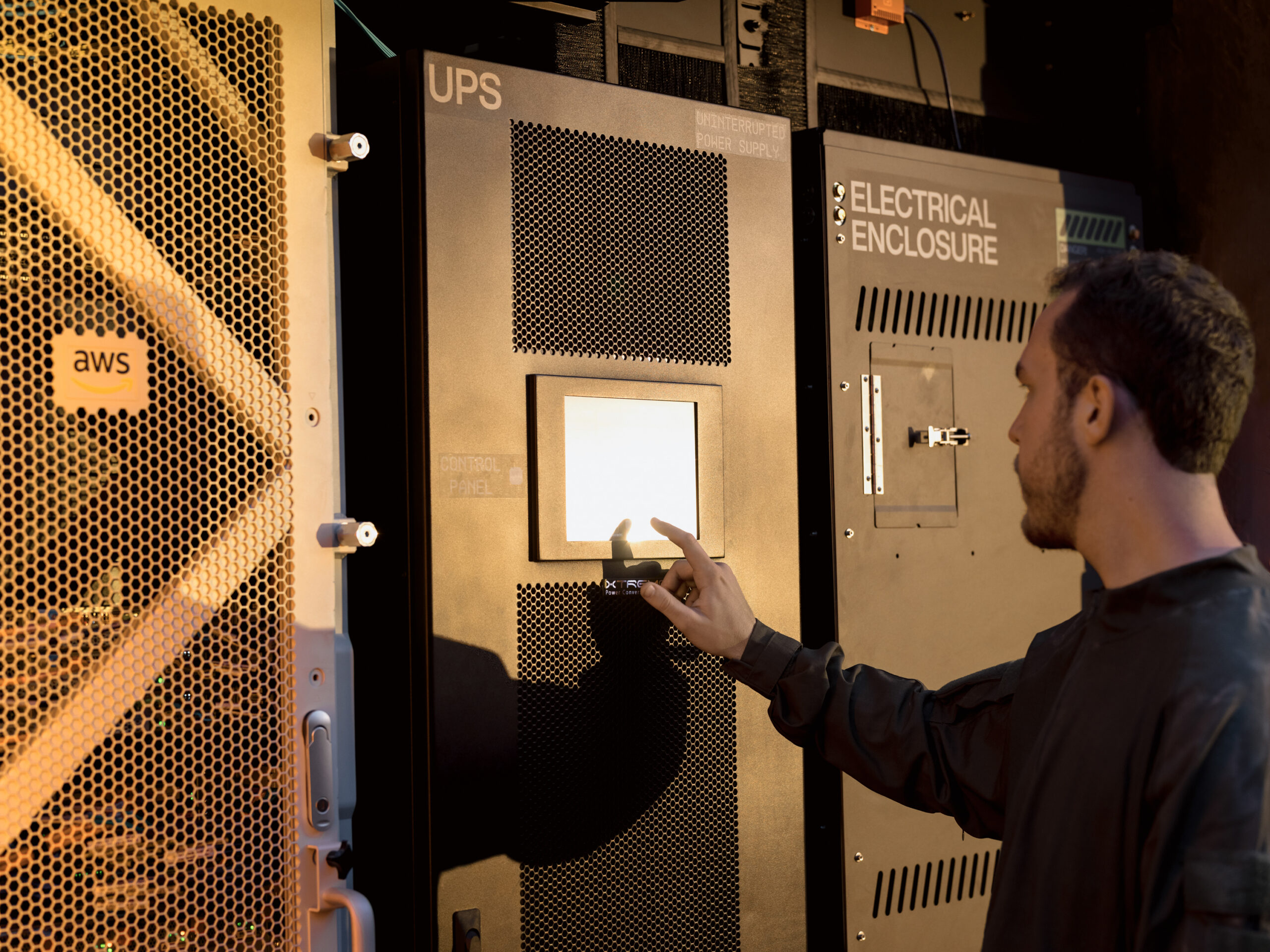
WASHINGTON – A significant partnership has been announced between Amazon Web Services (AWS), a leading global cloud services provider, and Anduril Industries, a rapidly expanding defense technology company. The collaboration aims to deliver high-capacity computing and artificial intelligence (AI) capabilities for critical military functions such as targeting and sensor fusion. These advanced capabilities will be housed within mobile data centers specifically designed for deployment in challenging, austere environments at the tactical edge of military operations.
On June 30, Amazon Web Services confirmed its selection of Anduril as a “preferred edge provider” for national security and defense applications. The announcement did not specify whether AWS intends to form similar partnerships with other edge technology providers in the future.
AWS, known for its dominant position in the cloud services market, maintains extensive relationships with various military and intelligence agencies globally. While it already offers a wide array of cloud-based services to these entities, this new partnership extends its reach to directly support Anduril’s Menace-I edge platform, bringing robust computing power closer to active combat zones.
Officials from both Anduril and AWS elaborated on the functions, potential use cases, and broader implications of this partnership for future military operations during a panel discussion at an AWS public sector event held in Washington.
The core of this initiative involves integrating AWS Outposts, a localized extension of Amazon’s cloud computing infrastructure, into Anduril’s mobile data centers. The strategic objective is to replicate the immense computational power typically found in large, centralized data centers and deploy it directly at the tactical level within a combat theater, vastly increasing on-site processing capabilities.
Tom Keane, Senior Vice President of Engineering at Anduril, highlighted the unique challenges of operating such systems in forward-deployed environments. “What we were able to do together, is to design those systems to run at the extreme tactical edge,” Keane stated. He further explained the distinctions from traditional data center environments: “And what’s different about the edge versus a data center? Well, the power is not as nice, there’s no air conditioning, the communications are a little spotty. You may be getting there via a helicopter, or a road train or a C-17.” This underscores the necessity for ruggedized, self-sufficient systems.
The development of compact, mobile data centers capable of executing complex technical processing, whether connected to enterprise services or operating autonomously in disconnected environments, represents a critical and rapidly evolving requirement for modern military forces.
Darrell West, a senior fellow for the Center for Technology Innovation at the Brookings Institute, emphasized the adaptability of these systems. In an email to Air & Space Forces Magazine, West noted, “Military operations typically are quite dynamic with lots of moving pieces. Users need the ability to cross geographic boundaries and access a variety of data sources. It helps to have mobile data centers that provide flexibility and can adapt to a variety of field conditions.”
The operational impact of such technology is substantial. Keane provided an example involving the F-35 Lightning II fighter jet, where a complex mission might typically demand up to eight human operators and take nearly two days to program. With the support of mobile data centers at the edge, the same tasks could be accomplished by two personnel in approximately two hours, demonstrating a significant increase in efficiency and speed.
While robust and clear communications allow systems to connect to secure data centers in distant locations, these long-distance connections inevitably introduce latency – a delay that can be critical in time-sensitive military operations, potentially determining the success or failure of a mission. The ability for systems to operate effectively even when communications are degraded or denied is therefore paramount.
“There is lower latency in mobile versus distant data centers and that can be important if people are making decisions in real-time,” West reiterated. “You don’t want to lose a target if you need military precision in the targeting process.”
Another panelist, Shannon Judd, General Manager at AWS Web Services Worldwide Public Sector Global Partners, illustrated this point with an example involving a defense industry prime contractor requiring rapid collection, assessment, and decision-making using flight data. Without AI and cloud-based capabilities available at the edge, users are compelled to “back haul” this data – sending it for processing at servers located hundreds or thousands of miles away in more secure, centralized locations. This process significantly extends the time required for critical analyses and decision-making.
The Hardware/Software Combination
Anduril’s Menace-I system is offered in three distinct variants: Core, Command, and Enhanced. Each variant is designed to be housed within standard shipping containers of varying sizes, facilitating transport and deployment. According to the Anduril website, the Core variant functions primarily as an edge-deployed cloud, bringing fundamental cloud services directly to the field. The Command variant is engineered to generate data for military sorties and missions, while the Enhanced version serves as a comprehensive AI factory, supporting advanced functions such as sensor fusion and precise targeting.
The primary differentiating factor between these variants lies in their physical size and the number of server racks they can accommodate. The Core and Command modules are designed to fit one AWS Outpost Rack each, whereas the Enhanced version is capable of supporting four racks. This configuration translates to approximately 40 to 42 servers per Core/Command unit and up to 168 servers for the Enhanced version, as detailed on the Anduril website.
The AWS Outposts integrated into these units utilize Ultra Low Latency Racks, which offer significantly faster processing speeds compared to standard server racks, according to individuals familiar with the technology. This speed is crucial for real-time applications at the tactical edge.
Anduril has reported that its Menace system has logged over 50,000 hours of rugged field use over the past three years, demonstrating its durability and reliability in challenging conditions. An Anduril representative confirmed that Menace is currently operational across various branches of the U.S. military, having been utilized in both training exercises and active operations, including Operation Epic Fury against Iran.
Further validating its mobility and readiness for deployment, the U.S. Marine Corps certified Menace for sling load movement by the Sikorsky CH-53K King Stallion helicopter in August 2025. This certification is a critical step for integrating the system into expeditionary operations.
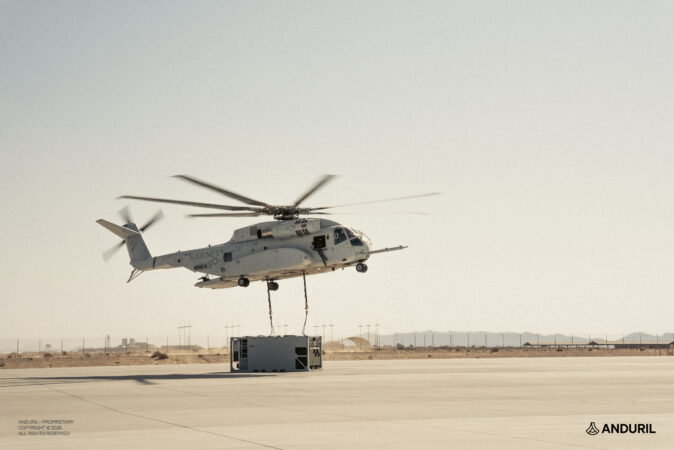
The successful sling load certification qualifies Menace to provide crucial mission planning support for fifth-generation aircraft, including advanced platforms like the F-35 and F-22 Raptor, enhancing their operational reach and effectiveness.
While AWS Outposts are already deployed within various major combatant commands and have been used in operations such as Epic Fury, their deployment has typically been restricted to more conventional, structured environments with existing infrastructure.
Liz Martin, Managing Director of AWS Global Defense, explained the traditional deployment model: “We have AWS Outposts deployed in the AOR already, but they align to how an outpost is comfortable to be deployed… Which is in the structure with a roof and heating and cooling and power.”
Martin highlighted that the availability of the Menace/Outpost combination during Operation Epic Fury would have significantly expanded capabilities. “The extra advantage of this as a capability in the AOR would have allowed a little bit more of a proliferation of those capabilities to a wider span of the AOR where mission was taking place that was different than the traditional environment of AWS Outposts,” Martin stated, emphasizing the enhanced flexibility for deploying advanced computing closer to dynamic missions.
Prior to this partnership, the Menace hardware has also successfully hosted software and capabilities from Palantir Technologies’ Tactical Intelligence Targeting Access Node (TITAN), which is recognized as the U.S. Army’s inaugural artificial intelligence ground system, further demonstrating its versatility and integration potential within military AI architectures.
Why This Matters
This partnership between Amazon Web Services and Anduril Industries represents a significant advancement in military technology and has profound implications for future global defense strategies. By integrating advanced cloud computing and artificial intelligence capabilities into ruggedized, mobile data centers, the initiative aims to fundamentally transform how military forces operate at the “tactical edge” – the frontline of conflict and decision-making.
Firstly, it addresses the critical need for speed and autonomy in modern warfare. The ability to process vast amounts of sensor data, fuse intelligence, and generate targeting solutions directly in the field drastically reduces the time required for critical actions. This reduction in “latency” can mean the difference between mission success and failure, especially in dynamic, high-stakes scenarios. It also lessens reliance on potentially vulnerable long-distance communications, enhancing operational resilience in contested environments.
Secondly, this collaboration accelerates the integration of AI into battlefield operations. By providing localized, powerful AI processing, systems like Menace-I can enable more sophisticated autonomous functions, enhance situational awareness for human operators, and streamline complex tasks that traditionally require extensive human input and time. This shift towards AI-enabled decision support could significantly improve the efficiency and effectiveness of military assets, from fifth-generation fighters to ground units.
Furthermore, this development highlights the increasing convergence of commercial technology with national defense. The involvement of a tech giant like AWS in developing tactical military hardware underscores the private sector’s growing role in shaping future defense capabilities. It signifies a move towards leveraging commercial innovation for military advantage, potentially leading to faster development cycles and more agile adaptation of cutting-edge technologies for defense applications globally. This trend could reshape defense procurement and industry partnerships, impacting international security dynamics and the balance of power.
Finally, the deployment of such mobile, high-capacity computing infrastructure offers unprecedented flexibility for military operations. It enables forces to carry out complex data analysis and AI-driven tasks in previously inaccessible or highly challenging environments, expanding the reach and capabilities of modern militaries worldwide. This decentralization of computing power signifies a strategic shift towards more resilient, distributed, and adaptable command and control architectures, profoundly influencing the future of warfare and military planning.