
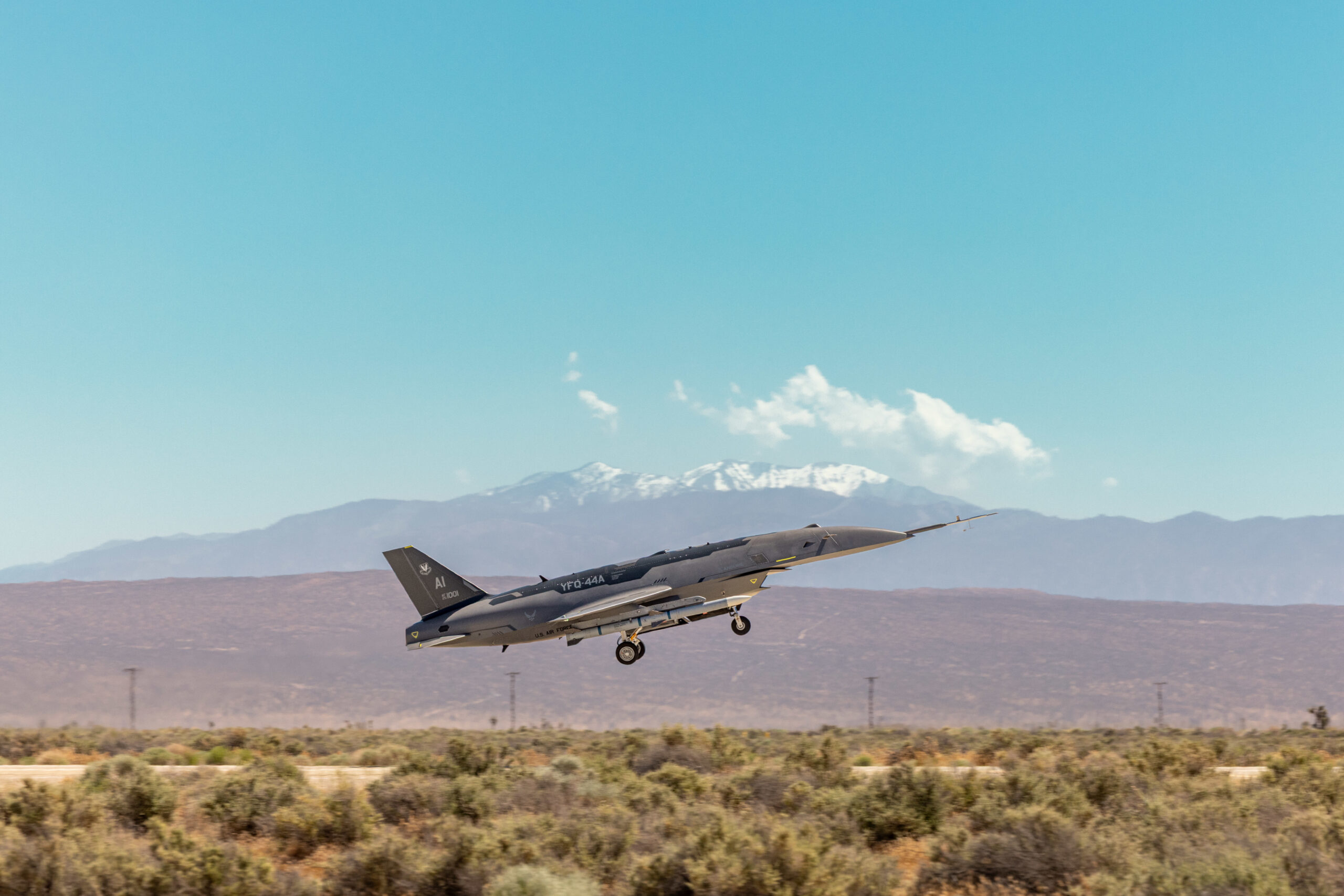
In a significant milestone for military aviation and the integration of artificial intelligence, two semi-autonomous drones of the U.S. Air Force successfully conducted complex air combat maneuvers, coordinated by advanced mission autonomy software, during a test on October 26. This event marks a critical first for the Air Force’s Collaborative Combat Aircraft (CCA) program, demonstrating enhanced capabilities in autonomous aerial operations.
The test, held at the Nevada Test and Training Range, involved two FQ-44A aircraft, which are uncrewed aerial vehicles developed by Anduril Industries. The flight operations and tactical decisions for these drones were managed by “Hivemind,” an AI-driven autonomy software developed by Shield AI. This software acted as an “AI pilot,” orchestrating the drones’ movements and responses.
During the exercise, the FQ-44As flew in formation and executed beyond-visual-range air combat maneuvers. Beyond-visual-range (BVR) combat refers to engagements where targets are located beyond the pilots’ visual perception, typically requiring radar and other sensors for detection and targeting. Shield AI vice president of Hivemind engineering, Todd Wesley, confirmed that the software directed these intricate maneuvers as the drones engaged a virtual threat. Unlike previous tests, there was no human pilot in an accompanying aircraft; instead, a ground operator provided high-level strategic directions to the pair of CCAs.
This October 26 flight builds upon an earlier landmark test on October 8, which took place at Edwards Air Force Base, California. In that prior event, a human pilot in a manned F-22 fighter jet directed a single FQ-44 Fury drone, also utilizing the Hivemind autonomy software. Wesley emphasized the progression, stating, “The initial test in early October was essentially a stepping stone to this capability. … This was kind of a graduation, so to speak, exercise beyond what happened in early October.” He characterized the October 26 test as a “full-on tactical air-to-air engagement,” highlighting the increased complexity and autonomy.
The successful execution of these maneuvers by fully autonomous drones, with human oversight limited to high-level strategic commands from the ground, signifies a substantial leap forward in the development of uncrewed combat aircraft. The “AI pilot” designation refers to sophisticated algorithms and machine learning models within the Hivemind software that enable the drones to make real-time tactical decisions, adapt to changing scenarios, and coordinate effectively with each other without direct human input for every action.
Looking ahead, Shield AI and the Air Force plan to expand the scope and complexity of future tests. Wesley indicated that upcoming exercises would involve larger teams of drones, the coordination of “teams of teams,” and more intricate operational scenarios, such as reassigning assets between different formations while in-flight. While the eventual goal includes CCAs carrying and employing live munitions, no specific timeline for such tests has been provided. Wesley stressed the importance of refining the human-machine interface (HMI) to ensure that human operators can effectively manage this increasing level of complexity, stating, “It starts to prove out more and more of the orchestration capabilities of these systems, and making sure that how we design the human-machine interface allows the humans in the cockpits to be able to manage this level of complexity, and learn those answers and where we need to simplify to do so appropriately.”
The U.S. Air Force has placed a significant strategic emphasis on the Collaborative Combat Aircraft program. The vision behind CCAs is to augment the existing fleet of manned fighter aircraft, providing a substantial increase in combat “mass” and extending the reach and capabilities of air power. Current concepts of operation envision a single manned fighter controlling multiple CCAs—initially suggested as two to five, and more recently, as many as eight. This “loyal wingman” concept aims to create a force multiplier, allowing manned aircraft to operate more safely and effectively by delegating dangerous or repetitive tasks to autonomous drones. For this vision to materialize, the autonomy software must be capable of coordinating intricate maneuvers with minimal direct input from human pilots, a capability demonstrated by the recent tests.
Why This Matters
The successful autonomous air combat maneuvers by the FQ-44A drones represent a pivotal moment in military aviation, signaling a profound shift in the future of air warfare. Here’s why this development holds significant importance:
- Revolutionizing Air Combat:This test validates the potential for AI-driven autonomous systems to operate independently in complex combat scenarios. It moves beyond simple drone surveillance or strike missions to sophisticated air-to-air engagements, fundamentally changing how air battles could be fought. It paves the way for human-machine teaming to become the norm, with AI-piloted drones acting as extensions of manned aircraft or operating semi-independently under strategic human direction.
- Strategic Advantage and Force Multiplier:For the U.S. and its allies, developing advanced CCA capabilities offers a critical strategic advantage. By increasing the number of combat assets (“mass”) available in a theater, these drones can overwhelm adversaries, penetrate contested airspace more effectively, and extend the range and endurance of air operations. This capability is particularly relevant in potential conflicts against near-peer adversaries with sophisticated air defenses.
- Enhanced Pilot Safety and Cost-Effectiveness:CCAs are designed to be “attritable,” meaning they are less expensive to produce and maintain than traditional manned fighters, and their loss in combat is more acceptable than losing a human pilot and a multi-million dollar aircraft. This reduces the risk to human life in highly dangerous missions and could make air power more sustainable and affordable in the long run, allowing for greater deployment numbers.
- Accelerated Development of Autonomous Systems:The speed at which the Air Force and its industry partners are progressing from human-directed drones to fully autonomous, multi-drone coordination highlights a rapid acceleration in AI and robotics development for defense applications. This push will likely spur further innovation in sensor integration, real-time decision-making, and secure communication links for uncrewed platforms.
- Ethical and Regulatory Considerations:As autonomous systems demonstrate increasing capabilities, especially with the future prospect of live munitions, it intensifies global debates surrounding the ethics, accountability, and international regulation of autonomous weapons systems. The development underscores the urgent need for clear policy frameworks and international agreements on the use of AI in warfare.
- Pacing the Competition:Nations like China and Russia are also heavily investing in military AI and autonomous systems. The U.S. Air Force’s progress in the CCA program is crucial for maintaining a technological edge and ensuring that adversaries do not gain a significant advantage in this rapidly evolving domain.