
Global pop music sensation Taylor Swift and Kansas City Chiefs tight end Travis Kelce are reportedly hosting a series of private events at Madison Square Garden in Manhattan this week, coinciding with their nuptials. The choice of venue and timing – over the bustling Fourth of July holiday weekend – highlights the complex logistical undertaking required for such a high-profile celebration in New York City.
The period is particularly crowded in New York, with visitors congregating to witness the annual fireworks display near the Statue of Liberty. This year, the city anticipates even larger crowds as it marks the nation’s 250th anniversary and hosts World Cup soccer matches, adding layers of complexity to event management and urban navigation.
Ms. Swift and Mr. Kelce have reportedly secured Madison Square Garden for two distinct events scheduled for Thursday and Friday. While specific details remain private, the gatherings are understood to be tied to their wedding celebrations, drawing significant public and media attention.
The occasion is anticipated to be a major cultural event, potentially rivaling high-profile galas such as the Met Gala in terms of celebrity attendance and public interest. Reports indicate that numerous celebrity guests are expected to attend in formal attire, while hundreds of Ms. Swift’s dedicated fans are likely to gather outside the venue.
Weeks of intricate logistical planning have reportedly preceded the events. The extensive preparations have included securing private security, obtaining city permits for potential street closures, arranging accommodations and transportation for a large number of high-profile attendees, coordinating elaborate decorations for the expansive arena, and collaborating with city agencies to ensure adequate police presence for crowd management. These efforts were largely conducted under strict secrecy.
In recent days, certain details have emerged, including information from an internal police memorandum. The memo reportedly outlined the schedule for what it termed the “Taylor Swift Wedding,” indicating a planned conclusion time of 2 a.m. on Saturday. Hundreds of law enforcement officers are expected to be deployed to patrol the vicinity of the event.
Camille Joseph Varlack, a former deputy mayor in Mayor Eric Adams’ administration with experience in staging major public events, emphasized the critical importance of Ms. Swift’s team coordinating closely with various city agencies. Ms. Varlack noted the inherent difficulties of organizing an event of this scale during an already busy summer period in New York City.
“To drop an event like this in the middle of an already busy summer is challenging,” Ms. Varlack stated.
Despite some public sentiment expressing surprise or disappointment at the choice of a sports arena for a wedding, Ms. Varlack explained that Madison Square Garden offers significant advantages in terms of security and privacy. She described the venue as being “encased in a fortress,” suggesting it provides a more controlled environment compared to outdoor locations such as Central Park.
Nonetheless, substantial logistical hurdles remain. The anticipated attendance of approximately 1,000 guests for the Friday event necessitates efficient entry procedures. Additionally, ensuring the safety of fans gathered outside the venue is a concern, particularly given the forecast for temperatures potentially exceeding 100 degrees Fahrenheit.
Members of the Kansas City Chiefs football team are reportedly accommodated at the Marriott Marquis hotel in Times Square. Guests are expected to access Madison Square Garden through a large tent erected at the V.I.P. entrance on 31st Street. The police memo indicated an expectation of up to 500 vehicles associated with the event.
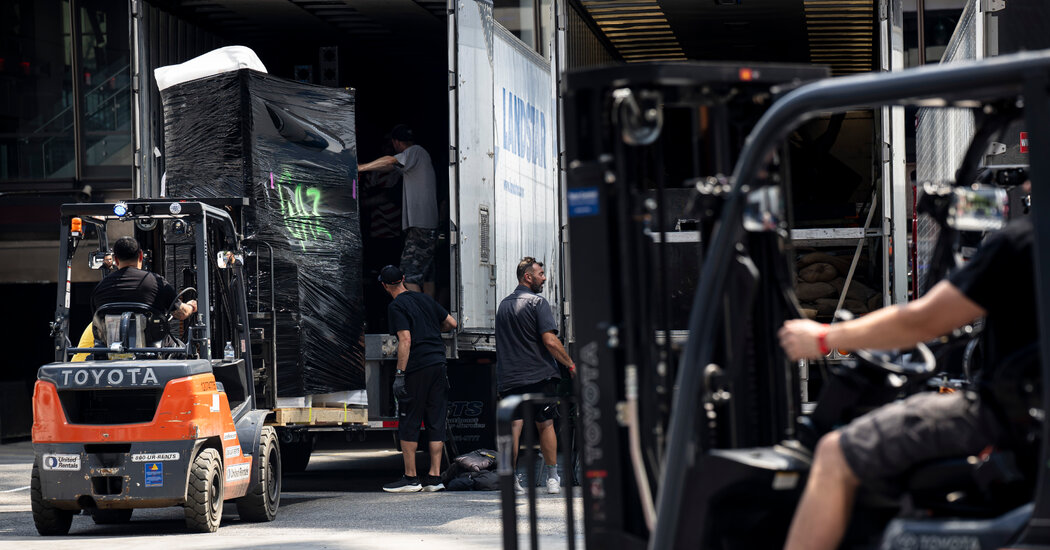
The Garden has been a hub of activity in the days leading up to the events. Large delivery trucks have been observed bringing in items such as tree decorations and boxes containing lobster. A red carpet was briefly installed on a staircase before being removed.
While Madison Square Garden, which opened in 1968, is sometimes perceived as utilitarian, Ms. Swift’s team is expected to implement extensive and elaborate decorations, consistent with the theatrical staging seen in her concert tours. Sonal J. Shah, a New York City-based luxury wedding planner, noted that security is likely the paramount concern and a significant budgetary item for such an event.
Ms. Shah characterized the Garden as a “controlled environment and a blank canvas,” offering the couple complete flexibility in designing their celebration.
Regarding street closures, Ms. Shah affirmed that obtaining permits for such measures is not unprecedented, citing her own experience in organizing events that involved “rolling street closures” for processions in Manhattan. With an estimated 1,000 guests, Ms. Shah identified the primary challenge as delivering an experience that adequately impresses such a large and potentially discerning group.
She elaborated on the substantial expenditures involved, stating, “The food, the alcohol, the entertainment — those are huge expenses, and they will want to knock it out the park.”
The scale of the events also necessitates a substantial workforce. José Maldonado, president of the union representing Garden workers, indicated that a typical arena event with 20,000 attendees requires over 800 staff members. For a smaller event like this, with 1,000 guests, approximately 250 workers would be needed.
Lexi Denihan, creative director for Hamptons Aristocrat, a luxury culinary event company with experience in over 500 weddings, estimated that more than 125 catering staff would be required, based on a standard ratio of one server per eight guests. A significant challenge, according to Ms. Denihan, is coordinating the timely arrival of numerous vendors and extensive equipment in Manhattan, including an estimated 8,000 glasses for a six-hour event.
She described the process as an “orchestra” of coordination, involving elements like draping and sound equipment, with potential disruptions from urban traffic. The presence of lobster deliveries suggests a high-end menu, with lobster often considered a premium culinary choice. Private security presents another major consideration, as many celebrities arrive with their own security details. Event staff must manage bag checks, enforce restrictions on mobile devices, identify potential security threats, and ensure the protection of the couple.
In early June, Winick Productions, a prominent New York-based event planning firm, submitted an application to the city’s Street Activity Permit Office for street closures in the vicinity of the arena.
The Madison Square Garden complex is characterized by its intricate layout, including a five-story circular ramp that leads to the main arena floor. The playing surface, adaptable for hockey or basketball, is located on the fifth floor, situated above Penn Station and a theater used for performances. While the ramp is narrow, it is capable of accommodating luxury vehicles. Larger trucks typically park outside, utilizing forklifts to transport equipment up the ramp. The arena’s windowless design offers the advantage of enhanced privacy, allowing the couple to control imagery from the event without concerns about external viewing or drones.
The Fourth of July weekend typically sees many affluent New Yorkers departing for destinations such as the Hamptons or the Jersey Shore. However, others remain in the city to enjoy fireworks displays from rooftops or attend viewing parties along the rivers. This year’s holiday celebrations are anticipated to be particularly extensive. On Friday, Times Square is scheduled to host a benefit show as part of the federal “America250” program, featuring eight ball drops to commemorate midnight in each American time zone. Concurrently, tall ships and war vessels, carrying an estimated 20,000 sailors—a significantly larger contingent than during Fleet Week—are expected to sail into the city.
On Saturday, major fireworks displays are planned for Lower Manhattan over both the East River and the Hudson River. Adding to the weekend’s activity, a FIFA World Cup match between Brazil and Norway is scheduled for Sunday in New Jersey, drawing fans who will utilize Manhattan’s transit hubs, including Penn Station located beneath Madison Square Garden, to reach the venue.
Mayor Eric Adams has referenced the nuptial events in public statements without confirming specific details. During a Tuesday news conference addressing a heat wave, Mayor Adams highlighted the strong air-conditioning capabilities of Madison Square Garden. “My recommendation to all New Yorkers is to stay inside and stay cool,” he said. “And if you happen to be getting married at Madison Square Garden, you will be staying inside, and you will be staying cool.”
***
Why This Matters
The reported nuptial events of Taylor Swift and Travis Kelce at Madison Square Garden signify more than just a celebrity wedding; they underscore several critical aspects of contemporary celebrity culture, urban event management, and economic impact. As two of the most recognizable figures in music and sports, their union attracts global attention, transforming a private celebration into a public spectacle with far-reaching implications.
**Cultural and Social Resonance:** The choice of Madison Square Garden, a venue typically associated with large-scale public entertainment, for an intimate event highlights the evolving landscape of celebrity privacy and public interest. The anticipation surrounding the event, described by experts as potentially eclipsing other major cultural gatherings, reflects the immense influence Ms. Swift and Mr. Kelce wield across demographics. It also sets a precedent for how high-profile individuals navigate personal milestones under intense media scrutiny, potentially influencing trends in luxury event planning and venue selection for future celebrity functions.
**Logistical and Security Precedent:** Organizing an event of this magnitude—with an estimated 1,000 high-profile guests, extensive vendor coordination, and thousands of enthusiastic fans—in a densely populated urban center during one of its busiest holiday weekends presents unprecedented logistical challenges. The reported involvement of private security, city agencies, and hundreds of police officers to manage traffic, crowd control, and personal safety establishes a benchmark for the scale of coordination required for private events that carry significant public interest. This event provides a real-world case study for urban planners and security professionals on managing complex, multi-layered operations.
**Economic Impact and Resource Allocation:** The substantial financial investment in venue rental, bespoke decorations, high-end catering, and extensive security services generates significant economic activity for New York City’s hospitality and event industries. Luxury wedding planners and catering companies, along with unionized venue workers, benefit directly from such large-scale endeavors. However, the allocation of city resources, particularly hundreds of police officers, for a private event during a period of heightened public celebrations and potential heat advisories, raises questions about the balance between supporting economic activity and ensuring public safety and resource availability for the broader populace.
**Media Management and Public Perception:** The meticulous efforts to maintain secrecy, coupled with the inevitable leaks and public speculation, illustrate the ongoing tension between a celebrity couple’s desire for privacy and the insatiable public and media appetite for details. The choice of a windowless arena like Madison Square Garden, which offers enhanced control over visual dissemination, underscores modern strategies for managing media exposure. Ultimately, this event serves as a microcosm of celebrity power, urban operational complexity, and the intricate dance between public fascination and private moments in the global spotlight.