

Key Takeaways: Navigating the Diesel Price Shock
- Systemic Inflation Driver: Diesel, as the backbone of global logistics, agriculture, and industry, is a potent, pervasive inflation multiplier. Its current price surge directly impacts virtually every economic sector, feeding into broader consumer price indices (CPI) and eroding purchasing power far beyond direct fuel costs.
- Geopolitical Risk Premium: The escalating US-Iran conflict, particularly threats to the vital Strait of Hormuz, instantly translates into a “geopolitical risk premium” across global energy benchmarks (Brent, WTI). This directly elevates input costs for refined products like diesel, creating immediate and significant supply chain vulnerabilities.
- Persistent Economic Headwind: Due to inherent lags in refining and distribution, elevated diesel prices create a prolonged inflationary tailwind. This persistence complicates central bank monetary policy decisions, anchors higher inflation expectations among businesses and consumers, and can lead to sustained margin compression for corporations, even if geopolitical tensions were to ease.
Lauren Simonetti breaks down the impact of the US-Iran conflict on global shipping and oil prices, noting public frustration with escalating gas costs. She highlights how many Americans expect the conflict to last over a year.
While the daily ritual at the gas pump often dominates public discourse and impacts consumer sentiment indices, the true, insidious inflationary force emanating from the US-Iran conflict lies in the less visible, yet far more pervasive, market for diesel fuel. This critical commodity, often overlooked by the average consumer, is fast becoming a primary driver of sustained inflationary pressures across the U.S. economy, posing a significant challenge for businesses, consumers, and monetary policymakers alike.
The fuel most Americans never think about could become the Iran conflict’s biggest economic consequence. While gasoline prices grab headlines, diesel quietly powers the trucks, farms, freight trains and heavy equipment that keep the U.S. economy moving.
From the groceries on supermarket shelves to the Amazon package on your doorstep and the materials used to build new homes, diesel is embedded in nearly every step of the supply chain. As prices rise, businesses face higher transportation costs that economists say often ripple through the economy, pushing up the cost of everyday goods.
Diesel, often referred to as the economy’s ‘workhorse fuel,’ is the lifeblood of industrial activity. It powers everything from heavy-duty trucking and rail freight to agricultural machinery and construction equipment. Its price trajectory is a direct determinant of logistical overheads, influencing the cost structure of nearly every tangible good consumed within the economy. This systemic embeddedness means diesel price inflation is not easily contained or absorbed, making it a critical metric for market watchers and economic strategists.
Diesel prices, which averaged $3.56 a gallon in January 2025, have climbed to $5.13 following the Iran conflict, according to the U.S. Energy Information Administration. This represents a staggering increase of over 44% in a short span, a metric that ripples far beyond individual transportation budgets, directly impacting corporate margins and consumer purchasing power.
For the commercial trucking sector, the primary conduit for goods distribution, such a price hike is a direct hit to margins. A standard semi-truck, consuming roughly 250 gallons to fill its tanks and achieving a mere 6 to 7 miles per gallon, now faces a fuel bill exceeding $1,280 per fill-up. This translates into significantly higher operational expenditures for carriers, which are inevitably passed down the supply chain, impacting everything from manufacturing input costs to retail prices on supermarket shelves.
BBQ LOVERS BEWARE: MIDDLE EAST CONFLICT MIGHT DISRUPT YOUR SUMMER PLANS THIS YEAR
“We all focus on gasoline because, ultimately, we’re consumers and pump prices are very visible. But what we don’t think about is the price of diesel, which is the workhorse fuel for the U.S. economy and especially for key sectors,” Bernard Yaros, lead U.S. economist for Oxford Economics, told Fox News Digital. Yaros underscores this concern, stating, “From an inflationary perspective, I’m very concerned about the recent rise in diesel prices as it pertains to the cost of food or grocery store prices.” He further elaborates on its systemic nature: “Take the food industry, for instance. Diesel powers the irrigation pumps, the tractors in the field and the trucks that bring food from the farm to your local grocery store. It’s part of every layer of food production in the U.S.” This pervasive impact makes diesel a key component in headline inflation, influencing the Consumer Price Index (CPI) across multiple categories.
‘KEEP A LOW PROFILE’: STATE DEPARTMENT WARNS AMERICANS OVERSEAS THEY COULD BE TARGETED
A person is seen grabbing the nozzle for diesel fuel at a gas station. (Rebecca Noble/Bloomberg/Getty Images / Getty Images)
The recent surge in diesel prices is not merely a domestic market phenomenon but a direct consequence of escalating geopolitical tensions in the Middle East, specifically the US-Iran conflict. An energy industry source, requesting anonymity due to the sensitivity of the situation, explicitly linked the price movement to the conflict: “The great majority of the price movement that you’ve seen in diesel markets over the last five months has been the direct result of the conflict in Iran and specifically the closure of the Strait of Hormuz.”
The Strait of Hormuz, a critical maritime chokepoint nestled between Iran, Oman, and the United Arab Emirates, is the world’s most vital artery for crude oil and refined product transit. An estimated 20 million barrels of oil — roughly 20% of global daily consumption — traverse this narrow passage each day. Any perceived or actual disruption to this flow immediately triggers a spike in global energy benchmarks, such as Brent crude (the international benchmark) and West Texas Intermediate (WTI, the U.S. benchmark), which in turn, feed into the cost of refined products like diesel. The market, inherently forward-looking, prices in a ‘geopolitical risk premium’ when such vital supply routes are threatened. This premium reflects the increased probability of supply disruptions, higher shipping insurance costs, and potential for rerouting, all of which inflate the final price of fuel, adding a layer of volatility for commodity traders and supply chain managers.
WHY THE STRAIT OF HORMUZ MATTERS AS TRUMP ISSUES FRESH ULTIMATUM TO IRAN
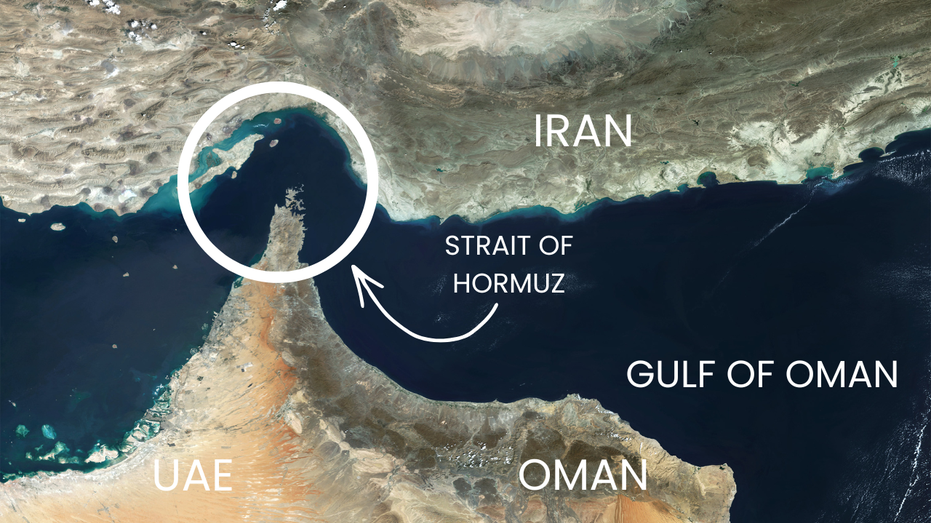
A satellite image shows the Strait of Hormuz, a key maritime passage connecting the Persian Gulf to the Gulf of Oman, vital for global energy supply. (Amanda Macias/Fox News Digital / Getty Images)
One of the more challenging aspects for policymakers and consumers alike is the inherent lag in how energy market dynamics translate into real-world prices. The anonymous energy source highlights this: “Refineries don’t process crude instantaneously. A lot of times what you’re filling up your car with today was refined a week and a half ago and was produced two months before that.” This ‘pipeline lag’ means that even if tensions in the Middle East were to de-escalate swiftly, the elevated cost of crude and the associated refining costs would continue to permeate the supply chain for several weeks, if not months. This delayed impact creates a persistent inflationary tailwind. Businesses that absorbed initial price shocks might be forced to adjust their pricing strategies over time, particularly as futures contracts for fuel reflect continued high costs. This prolonged pressure on input costs can lead to a more entrenched inflation, making it harder for central banks to manage.
The ripple effects of sustained high diesel prices are broad and deep. The transportation sector, encompassing trucking, rail, and even maritime shipping, is directly hit, leading to increased freight charges. These charges are then passed on to retailers and ultimately, consumers. For the agricultural sector, already facing pressures from labor and fertilizer costs, diesel price hikes add another layer of expense, potentially impacting food security and pricing structures at the consumer level. Manufacturing industries, reliant on diesel for heavy machinery and logistics, also face eroding margins, which could lead to reduced investment or job cuts. The cumulative effect is a broader erosion of consumer purchasing power. As Americans expect the conflict to last over a year, according to Lauren Simonetti’s observation, the expectation of prolonged elevated costs could shift consumer spending habits, prioritizing essentials over discretionary goods and services, leading to a deceleration in consumer-driven economic activity.
For the Federal Reserve and other central banks, this surge in diesel prices presents a significant challenge. While central banks typically focus on core inflation, which strips out volatile energy and food prices, the pervasive impact of diesel on these very categories makes it difficult to ignore. Persistent energy-driven inflation risks anchoring higher inflation expectations among consumers and businesses, potentially leading to a wage-price spiral. This complicates the Fed’s dual mandate of price stability and maximum employment, potentially forcing difficult decisions regarding interest rate policy in an already uncertain economic landscape. Should energy prices remain elevated, the likelihood of a more hawkish stance from the Fed increases, with implications for borrowing costs across the economy, corporate investment, and the housing market.
That lag means higher diesel costs can continue working their way through the economy even after crude oil prices stabilize, leaving consumers to pay more for groceries, deliveries and other everyday goods long after the headlines from the Middle East begin to fade, creating a drag on economic recovery efforts.
Market Impact
The sustained escalation in diesel prices, driven by geopolitical instability in the Middle East, is poised to have multifront market implications. Equity markets could see increased volatility, particularly for sectors with high logistical dependencies (e.g., retail, consumer staples, industrials) as corporate earnings face margin compression. Companies with efficient supply chains, those with strong pricing power, or those able to hedge fuel costs may demonstrate relative resilience. Inflation expectations, a key metric for bond markets, are likely to remain elevated, putting upward pressure on Treasury yields across the curve and potentially strengthening the U.S. dollar as a safe haven asset amidst global uncertainty. Furthermore, the inflationary squeeze on consumer discretionary spending could temper overall economic growth forecasts, presenting a challenging environment for investors and policymakers grappling with the fallout from an increasingly intertwined global energy market and geopolitical risk landscape. Energy sector stocks, particularly refiners and exploration & production (E&P) companies, might see short-term gains from higher commodity prices, but the broader economic slowdown risks could cap their upside. The potential for prolonged higher interest rates to combat this inflation could also dampen corporate investment and consumer borrowing, impacting broader economic expansion and capital markets activity.