
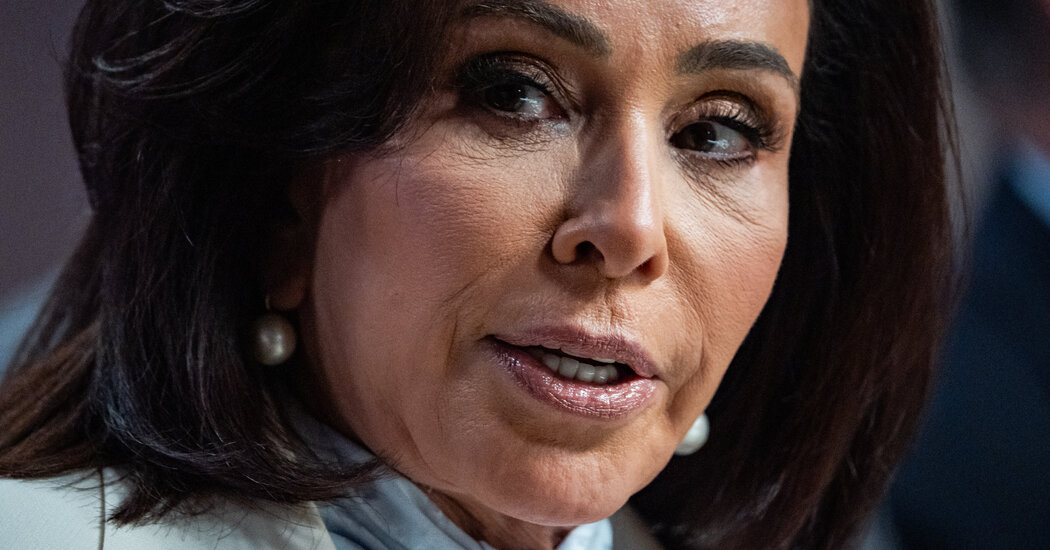
A significant professional confrontation unfolded in the Oval Office late Monday, involving Jeanine Pirro, the U.S. Attorney for the District of Columbia, and Doug Burgum, the Interior Secretary. The meeting addressed Ms. Pirro’s recent decision to withdraw charges in a high-profile vandalism case, a move that contradicted a narrative previously endorsed by President Trump and Mr. Burgum.
Earlier on Monday, President Trump had publicly expressed strong dissatisfaction with Ms. Pirro’s actions. Speaking to reporters from the Resolute Desk, the President stated that Ms. Pirro, a long-time ally and friend from New York, had “folded like an umbrella” and “choked” after her office withdrew charges against David Hearn, a man initially accused of damaging the lining of the Lincoln Memorial Reflecting Pool.
The President’s displeasure stemmed from Ms. Pirro’s public refutation of a narrative, reportedly championed by Mr. Burgum, that attributed damage to the recently renovated Reflecting Pool to vandals rather than potential issues with a contractor hired by the Interior Department. This contradiction reportedly angered President Trump, leading to private criticisms, public statements to reporters, and widespread speculation within the West Wing about Ms. Pirro’s job security. These events culminated in a direct, high-stakes meeting at the White House.
For the meeting, which Mr. Burgum was also scheduled to attend, Ms. Pirro reportedly arrived prepared. She entered the White House via the West Executive driveway, observed carrying boxes containing documents and evidence, suggesting an intention to present a robust defense of her office’s actions and findings.
Inside the Oval Office, Ms. Pirro joined President Trump, Chief of Staff Susie Wiles, and White House Counsel David Warrington. Interior Secretary Doug Burgum was also present.
Following approximately an hour of discussion, Ms. Pirro’s employment status remained intact, at least for the immediate future. President Trump, speaking to reporters during a trip to the West Coast on Tuesday evening, acknowledged the meeting and reiterated his dissatisfaction with Ms. Pirro’s filing. He indicated that he was still deliberating on her future. “I haven’t made a determination,” he stated when asked about the security of Ms. Pirro’s position.
During the Monday meeting, Ms. Pirro reportedly confronted Mr. Burgum directly, at times speaking with a raised voice. She accused the Interior Secretary of misleading the President and suggested he had promoted a narrative designed to obscure potential missteps related to the Reflecting Pool renovation.
Mr. Burgum offered a defense of his actions, though he spoke less frequently than Ms. Pirro, according to an individual briefed on the internal discussions who requested anonymity. By the end of the day, reports suggested the President’s demeanor had become less agitated.
Spokespersons for the White House, Ms. Pirro’s office, and Mr. Burgum’s office did not respond to requests for comment regarding the events.
This account, compiled from interviews with multiple individuals knowledgeable about the events, highlights the dynamics within the administration, particularly regarding officials who challenge narratives favored by the President, even when those officials have long-standing ties to him and have generally supported his agenda.
The origins of the dispute trace back to July 2, when Ms. Pirro held a press conference to announce the indictment of David Hearn, 67, a former Olympic canoeist. Mr. Hearn faced a single felony count of vandalism, accused of damaging the Lincoln Memorial Reflecting Pool lining. Ms. Pirro emphasized the perceived significance of the case at the time. “This is not only a priority for the president, but for myself,” she stated, adding, “We will prove beyond a reasonable doubt that Hearn willfully destroyed property.”
However, the prosecution did not proceed as initially announced. On the preceding Friday, Ms. Pirro’s office filed a 20-page court motion, effectively withdrawing the charges against Mr. Hearn. The filing acknowledged that the rapid indictment, initiated in July, had been based on incomplete evidence and flawed assumptions.
The comprehensive document presented findings that implicitly raised questions about the conduct of Interior Secretary Burgum, Atlantic Industrial Coatings (the contractor responsible for the pool’s repair), and officials from the U.S. Park Police. Ms. Pirro’s filing indicated that Mr. Burgum had potentially failed to adequately oversee the renovation project and subsequently influenced President Trump to accept a narrative attributing the damage to vandalism. The U.S. Attorney’s office stated that its initial reliance on claims from Interior Department officials, who asserted that extensive damage to the pool lining was solely caused by Mr. Hearn and other individuals observed manipulating the material, was misplaced.
After a thorough review of thousands of pages of evidence, Ms. Pirro’s office concluded that the Interior Department’s renovation process had been rushed and, in her office’s assessment, “botched.” Furthermore, the filing asserted that inaccurate information provided by Park Police officials had led her to initially claim “tremendous evidence” against Mr. Hearn, which was subsequently found not to exist in a manner that supported the felony vandalism charge.
The felony charge against Mr. Hearn, a three-time Olympian, carried a potential maximum sentence of 10 years in prison, based on an initial assessment by Ms. Pirro’s team that the alleged damage exceeded $1,000. Ms. Pirro’s decision to reverse course on such a serious charge, particularly one that had garnered presidential attention, carried significant professional risks.
Prior to filing the motion to dismiss the charges against Mr. Hearn, Ms. Pirro’s office informed the White House of its impending action, indicating an awareness of the political sensitivities surrounding the case and the potential for presidential reaction.
Why This Matters
This incident highlights several critical aspects of governance and the rule of law within a presidential administration. Firstly, it underscores the tension that can arise between political loyalty and prosecutorial independence. The U.S. Attorney for the District of Columbia is a federal prosecutor, and while appointed by the President, their role requires adherence to legal facts and due process, even when doing so contradicts preferred political narratives or risks presidential disapproval. Ms. Pirro’s decision to withdraw charges, despite the known displeasure of the President, demonstrates an assertion of prosecutorial judgment over political pressure, a cornerstone of an independent justice system. The President’s public rebuke and the subsequent high-level meeting illustrate the challenge faced by officials who prioritize factual accuracy when it clashes with the administration’s public messaging.
Secondly, the case raises questions about public accountability and government oversight. The initial indictment of Mr. Hearn, based on what Ms. Pirro’s office later deemed “false assumptions and incomplete evidence,” suggests potential deficiencies in the initial investigation by U.S. Park Police and the information provided by the Interior Department. The subsequent findings in Ms. Pirro’s motion, criticizing the handling of the renovation project and the accuracy of information from Interior Secretary Burgum’s department, point to a need for robust oversight of government contracts and official statements. This situation puts a spotlight on the importance of transparent and accurate reporting from government agencies, particularly when public funds are involved in projects like the renovation of national landmarks.
Finally, the episode touches upon the broader implications for individuals caught in the crossfire of political disputes. Mr. Hearn, a private citizen and former Olympian, faced a serious felony charge with a potential 10-year prison sentence. The dismissal of these charges, based on a reassessment of evidence, underscores the grave consequences of premature or inadequately supported legal actions. It serves as a reminder of the power of the state and the necessity for rigorous evidentiary standards in criminal prosecutions, protecting individuals from wrongful accusations that may arise from politically motivated narratives or administrative missteps. The outcome of Ms. Pirro’s employment status following this event will likely be watched closely as an indicator of the administration’s tolerance for independent action within its ranks.
A rare and public dispute has erupted between former President Donald Trump and U.S. Attorney Jeanine Pirro, following Ms. Pirro’s move to withdraw a federal indictment in a case involving significant property damage. The unusual action by a federal prosecutor, coupled with Mr. Trump’s immediate and escalating criticism, has drawn scrutiny to the independence of the justice system and the dynamics between the former president and senior legal officials.
Ms. Pirro filed a motion in federal court on a Friday, seeking to rescind an indictment against an individual identified as Mr. Hearn. The charges in question stemmed from what Mr. Trump has vocally characterized as “VANDALISM” related to damage at a pool. Ms. Pirro’s decision to withdraw the indictment came after her office reportedly reviewed thousands of pages of evidence over several weeks, leading her to conclude that the case against Mr. Hearn was unlikely to withstand judicial challenge and would be better withdrawn than risking dismissal by the court.
The former president’s displeasure with Ms. Pirro’s action became evident quickly. On Saturday morning, the day after her motion was filed, Mr. Trump posted a strong denunciation on his Truth Social platform. “I disagree 100 percent with Jeanine Pirro,” Mr. Trump wrote. “I don’t know what she was thinking? To me, it was a pure case of VANDALISM.” He further elaborated, “There may have been some contractor difficulty, but the major damage was caused by VANDALS!” This public statement immediately framed the controversy as a direct challenge to his view of the incident.
Following Mr. Trump’s social media posts, Mr. Burgum, who appears to be an individual central to the initial accusations or defense related to the pool damage, took to social media to defend himself. He stated that his staff had “provided the U.S. attorney’s office expert and eyewitness testimony to the damage done by vandals and provided every piece of evidence they asked for in the requested time line detailing each area of damage at the pool.” This assertion directly countered any suggestion that the damage was purely the result of contractor error and reinforced the narrative of vandalism.
As the weekend progressed, Mr. Trump’s initial disagreement with Ms. Pirro reportedly intensified. People familiar with the situation, who requested anonymity to discuss internal deliberations, indicated that while it was unclear if Mr. Trump was formally briefed on Ms. Pirro’s motion before his public statements, his anger toward her grew steadily. This simmering frustration culminated in a direct and public confrontation by mid-Monday.
During a press availability in the Oval Office, Mr. Trump seized an opportunity when asked about Ms. Pirro. He expressed profound disappointment in her actions and publicly accused her of being “too afraid” to present the case to the judge in the Hearn case. This marked a significant escalation, transitioning from social media criticism to a direct, face-to-face rebuke from the highest office. Notably, when questioned by a reporter about Ms. Pirro’s future employment, Mr. Trump conspicuously avoided providing an answer, leaving her professional standing ambiguous.
The motivations behind Ms. Pirro’s decision to risk the former president’s wrath remain a subject of considerable speculation, particularly given her long-standing familiarity with Mr. Trump’s personality and “trigger points.” According to two individuals close to the situation, Ms. Pirro’s determination to rescind the Hearn indictment stemmed from her review of extensive evidence. After examining thousands of pages of materials over several weeks, she concluded that the prosecution’s case was sufficiently weak that it would likely be dismissed by the court, making a proactive withdrawal a more prudent course of action.
However, critics have questioned whether Ms. Pirro’s motives were as straightforward or altruistic as presented. Some suggest that her decision to withdraw the indictment was primarily self-protective. This theory posits that Ms. Pirro might have been attempting to preempt potential disciplinary action that could arise if grand jury testimony or other internal prosecutorial materials were to become public, potentially revealing an initial rush to judgment or a flaw in the original indictment process. Lawyers for Mr. Hearn echoed this sentiment, accusing Ms. Pirro of the very behavior she had implicitly criticized Mr. Burgum for: rushing to take action to appease a superior. They further asserted that Ms. Pirro had ample access to evidence suggesting contractor responsibility for the damage prior to indicting Mr. Hearn.
The contractor involved in the pool work, Atlantic Industrial Coatings, has not publicly responded to queries about the case. However, a statement on the company’s website dated June 21 acknowledges that “some areas” of the pool require repairs, a detail that lends credence to the argument that contractor difficulty, rather than outright vandalism, might have been a contributing factor to the damage.
Ms. Pirro’s perceived independence is a notable factor in this unfolding drama. Having risen to prominence in the competitive New York City media and legal landscape alongside Mr. Trump, she has, by many accounts, demonstrated a greater sense of autonomy than many other senior department officials whose careers have been entirely shaped by their association with the former president. She notably left a significantly higher-paying position at Fox News to assume the U.S. attorney role and has expressed a lukewarm attitude towards Washington D.C. She has reportedly conveyed to friends, some of whom remain skeptical, that she views her current post as a capstone achievement rather than a steppingstone, implying she does not fear the career-ending “you’re fired” moment often associated with Mr. Trump.
Despite the intense public pressure, Ms. Pirro reportedly offered a spirited defense of her actions on Monday. By all accounts, she appears resolute in her determination to prevail in her dispute with Mr. Burgum concerning the nature of the damage and, ultimately, to regain the favor of Mr. Trump.
David A. Fahrenthold, Maggie Haberman and Maxine Joselow contributed reporting.
Why This Matters
This public confrontation between former President Donald Trump and U.S. Attorney Jeanine Pirro carries significant implications for the independence of the American justice system, the role of a president in dictating prosecutorial decisions, and the professional autonomy of federal officials.
Firstly, the dispute underscores the delicate balance between the executive branch and the Department of Justice. A U.S. Attorney, while appointed by the President, is expected to exercise independent judgment in legal matters, free from political pressure. Mr. Trump’s direct and highly public criticism of Ms. Pirro’s prosecutorial decision, including questioning her courage and suggesting she was “afraid,” challenges this principle of judicial independence. Such interventions can create a chilling effect on federal prosecutors, potentially influencing their decisions in future cases and leading to concerns that legal processes might be swayed by political considerations rather than solely by evidence and law.
Secondly, the incident highlights the unique relationship between Mr. Trump and officials who served under him. His expectation of loyalty and his willingness to publicly condemn those who diverge from his views are well-documented. Ms. Pirro’s decision to proceed with rescinding the indictment, despite her deep understanding of Mr. Trump’s potential reaction, speaks to a rare act of defiance within his orbit. Her perceived independence, rooted in her career trajectory and financial security, positions her uniquely to withstand such pressure, but also makes her a focal point for the broader question of who controls prosecutorial discretion.
Thirdly, the substance of the dispute—whether pool damage constitutes “vandalism” or “contractor difficulty”—illustrates how factual interpretations can become highly politicized. Mr. Trump’s insistence on “vandalism” appears to be foundational to his disapproval of Ms. Pirro’s actions. The differing accounts from Mr. Burgum and the contractor’s website, combined with Ms. Pirro’s review of “thousands of pages of evidence,” suggest a complex situation that is now playing out in the public sphere, potentially eroding public trust in the objectivity of legal findings when they clash with high-profile political narratives.
Finally, the “Why This Matters” also extends to the integrity of the legal process itself. The suggestion by critics and Mr. Hearn’s lawyers that Ms. Pirro’s initial indictment might have been rushed, or that her current withdrawal is “self-protective” to prevent disciplinary action, raises questions about prosecutorial ethics and accountability. Grand jury testimony and internal materials are typically shielded to protect the process, but public disputes like this can lead to calls for greater transparency, potentially impacting how such proceedings are conducted and reviewed in the future. The outcome of this high-profile conflict will likely influence perceptions of justice and accountability for years to come.