
Unlock the Editor’s Digest for free
Roula Khalaf, Editor of the FT, selects her favourite stories in this weekly newsletter.
**Key Takeaways**
1. **European Migration Policies & Fiscal Strain:** The contentious debate around Spain’s immigration amnesty highlights a growing divergence in EU migration policies, raising concerns about potential fiscal burdens, social integration costs, and renewed pressure on public services across member states. This policy fragmentation introduces uncertainty for investors, potentially impacting sovereign bond yields and government spending forecasts across the bloc.
2. **Schengen Integrity & Economic Efficiency:** Sweden’s Prime Minister’s warning about the integrity of the Schengen Area underscores the market’s sensitivity to anything threatening the EU’s foundational free movement principles. Any perceived weakening of Schengen could lead to increased intra-EU border checks, supply chain disruptions, and higher operational costs for businesses, thereby dampening economic growth and investor confidence in the bloc’s single market.
3. **Swedish Political Volatility & Geopolitical Risk Premium:** The tight Swedish election, with the potential for a government including the nationalist Sweden Democrats, introduces domestic policy uncertainty regarding fiscal management, social spending, and international relations. Concurrently, the overarching geopolitical threat from Russia reinforces the investment case for defense sectors but also maintains a broader risk premium on European assets, influencing capital flows and sectoral valuations.
—
The political winds sweeping across Europe continue to send ripples through financial markets, with Sweden’s prime minister sounding a stark warning over Spain’s recent amnesty for irregular immigrants. Ulf Kristersson has branded the move a “very bad idea,” cautioning that it risks catapulting Europe back into a 2015-style migration crisis, a scenario fraught with significant fiscal pressures, social instability, and existential questions for the continent’s cherished free-movement zone, the Schengen Area. For investors, such political fault lines signal potential for increased volatility and re-evaluation of sovereign risk across EU member states.
Kristersson, the Swedish centre-right leader gearing up for a crucial re-election next month, conveyed to the Financial Times that Spain’s amnesty, potentially benefiting over 1 million people, had ignited a “pretty big outcry” among EU leaders. This inter-European discord is a red flag for markets, as political friction complicates policy harmonisation and can create an environment of uncertainty, deterring cross-border investment. The sheer scale of the Spanish amnesty, surpassing initial estimates, immediately raises concerns about the potential for unquantified fiscal burdens, particularly if integration costs are not effectively managed or shared across the EU.
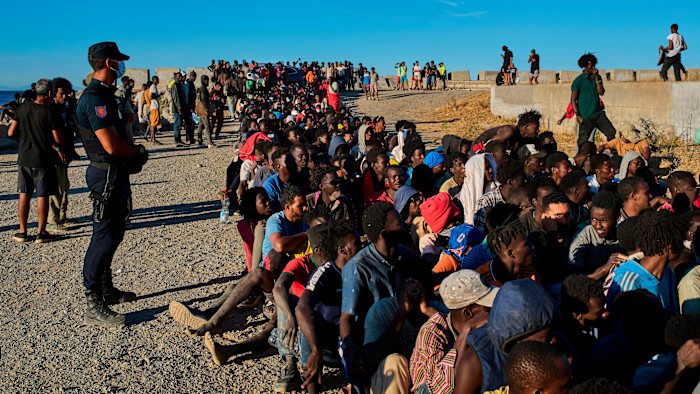
Leaders from economic powerhouses like Italy and Germany, alongside Denmark, have voiced sharp criticism, especially following the recent influx into the Spanish exclave of Ceuta. While most individuals returned to Morocco quickly, the incident underscored the porous nature of Europe’s external borders and the potential for a single nation’s policy to create widespread ripple effects. Such divergent national approaches on a fundamental issue like migration can strain EU solidarity, potentially hindering future economic integration initiatives or even threatening existing ones like the single market. This political friction can weigh on investor sentiment, particularly towards peripheral EU bonds, if the perception of increased systemic risk takes hold.
Kristersson’s invocation of the 2015 crisis serves as a potent reminder of the economic scars left by that period. “It symbolises that we still have to be very, very careful not to act in a way that could even come close to what happened in 2015,” he stated. “I think Spain got the message . . . but it shows the vulnerability.” The 2015 episode led to significant increases in public spending on social services, housing, and integration programs across affected countries, contributing to fiscal strain and, in some cases, a rise in populist movements advocating protectionist economic policies. This vulnerability, if perceived as recurring, becomes a tangible sovereign risk factor, influencing credit ratings and borrowing costs.
Sweden, having accepted one of the highest numbers of immigrants relative to its population in 2015, experienced firsthand the subsequent economic and social challenges. Deep integration hurdles and a noticeable rise in gang crime rates followed. For markets, “integration challenges” translate directly into significant public expenditure on housing, education, healthcare, and welfare programs, diverting resources that could otherwise be allocated to infrastructure or productivity-enhancing investments. Moreover, societal challenges like “spiralling gang crime” can deter foreign direct investment, reduce tourism, and impact local economies, raising internal security costs for governments and potentially impacting property values.
Domestically, Kristersson’s re-election campaign is built on a platform of significantly slashing asylum seeker numbers and reducing violent crime. However, his centre-right bloc, which controversially includes the nationalist Sweden Democrats, currently trails the left in opinion polls led by the Social Democrats. This political uncertainty within Sweden itself adds another layer of market risk. A shift in government could lead to changes in fiscal policy, labor market regulations, or even Sweden’s stance on key EU issues. The potential inclusion of nationalist parties often brings with it concerns about protectionism and less predictable policymaking, which could lead to a “Sweden risk premium” in local equity and bond markets.
The Swedish prime minister explicitly communicated his disapproval of the Spanish amnesty to his counterpart, Pedro Sánchez. The fact that the amnesty attracted 1.2 million applicants, more than double Madrid’s initial expectations, highlights a significant policy miscalculation. This discrepancy underscores the potential for unforeseen fiscal and social pressures. Such a magnitude of inflow, if not adequately planned for, can stress public resources and infrastructure, potentially leading to increased government borrowing, higher taxes, or a reallocation of existing funds, all of which are closely watched by bond markets and credit rating agencies.
Kristersson further articulated the broader European concern: “Having [the amnesty] also creates a possibility for you to use European territory. That is specifically damaging for us because we know from experience that many people coming to Europe prefer to go north. Exactly that happened in 2015.” This statement directly links Spain’s national policy to potential “leakage” into other EU states, implying that one nation’s policy choices can have unquantified externalities on others. Such an outcome would undermine the EU’s shared economic space and could provoke retaliatory measures, such as temporary internal border controls, disrupting supply chains and the free flow of goods and labor within the Schengen Area, impacting corporate profitability across sectors.
Countering this perspective, Spanish Prime Minister Sánchez argues that immigration is indispensable for the long-term economic health of Spain’s ageing population. The amnesty offers irregular immigrants a one-year, renewable residence permit if they have resided in Spain for five months and possess a clean criminal record. From this viewpoint, demographic decline and persistent labor shortages represent real economic threats for many European countries, impacting productivity, the sustainability of pension systems, and long-term GDP growth. Spain’s policy, therefore, can be framed as an attempt to address a structural economic problem, potentially boosting labor supply in critical sectors and stimulating consumer demand. For investors, this presents a complex trade-off: short-term political friction versus long-term demographic solutions to economic stagnation.
The critical market distinction lies in the differing rights conferred. While the Spanish amnesty grants rights to live and work within Spain, it does not extend these rights to the rest of the EU. However, migrants – many of whom are Latin American – would retain the ability to move freely inside Europe’s Schengen Area for borderless travel. This is the crux of the “free movement” issue for markets. While the right to *work* is national, the right to *travel* freely within Schengen implies a potential for labor market “arbitrage” or unintended distribution effects across the EU. This could lead to uneven pressure on social services and informal labor markets in other countries, again posing fiscal challenges and undermining a harmonized EU approach to labor mobility.
Kristersson emphasized that Schengen’s functionality hinges on member states acting “in a united way to be able to protect our external borders and to have as aligned policies as possible.” The importance of a cohesive EU external border policy is paramount for maintaining the internal borderless travel that defines Schengen. A breakdown in this unity poses a direct threat to the economic benefits derived from the single market, potentially forcing companies to re-evaluate their pan-European logistics, supply chain strategies, and location decisions, adding costs and reducing efficiency.
He further elaborated that “there was no doubt” that increased migration flows resulting from one country’s decision would inevitably impact the “solidarity” of the Schengen system. “Solidarity” in the EU also carries significant financial implications. If countries perceive they are bearing disproportionate costs or risks, it can undermine their willingness to participate in future financial support mechanisms, joint economic projects, or even the stability mechanisms crucial for the Eurozone itself. This could translate into a higher perceived risk premium for holding European assets, from equities to sovereign bonds, as the bloc’s cohesion comes into question.
Sweden itself has proactively tightened its migrant rules, focusing on deportations and permanent residence, leading to a 40-year low in asylum seekers last year. This policy shift reflects a domestic cost-benefit analysis drawn from its 2015 experience. While tighter policies may alleviate fiscal strain from integration costs, they could also lead to labor shortages in specific sectors, impacting economic growth and inflation dynamics. This represents a sovereign policy choice with clear economic tradeoffs, influencing labor force participation and potential GDP growth.
“It is not the time to get relaxed on this . . . there is a huge majority in Sweden saying they cannot go back to an uncontrolled situation,” Kristersson asserted. “Doing things that could jeopardise a stable situation would be a very bad idea.” A “stable situation” is paramount for attracting and retaining both domestic and foreign investment. Uncontrolled situations, whether migration-related or otherwise, introduce volatility and unpredictability, which are anathema to market stability and long-term capital allocation decisions. Kristersson’s words underscore a political commitment to maintaining a predictable and stable economic environment, a key factor for investor confidence.
September’s elections represent a watershed moment in Swedish politics, with Kristersson and his centre-right allies for the first time signalling their willingness to include the Sweden Democrats in government. This party, with roots in the neo-Nazi movement and a history of antisemitism for which its leader recently apologised, introduces significant political risk. Markets dislike uncertainty, and a government involving a party that has historically been an outlier can lead to unpredictable policy shifts, particularly in areas like trade, EU relations, and social spending. This could impact Sweden’s credit rating, foreign direct investment inflows, and broader investor perception of the country’s political stability and economic outlook.
The opposition Social Democrats, meanwhile, have stated their willingness to work with any party in parliament except the Sweden Democrats. Recent polls indicate a fractured political landscape, with the centre-left Social Democrats at 32 per cent, ahead of the Sweden Democrats at 20 per cent and Kristersson’s Moderates at 17 per cent. This close polling and political fragmentation suggest the potential for an unstable coalition government, regardless of the election outcome. Such instability can lead to policy paralysis, delayed reforms, or frequent government changes, all of which are detrimental to long-term economic planning and investor confidence, potentially leading to a higher political risk premium on Swedish assets.
Kristersson defended the inclusion of the Sweden Democrats, arguing that his rightwing bloc presented a clear coalition proposal, unlike the Social Democrats, who have not specified their potential governing partners. While this defense aims to portray a sense of clarity, markets might view the inclusion of the Sweden Democrats as a trade-off: perceived stability of a coalition versus the policy uncertainty associated with an historically fringe party. The lack of a clear alternative from the Social Democrats only adds another layer of pre-election uncertainty, keeping investors on edge.
Beyond domestic politics, all eight parties in the outgoing Swedish parliament support Ukraine and increased defence spending. However, the prime minister questioned whether a new Social Democrat-led government could maintain the same impactful role in NATO as his administration, which successfully navigated Sweden into the alliance. Stockholm’s subsequent forceful role in regional defence plans and its robust defence industrial capabilities are significant economic assets. Defence spending is a substantial fiscal commitment and a key growth driver for the defence industry. A clear, consistent NATO policy impacts geopolitical stability, which in turn affects risk premiums on European assets. Sweden’s industrial capabilities offer an economic benefit, and its influential role in NATO influences its international standing and attractiveness for foreign direct investment.
Kristersson underscored the enduring threat, stating Russia would be the “defining threat” for Europe and that “security will be a fundamental part of everything we do in the coming years.” This statement signals a long-term shift towards a “security economy.” Increased defence budgets mean public funds potentially diverted from other areas, but also provide a stimulus to specific industrial sectors. The persistent geopolitical risk stemming from Russia maintains a higher risk premium on European energy prices, commodity markets, and overall investment decisions, simultaneously boosting demand for perceived safe-haven assets.
He further challenged the opposition: “If the left parties win, two out of four [of them] will be against Swedish Nato membership and against the new security policy orientation we have. How on earth would they even be able to make any new decisions on Nato participation from the Swedish side?” While the Social Democrats affirm strong backing for Sweden’s NATO membership, its defence industry, and support for Ukraine, contradictory statements from potential coalition partners introduce significant foreign policy and security uncertainty. This can influence defence stock performance, bond yields (as perceived geopolitical risk changes), and Sweden’s standing within international alliances, impacting trade and diplomatic relations. Markets inherently prefer policy coherence and predictability in international relations.
—
**Market Impact**
The escalating rhetoric and policy divergences on migration across Europe, coupled with Sweden’s upcoming election and the broader geopolitical anxieties, are poised to inject further volatility into European asset markets. Investors should brace for potential short-term headwinds stemming from political uncertainty, particularly in Sweden, which could see its sovereign bonds and equity markets experience increased risk premiums. The integrity of the Schengen Area, fundamental to the EU’s economic efficiency, remains a critical watchlist item; any perceived erosion of free movement principles could negatively impact cross-border trade, supply chains, and corporate earnings across the bloc. While increased defence spending driven by the persistent threat from Russia offers a tailwind for defence contractors and related industries, the overall political fragmentation and lack of a unified EU approach to critical challenges like migration could weigh on broader investor confidence, potentially leading to capital outflows from European assets and a preference for more stable, less politically fraught markets. The ongoing debate highlights that political stability and policy consensus are increasingly priced into European valuations.