
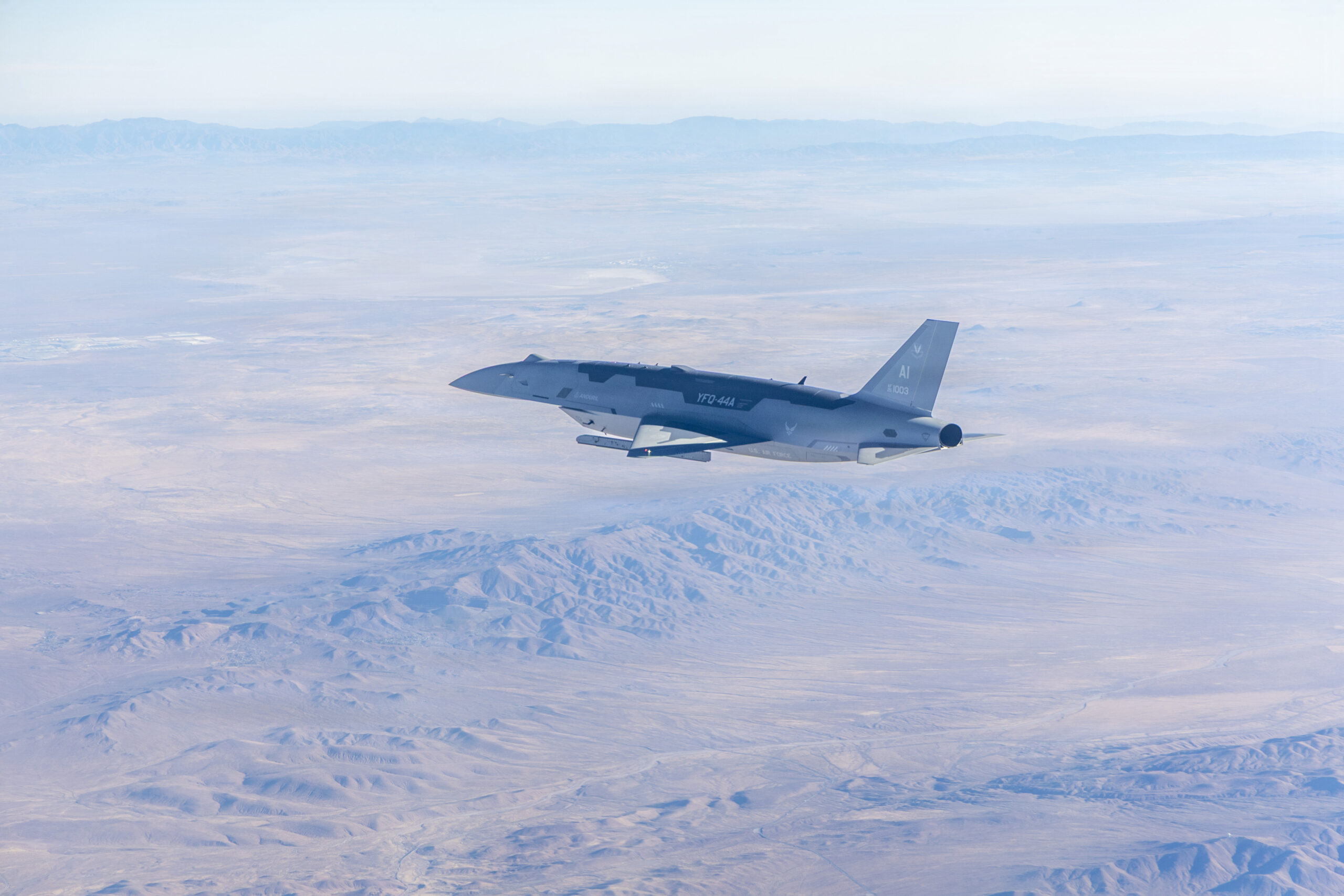
In a significant advancement for military aviation, a U.S. Air Force F-22 Raptor pilot successfully controlled a YFQ-44A Fury Collaborative Combat Aircraft (CCA) while both aircraft were airborne. This milestone, announced on October 16, marks a pivotal moment in the Air Force’s ongoing efforts to integrate advanced uncrewed systems into its combat operations.
During the flight demonstration, the human pilot operating the F-22 served as an “airborne quarterback” for the YFQ-44A drone. The pilot issued high-level tactical directives to the uncrewed aircraft, which then utilized its on-board autonomy software to interpret and execute these commands in real-time. This capability allowed the Fury to perform dynamic flight maneuvers and simulate various combat tasks autonomously.
Anduril Industries, the manufacturer of the Fury, confirmed that the flight test occurred during the week of October 5, originating from Edwards Air Force Base, California. Mark Shushnar, Anduril’s vice president of autonomous airpower, provided further details, stating that both the Fury and the F-22 took off from Edwards and subsequently linked up in mid-air. The Raptor pilot then transmitted an updated mission plan to the Fury CCA via a tactical data link, effectively “commanding Fury through operationally relevant maneuvers from the cockpit of the crewed quarterback” fighter.
While this specific demonstration involved an F-22 controlling a single YFQ-44A, the broader vision of the U.S. Air Force is to enable each fighter pilot to control multiple CCAs simultaneously as part of a cohesive formation. This strategy aims to significantly expand the service’s combat mass, extend its operational reach, and enhance its overall lethality and survivability in contested environments.
Air Force Chief of Staff Gen. Kenneth S. Wilsbach commented on the demonstration, emphasizing its strategic importance. In a statement, he noted that the event “shows the power of crewed-uncrewed teaming and the advantage it provides our warfighters” and expressed a commitment to rapidly build upon this progress. “We must test often, learn fast, and give commanders what they need, when they need it,” Wilsbach affirmed, highlighting the urgency of these developments.
Similarly, Air Force Secretary Troy Meink underscored the imperative for rapid innovation and deployment. “This achievement demonstrates what is possible when we are aligned with industry on a shared imperative: delivering capability to the warfighter at unprecedented speed,” Meink stated. He further added, “We are driving urgency into every part of acquisition from rapid integration and flight learning to disciplined assessment, so we can turn promising technology into combat capability at the pace the threat demands.”
The mission, which reportedly lasted for multiple hours, was deemed a success by Shushnar. He indicated that the rapid progress in developing an operational CCA program is evident in such demonstrations. Shushnar asserted that the U.S. Air Force’s CCA program is currently the most active and advanced worldwide, positioned to be the first to field operational aircraft. Achieving this, he explained, necessitates close collaboration between Anduril and the Air Force to validate capabilities, define operational procedures, and foster trust between human operators and their semi-autonomous wingmen.
Data gathered from this test will be instrumental in informing future software integration efforts, developmental testing protocols, and the evolution of future CCA concepts. The collaborative nature of this initiative was evident in the participation of various Air Force units, including personnel from the 412th Test Wing at Edwards, the 422nd Test and Evaluation Squadron at Nellis Air Force Base, Nevada, the 309th Software Engineering Group at Hill Air Force Base, Utah, and the CCA Experimental Operations Unit at Creech Air Force Base, Nevada. The F-22 System Program Office and the CCA Software Autonomy and Teaming Branch were also key contributors.
This flight builds upon previous testing efforts involving “surrogate” drones designed to emulate CCAs, most notably the General Atomics MQ-20 Avenger. In February, an F-22 successfully controlled an MQ-20 Avenger from the air, while in May, an F-35 pilot on the ground demonstrated control over an airborne Avenger. These tests have progressively advanced the Air Force’s understanding and capabilities in manned-unmanned teaming.
The Air Force has ambitious goals for its CCA program, aiming to deploy 500 CCAs by 2032, with an eventual fleet size potentially exceeding 1,000 aircraft. These uncrewed platforms are envisioned to perform a diverse array of missions, including air-to-air engagements, air-to-ground strikes, intelligence, surveillance, and reconnaissance (ISR), and electronic warfare. The initial iteration of CCAs, which includes General Atomics’ FQ-42 and Anduril’s FQ-44, is primarily focused on air-to-air missions. The Air Force has set a cost target of no more than $20 million per air vehicle for these CCAs, excluding the cost of sensors, weapons, or other specialized equipment they might carry.
While the primary emphasis of the CCA program has been on integrating these uncrewed assets with pilots in the air, the Air Force is also actively developing capabilities that would allow Airmen to command CCAs from ground-based control stations, offering additional operational flexibility.
Why This Matters
The successful in-flight control of a Collaborative Combat Aircraft by an F-22 pilot signifies a profound shift in military aviation and holds substantial implications across several critical domains:
**Transforming Military Strategy and Operations:** This development is central to the U.S. Air Force’s vision for future warfare, often referred to as “Next Generation Air Dominance” (NGAD). By allowing a single human pilot to command multiple uncrewed aircraft, CCAs can significantly increase the combat power of a formation without directly exposing more human lives to risk. They can serve as loyal wingmen, extending sensor reach, carrying additional weapons, acting as decoys, or conducting electronic warfare operations in highly contested airspace. This “mass without men” approach aims to overcome numerical advantages held by potential adversaries and deter aggression by presenting a more formidable and adaptable force.
**Advancements in Artificial Intelligence and Autonomy:** The ability of the YFQ-44A’s autonomy software to interpret high-level tactical directives and execute complex maneuvers independently highlights the rapid progress in artificial intelligence for military applications. This is not simply remote control; it’s about trust in sophisticated algorithms to make real-time decisions within defined parameters. The ongoing data collection and software integration will further refine these autonomous capabilities, pushing the boundaries of what uncrewed systems can achieve while maintaining human oversight at critical junctures. This also sets a precedent for how human-machine teaming will evolve across various sectors.
**The Global Arms Race and Geopolitical Balance:** The U.S. Air Force’s aggressive timeline for fielding operational CCAs – aiming for 500 by 2032 and potentially over 1,000 – underscores a fierce competition among global powers in military technology. Other nations, including China and Russia, are also investing heavily in autonomous combat systems. The U.S. lead in this area, as highlighted by Anduril, could provide a strategic advantage, influencing deterrence and the balance of power. Conversely, any perceived lag could prompt accelerated development by rivals, leading to an intensified technological arms race in military AI and robotics.
**Economic Impact and Defense Industrial Base:** The ambitious scale of the CCA program represents a substantial investment in the defense industrial base. The target cost of $20 million per aircraft is significantly lower than that of crewed fighters (which can cost hundreds of millions), making a large fleet more financially feasible. This drives innovation and competition among defense contractors, fostering new technologies and potentially creating jobs in specialized engineering, software development, and manufacturing sectors. It also shapes future defense procurement strategies, favoring modular, rapidly upgradeable, and relatively inexpensive platforms over monolithic, costly systems.
**Ethical and Regulatory Considerations:** As autonomous combat systems become more sophisticated, ethical and regulatory questions surrounding their use will grow in prominence. Issues such as the level of human control in lethal decision-making, accountability for actions taken by autonomous systems, and adherence to international humanitarian law are subjects of ongoing debate. While the current model emphasizes human “quarterbacking,” the trajectory of technology suggests that these discussions will become increasingly urgent as autonomy advances. This test contributes to the practical understanding of how human-machine interfaces can be designed to address these complex ethical challenges.
In essence, this demonstration is not merely about a drone flight; it represents a foundational step towards a future where human pilots and highly autonomous uncrewed aircraft operate in seamless collaboration, fundamentally reshaping the dynamics of air combat and global security.