
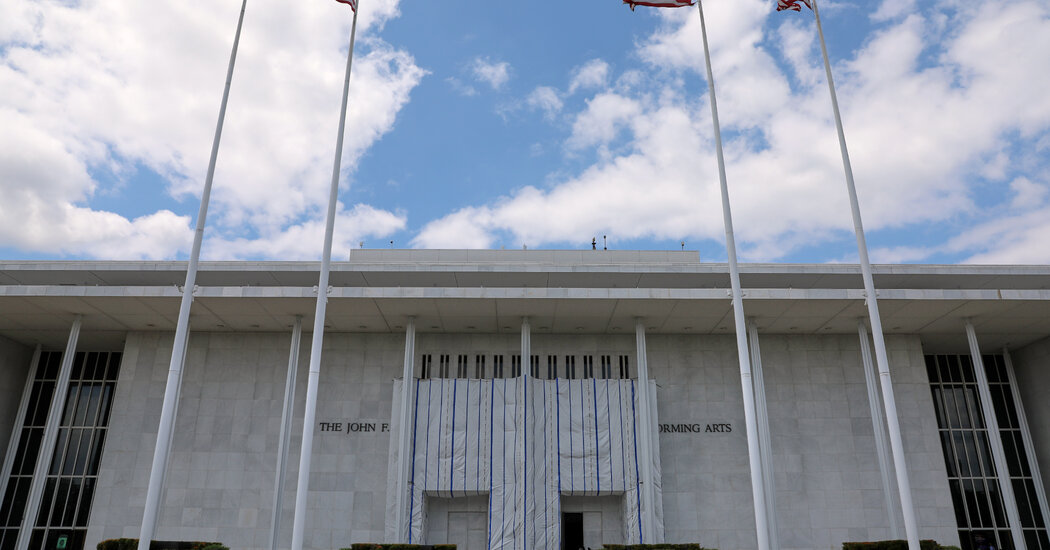
The Board of Trustees for the John F. Kennedy Center for the Performing Arts has voted to inscribe President Donald J. Trump’s name on the building, positioned beneath the main signage. This decision, confirmed by two individuals with direct knowledge of the proceedings, represents a renewed effort to honor the President at the institution and appears to challenge a previous federal court order. The board also voted to proceed with a significant renovation plan that will require the center’s main building to close.
According to the resolution approved by the board, which has been characterized as largely allied with President Trump, the proposed inscription would read: “Restored and Renovated by President Donald J. Trump.” The resolution mandates that officials act by “all legal means” to implement this decision. This move follows the board’s earlier vote to endorse President Trump’s plan for the extensive renovation project, which will necessitate the closure of the iconic performing arts venue for an extended period.
This is not the first attempt to publicly link President Trump’s name with the Kennedy Center. Last year, the President’s name was added to the building as part of a proposed change to the institution’s official designation. However, a federal judge subsequently ordered the removal of these letters, ruling that only the United States Congress possesses the authority to alter the name of the institution, which was originally dedicated to President John F. Kennedy in 1964. The center complied with the judge’s order by removing President Trump’s name in June but has since filed an appeal against that ruling.
The recent decision by the board to add an inscription, rather than change the institution’s official name, appears to be a strategic reinterpretation of federal law. The governing statute for the Kennedy Center includes a provision that explicitly states: “no additional memorials or plaques in the nature of memorials shall be designated or installed in the public areas.” The board’s current approach seems to navigate this restriction by framing the inscription as an acknowledgement of restoration efforts rather than a new memorial.
In the resolution passed on Thursday, the board specified its intent to recognize and honor President Trump for his purported role in bringing the center back “from the brink of disaster.” The measure outlined various potential avenues for this recognition, including the possibility of designating the center’s grounds as the “President Donald J. Trump Plaza.” The resolution formally stated, “It is hereby resolved, that the center desires to recognize and honor President Trump’s existential and unprecedented contributions to the survival of the center by all legal means.” This language underscores the board’s strong commitment to publicly crediting President Trump for the institution’s future viability.
Both the decision to proceed with the closure and the plan for the inscription are anticipated to undergo rigorous review by the federal judge who previously expressed concerns about the board’s due diligence. This judge had earlier found that the board had been “derelict” in its initial consideration of the closure plan. President Trump first announced his vision for the center’s closure in February, advocating for a two-year shutdown with the aim of transforming what he described as a “tired, broken and dilapidated” institution into a revitalized venue.
The board’s recent vote on Thursday specifically approved the closure of the Kennedy Center’s main building. During this period, a newer addition to the campus, known as the Reach, is slated to remain operational for limited programming. Furthermore, the Reach facility will serve as an active memorial to John F. Kennedy throughout the renovation process, ensuring that the commemorative aspect of the institution continues.
Prior to the meeting, board members were presented with a comprehensive 163-page proposal detailing a $250 million “renewal” project. This extensive plan encompasses crucial structural repair work, the installation of new marble floors, and an investment of $11.8 million dedicated to “acoustical improvements.” A notable logistical aspect of the renovation involves the temporary relocation of the center’s prominent 3,000-pound bronze bust of President Kennedy to another building on the campus, safeguarding this significant memorial during construction.
The approved resolution further asserts that the decision to close the main building was made based on an “independent and objective analysis” of available options, conducted by an external consulting firm. This analysis reportedly concluded that maintaining the main building’s operation during the proposed renovations would incur significantly higher costs and present operational challenges. The board’s resolution also states its “full commitment” to ensuring the continuity of arts and educational programming throughout the closure period, as well as preserving the “historic and architecturally significant nature of the center’s main building.”
The initial announcement of the closure plan earlier this year saw the board—which is led by President Trump and largely comprises his appointees—quickly endorse the proposal. However, this swift approval faced immediate legal challenge. A Democratic lawmaker, who also serves on the board, filed a lawsuit contesting the decision. In response, a federal judge issued a temporary injunction blocking the closure, characterizing the original vote as “ill-informed and seemingly preordained.”
In his May order, Judge Christopher R. Cooper of the Federal District Court in Washington emphasized the trustees’ legal obligation. He stated that should the center continue to pursue a closure plan, its board members were legally bound to conduct a thorough and serious consideration of the potential repercussions of shuttering Washington’s pre-eminent performing arts venue. Following Judge Cooper’s initial ruling, President Trump publicly criticized the judge’s decision, asserting that it would be “dangerous” to keep the center operational during renovations. Subsequently, center officials provided assurances to the judge that they were adhering to his order and undertaking further scrutiny of the closure decision, which culminated in the board meeting held on Thursday morning.
Judge Cooper is now expected to review the board’s latest decision to assess whether, in his judgment, the trustees have performed sufficient due diligence ahead of this new vote. His May order had clearly stipulated: “The board will be expected to prepare itself with sufficient information to make a considered, independent decision, taking account of its obligation to both maintainand operatea premiere arts venue and its solemn duty to memorialize a fallen president.” This framework will guide his upcoming evaluation.
For several weeks preceding the board’s recent vote, the future operational status of the Kennedy Center remained uncertain, resulting in a significantly reduced and largely bare performance calendar. This period of ambiguity has had tangible consequences for the institution and the broader arts community. Major Broadway touring productions, which typically represent a substantial source of ticket revenue for the center, have redirected their engagements to other venues for the upcoming season. Similarly, the National Symphony Orchestra, the Kennedy Center’s esteemed resident ensemble, has yet to announce its season schedule, which traditionally commences in late September. Furthermore, employees at the center, some of whom have already faced rounds of layoffs in anticipation of a full closure, continue to experience uncertainty regarding their employment futures.
In preparation for the meeting, board members were provided with an analysis comparing two distinct renovation scenarios, prepared by an external consultant. Both this consultant and the construction management firm, JLL, presented findings that highlighted significant safety and cost concerns associated with attempting to keep the main building open during a phased renovation. Their assessments argued that a full closure would be more efficient and safer for both workers and any potential patrons.
The proposal outlined by JLL details a comprehensive project aimed at addressing chronic leaks, replacing outdated equipment, and undertaking a redesign of various interior sections. Specific enhancements include new furniture, the addition of a new coffee shop, the installation of electronic ticketing kiosks, and a substantial investment of $7 million dedicated to public restroom renovations. The projected target for the center’s reopening following these extensive works is the summer of 2028.
As emphasized by Judge Cooper in his prior order, the board carries a legal obligation to maintain the facility as a memorial to President Kennedy. Under the proposed closure and renovation plan, all memorial materials and exhibits related to President Kennedy are intended to be temporarily relocated to the building known as the Reach, ensuring their continued accessibility and preservation during the main building’s shutdown.
Immediate clarity was not available after the virtual board meeting, which was not open to the public, regarding whether the center intends to adhere precisely to the construction plan detailed in the report, pending the judge’s forthcoming review. The outcome of that judicial evaluation will likely influence the exact path forward for the renovation.
Over the past year and a half, the Kennedy Center, under the leadership of a board perceived as aligned with President Trump, has reportedly faced significant operational and reputational challenges. These challenges include a noticeable decline in audience attendance, an exodus of employees, and a reluctance among artists to engage with an institution increasingly viewed by some as having become politicized and functioning as an extension of the White House. The most intense period of this backlash occurred late last year when the board initially voted to officially change the institution’s name to the “Trump-Kennedy Center.” New letters reflecting this proposed change were subsequently added to the building’s distinctive marble facade the day after that vote.
Judge Cooper’s intervention specifically rejected that earlier decision to rename the institution. His ruling definitively stated that only the United States Congress—the legislative body that originally dedicated the institution to President Kennedy in 1964, shortly after his assassination—possesses the sole legal authority to alter the center’s name. While the center is currently appealing this ruling, it has, in the interim, complied with the judge’s order to remove “Trump” from the building’s main signage, reverting to its original designation pending the outcome of the appeal process.
Why This Matters
The recent decisions by the Kennedy Center’s Board of Trustees hold significant implications across several domains: institutional governance, the preservation of national memorials, the independence of cultural organizations, and the intersection of politics with the arts.
Firstly, the ongoing legal battle surrounding the Kennedy Center’s naming and operational decisions highlights a fundamental tension regarding the control and designation of national cultural institutions. The Kennedy Center was established by Congress as a living memorial to President John F. Kennedy. The repeated attempts to append or attribute President Trump’s name, particularly in defiance of a federal court order emphasizing congressional authority, raises questions about the respect for legislative intent and judicial oversight. It also tests the boundaries of a board’s power versus the foundational statutes governing such national treasures.
Secondly, the planned multi-year closure for renovations, while potentially necessary for structural integrity and modernization, presents a significant disruption to Washington D.C.’s cultural landscape. As a pre-eminent performing arts venue, its closure impacts the schedules and livelihoods of resident artistic groups like the National Symphony Orchestra, limits opportunities for touring productions, and affects the thousands of employees and artists who rely on the center. The economic and cultural vacuum created by a prolonged closure, even with alternative programming at the Reach, could have lasting effects on the local arts ecosystem and audience engagement.
Thirdly, the narrative surrounding the Kennedy Center has become increasingly politicized over the past year and a half. Reports of declining audiences, employee departures, and artists’ reluctance to perform signal a concern within the arts community about the perceived independence and artistic integrity of the institution. A national cultural center, ideally, should serve all citizens and foster an environment free from partisan influence. The ongoing controversies risk alienating segments of the public and the artistic world, potentially undermining the center’s mission to promote the arts and honor President Kennedy’s legacy.
Finally, the role of federal judiciary, specifically Judge Christopher R. Cooper, in overseeing these decisions underscores the importance of checks and balances, even for cultural institutions. The judge’s repeated insistence on due diligence and adherence to legal obligations reinforces the principle that even presidential appointees on a board must operate within established legal frameworks and with careful consideration for the institution’s core mission and its public trust. The outcome of his upcoming review will set a precedent for governance at federally chartered cultural organizations.
In essence, this situation is not merely about a building’s name or a renovation project; it is about the stewardship of a national memorial, the health of the arts, and the delicate balance between political influence and institutional autonomy in a democratic society.
Washington D.C. – The John F. Kennedy Center for the Performing Arts, a prominent national cultural institution, is embroiled in a legal and administrative dispute regarding its plans for a comprehensive, multi-year closure to facilitate extensive renovations. The controversy centers on the necessity and true motivations behind the proposed full closure, with a lawsuit alleging potential financial duress driving the decision, while the Center maintains it is the most fiscally responsible approach to execute congressionally mandated upgrades.
The Kennedy Center, a living memorial to President Kennedy and a premier venue for performing arts in the United States, announced in late August its intention to fully close its doors for four years, beginning in the fall. This decision followed a series of judicial actions, including a temporary injunction that had previously halted the plans.
The proposed renovations are substantial, aimed at modernizing the Center’s facilities and infrastructure. Congress last year appropriated $257 million for these upgrades. According to Matt Floca, the Center’s executive director, a complete closure is the most efficient and responsible method to carry out these much-needed improvements. Floca has presented arguments that a phased renovation process, which would allow the Center to remain partially open, would significantly inflate costs, potentially exceeding the congressional allocation by a substantial margin.
A report commissioned by the board from Delta Consulting Group supported this stance. The consulting firm, tasked with comparing various renovation scenarios, concluded that a phased construction approach spread over four years would only cover less than half of the estimated costs with the current congressional appropriation. This finding underscores the Center’s argument that a full closure is a financial imperative to ensure the project can be completed within budget.
However, the Center’s closure plans have faced strong opposition, notably from Representative Joyce Beatty, a Democrat from Ohio who holds an ex officio seat on the Kennedy Center’s board of trustees. Representative Beatty initiated a legal challenge, questioning the genuine rationale behind the closure. Her lawsuit suggests that the decision to close might be an attempt to obscure underlying financial difficulties, specifically citing concerns about declining ticket sales and a reduction in artist engagement.
Initially, U.S. District Judge Tanya S. Chutkan issued a temporary injunction on July 10, effectively pausing the Center’s plans to fully shut down. This ruling provided a temporary victory for those opposing the immediate closure. However, in August, a different federal judge, Judge Amit P. Mehta, reversed this injunction, allowing the Kennedy Center to proceed with its closure preparations. Subsequently, a panel of judges, including Judge Richard J. Leon, affirmed the Center’s right to implement the closure, clearing the path for the August announcement.
Adding to the complexity of the situation is the composition of the Kennedy Center’s board, which includes several individuals with close ties to former President Donald Trump. Among them are Susie Wiles, who served as White House chief of staff; Dan Scavino, a former Trump adviser; and Allison Lutnick, a lawyer married to Commerce Secretary Howard Lutnick. These appointments have raised questions about potential political influence on the Center’s operations and decisions.
Howard Lutnick, in particular, has become a more visible figure in matters concerning the Kennedy Center, acting as a representative for Mr. Trump. During an interview in June at a Kennedy Center event honoring comedian Bill Maher, Mr. Lutnick stated that Mr. Trump had personally requested his involvement to ensure the board’s processes adhered to judicial expectations. “He asked me to help him make sure everything is organized,” Mr. Lutnick said, “so that when judges consider what the board is doing, that it’s done perfectly.” This statement implies a direct interest from the former president in the Center’s governance and the ongoing legal challenges.
In anticipation of the full closure, the Kennedy Center has already taken visible steps. Its website and other official communications now reflect the upcoming shutdown. Physical manifestations include the installation of a large scaffolding structure, covered in tarps, which largely obscures existing signage around the facility. This preparatory work signals the Center’s commitment to moving forward with the renovations as planned.
Concerns about the financial implications of a full closure have also been voiced by outside arts administrators. These experts suggest that, contrary to the Center’s projections, cultural organizations typically exert every effort to avoid complete shutdowns. Their reasoning is rooted in the significant loss of essential revenue streams from ticket sales and the potential for donor attrition that prolonged closures can entail, making the Kennedy Center’s approach seem unusual to some within the arts community.
The legal process continues, with the Kennedy Center now facing a deadline next week to submit its detailed plan to Judge Cooper. This submission will be a crucial step in demonstrating how the Center intends to execute the renovations and manage its operations during the four-year closure period, further scrutinizing the transparency and rationale behind its decision.
Why This Matters
The dispute surrounding the Kennedy Center’s planned four-year closure is more than just an internal administrative matter; it touches upon several critical issues with broad implications for national cultural institutions, public arts funding, and governance transparency.
Firstly, it highlights the significant financial pressures facing major cultural organizations. While the Kennedy Center points to the efficiency of a full closure for renovations, the alternative argument suggests potential underlying financial vulnerabilities exacerbated by factors like slumping ticket sales or decreased philanthropic support. Understanding these dynamics is crucial for policymakers and the public in assessing the health and sustainability of federally supported arts institutions.
Secondly, the case raises important questions about the oversight and governance of institutions that receive substantial public funding. The Kennedy Center is a federal entity, receiving appropriations from Congress. The composition of its board, including individuals with close political ties, and the direct involvement of high-profile political figures, such as former President Trump through his surrogate, prompt scrutiny into how decisions are made, whether they are solely in the best interest of the institution and its mission, and how accountability is maintained.
Thirdly, the debate sets a precedent for how major renovations are approached in the cultural sector. If a full, multi-year closure becomes the standard for federally funded institutions undertaking large-scale projects, it could impact public access to the arts for prolonged periods. Conversely, if phased renovations prove financially prohibitive, it could indicate a need for more robust and flexible funding mechanisms from Congress, or a reevaluation of how such projects are cost-estimated and managed.
Fourthly, the potential loss of ticket revenue and donor engagement during a four-year shutdown presents a substantial risk not only to the Kennedy Center’s immediate financial health but also to its long-term relationships with patrons and artists. Cultural institutions thrive on continuous engagement. A prolonged absence from the public eye could necessitate a significant re-engagement strategy upon reopening, with uncertain outcomes. This concern resonates across the arts community, where maintaining audience loyalty and donor relations is paramount.
Finally, the ongoing legal battle underscores the importance of transparency in decision-making for public institutions. Representative Beatty’s lawsuit, by questioning the true motivations behind the closure, advocates for greater clarity regarding the Center’s financial health and its strategic planning. For the public and stakeholders, ensuring that decisions impacting a national treasure like the Kennedy Center are made with clear, verifiable justifications is essential for maintaining trust and confidence in public institutions and the allocation of taxpayer funds.
Ultimately, the outcome of this dispute will influence how other federally chartered cultural organizations manage their infrastructure needs, how political appointments intersect with institutional governance, and how the public can expect to engage with and support the arts in the nation’s capital.