
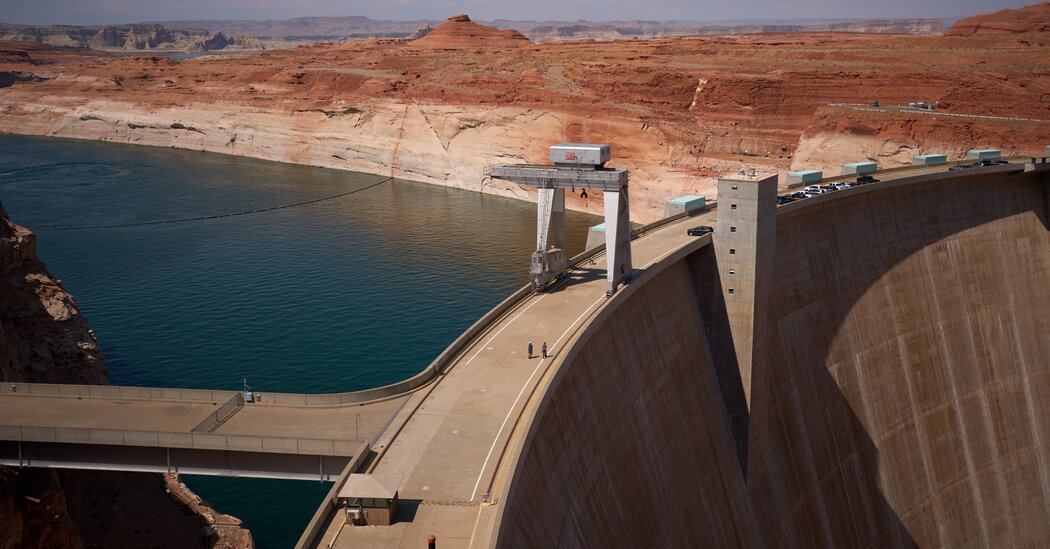
Lakes Powell and Mead, the United States’ two largest reservoirs, are currently experiencing unprecedented low water levels, pushing the Colorado River system into a critical state. This vital river system provides water and electricity to millions of people across the Southwestern United States and parts of Mexico, facing severe and escalating challenges.
Water levels in Lake Powell, situated along the Utah-Arizona border, recently plummeted to a record low. This development closely followed Lake Mead, the larger and more downstream of the two reservoirs, which also reached its lowest recorded point just a week prior. These record lows highlight a deepening crisis for a region heavily reliant on these water sources.
The combined storage capacity of these reservoirs, which serve as an essential water supply for major cities and extensive agricultural operations across Arizona, Nevada, and Southern California, has not been this depleted since 1957. This historical context underscores the severity of the current situation, as 1957 predates the filling of Lake Powell and a period when the Southwest’s climate and water demands were vastly different. Scientists attribute much of the current decline to a three-decade-long drought, considered the most severe dry spell to affect the Southwest in at least 1,200 years, exacerbated by the effects of climate change.
In response to the deepening crisis, federal and state officials, alongside communities throughout the region, have initiated emergency measures to mitigate potential catastrophes. These actions have included transferring water from smaller upstream reservoirs to Lake Powell in an effort to stabilize its levels and appeals for water conservation. While some conservation efforts are voluntary, the urgency of the situation suggests more stringent measures may be necessary.
The ongoing water shortage carries profound implications for rapidly expanding urban centers within the Sun Belt, such as Phoenix, Las Vegas, and Los Angeles. Key economic sectors, including the vast agricultural industry in the region and the growing number of data centers that require substantial water for cooling, also face significant threats. Furthermore, the hydroelectric dams associated with these reservoirs are crucial for generating electricity that powers millions of homes across the Southwest, and their diminished operational capacity poses a serious risk to regional energy security.
The immediate cause of the shrinking reservoirs stems from a combination of factors this past year: record-low snowpack during the winter, followed by record-high temperatures in the spring. Snowpack melt typically accounts for the majority of the Colorado River’s flow during the drier summer months. However, as the Southwestern climate has become progressively hotter and drier over recent decades, the river’s flow has become notably smaller and increasingly unreliable, a trend directly linked to broader climate change patterns.
“We expected to be in a very unpleasant place, and that’s where we find ourselves,” stated Kathryn Sorensen, director of research at the Kyl Center for Water Policy at Arizona State University, underscoring the predictability of the current predicament. “Mother Nature is in charge of this system,” she added, emphasizing the overwhelming natural forces at play.
Concurrently, the Southwest has experienced significant population growth, coupled with intensive agricultural practices, leading to a situation where the region’s water consumption far exceeds the natural supply capacity of the Colorado River. This imbalance between supply and demand is a critical underlying factor exacerbating the crisis.
Understanding the intricacies of this water crisis is essential given its widespread ramifications across multiple sectors and communities. Below is a detailed overview of the situation.
Who Relies on the Reservoirs?
The Colorado River basin is a lifeblood for an estimated 40 million people and supports approximately 5.5 million acres of farmland across parts of seven U.S. states: Arizona, California, Colorado, Nevada, New Mexico, Utah, and Wyoming. Additionally, numerous Native American tribes, holding senior water rights, and two Mexican states also depend on the river’s flows for their water needs.
Lakes Powell and Mead play a central role in maintaining this extensive water supply, particularly for the lower half of the Colorado River basin. While the river’s upper basin states—Wyoming, Colorado, Utah, and New Mexico—rely more directly on seasonal stream and river flows, the two large man-made reservoirs have historically provided a predictable and stable water source for the more populous lower basin states, which include parts of Nevada, Arizona, and California. These reservoirs act as critical storage buffers, accumulating water during wet periods and releasing it during dry spells to ensure consistent supply.
Agriculture represents the largest consumer of Colorado River water. Specifically, the cultivation of alfalfa and other feed crops for livestock accounts for nearly half of the water consumed from the river system. Municipal water systems, serving urban populations, utilize approximately a quarter of the river’s flow.
A growing portion of the river’s flow—estimated at about 10 percent—is lost not through consumption but through evaporation as rising temperatures across the Southwest lead to increased water surface temperatures in the reservoirs and river channels. This non-consumptive loss further reduces the available water supply.
Extent of Water Supply Decline
Over the past two decades, consistently dry and hot conditions across the Colorado River basin have led to an approximate 20 percent reduction in the river’s average annual flow. This significant decrease in natural supply contrasts sharply with the established legal allocations. While the Colorado River currently delivers an average of about 12 million acre-feet of water annually, century-old agreements that govern water rights have allocated rights to more than 16 million acre-feet. This structural imbalance between available water and legal entitlements renders current water use levels fundamentally unsustainable. For context, one acre-foot, defined as the amount of water needed to cover one acre to a depth of one foot, equates to approximately 326,000 gallons—enough to supply two to three average households for a year.
The combination of diminishing natural supply and decades of persistent overuse has resulted in a steady and alarming decline in water levels within Lakes Powell and Mead over the last 30 years. Neither reservoir has been close to its full capacity since the late 1990s. As of recent measurements, Lake Mead is estimated to be approximately 27 percent full, while Lake Powell stands at an even lower 23 percent of its total capacity, marking historic lows for both critical water bodies.
Consequences of Further Decline
Both Lake Mead and Lake Powell are integral to regional energy infrastructure, contained by the Hoover Dam and Glen Canyon Dam, respectively. The decreasing water levels at Lake Powell are approaching a critical threshold known as “minimum power pool,” below which the Glen Canyon Dam will no longer be able to generate electricity. Current forecasts from the Bureau of Reclamation, the federal agency overseeing these dams, indicate that Lake Powell’s water levels could reach this point as early as this winter, depending on precipitation levels during the wetter fall and winter months. Approximately 6 million people across the Southwest rely on the hydroelectric power produced by these dams, and dwindling water levels have already led to reduced power output.
Beyond the immediate impact on hydropower, if Lake Powell’s level drops below the minimum required for power generation, it risks entering a condition referred to as “dead pool.” In this scenario, water would no longer be able to flow through the dam’s intakes at all, effectively cutting off a crucial water supply for the lower basin states. The precise timeline for when this catastrophic event might occur remains uncertain, but it represents the most severe potential outcome of the ongoing decline.
Actions to Stabilize Reservoirs
Recognizing the urgency of the situation, the Bureau of Reclamation implemented emergency measures this spring to prevent Lake Powell from dropping below the minimum power pool. These actions included transferring water to Powell from Flaming Gorge, an upstream reservoir located on the Wyoming-Colorado border. Additionally, releases of water from Lake Powell, which flows through the Grand Canyon into Lake Mead, were limited to conserve water within Powell itself.
At the local level, communities across the Western U.S. have activated drought contingency plans and imposed various restrictions on water use, ranging from outdoor watering limits to promoting water-efficient appliances. Encouragingly, investments in water efficiency have allowed large cities like Phoenix to maintain their overall water consumption at levels comparable to when their populations were significantly smaller, demonstrating the potential for conservation and technological solutions.
Despite these efforts, Reclamation officials and the seven Colorado River basin states continue to engage in complex negotiations aimed at forging a long-term, comprehensive solution to the water crisis. However, these discussions have thus far proved challenging and have not yielded substantial breakthroughs, reflecting the diverse and often conflicting interests of the various stakeholders.
A federal plan outlining guidance for water use over the next decade, released last month, proposed drastic water allocation cuts for the states that depend heavily on Lakes Powell and Mead. Officials in Arizona, one of the most impacted states, promptly deemed these proposed cuts “unacceptable,” arguing they threatened the growing state’s economy and development. More detailed plans for the allocation and management of water over the next two years are anticipated to be released by Reclamation officials in the near future, which are expected to outline more specific mandates for water conservation and use.
Why This Matters
The unprecedented decline of Lakes Powell and Mead, central to the Colorado River system, represents more than just a regional environmental concern; it signifies a critical challenge with far-reaching implications for economic stability, public health, social equity, and inter-state governance. The Colorado River is a linchpin for the entire American Southwest, directly influencing the lives and livelihoods of tens of millions of people.
**Economic Stability:** The crisis threatens key economic pillars. Agriculture, a multi-billion dollar industry in the Southwest, faces severe restrictions, potentially impacting national food supplies, rural economies, and jobs. Rapidly growing urban centers, often touted as economic engines, depend on a stable water supply for residential, commercial, and industrial development, including critical sectors like technology (data centers). The dwindling capacity for hydroelectric power directly impacts energy costs and reliability for businesses and homes, potentially stifling economic growth and investment in the region.
**Public Health and Social Equity:** Reliable access to clean water is a fundamental human right. Water scarcity can lead to increased costs for potable water, disproportionately affecting low-income communities. It also poses risks to public health through potential water quality degradation or insufficient supply for sanitation. Furthermore, the crisis has significant implications for Native American tribes, whose sovereign rights and traditional ways of life are intimately tied to the river’s health and who often hold senior, yet vulnerable, water rights.
**Environmental Impact:** Beyond human consumption, the Colorado River system supports unique and fragile ecosystems, including the Grand Canyon. Reduced flows threaten biodiversity, fish populations, and riparian habitats. The “dead pool” scenario, if realized, would not only cut off water supply but also devastate the ecological balance of the river and its associated landscapes, leading to irreversible environmental damage.
**Inter-state Relations and Governance:** The crisis is testing decades-old water compacts and legal frameworks that govern water allocation among the seven basin states and Mexico. The difficulty in reaching consensus on new, more restrictive water-sharing agreements highlights the complex political and legal challenges involved. The need for innovative governance models and unprecedented cooperation among states, federal agencies, and international partners is paramount to avert further escalation and potential conflict over dwindling resources.
**A Bellwether for Climate Change Adaptation:** The Colorado River crisis serves as a stark warning and a critical case study for climate change adaptation globally. It illustrates how prolonged drought, rising temperatures, and increased evaporation, driven by a changing climate, can rapidly deplete vital resources even in developed nations. The solutions developed (or not developed) in the Southwest will offer valuable lessons for other arid regions worldwide facing similar water scarcity challenges, underscoring the urgency for proactive climate action and sustainable resource management.