
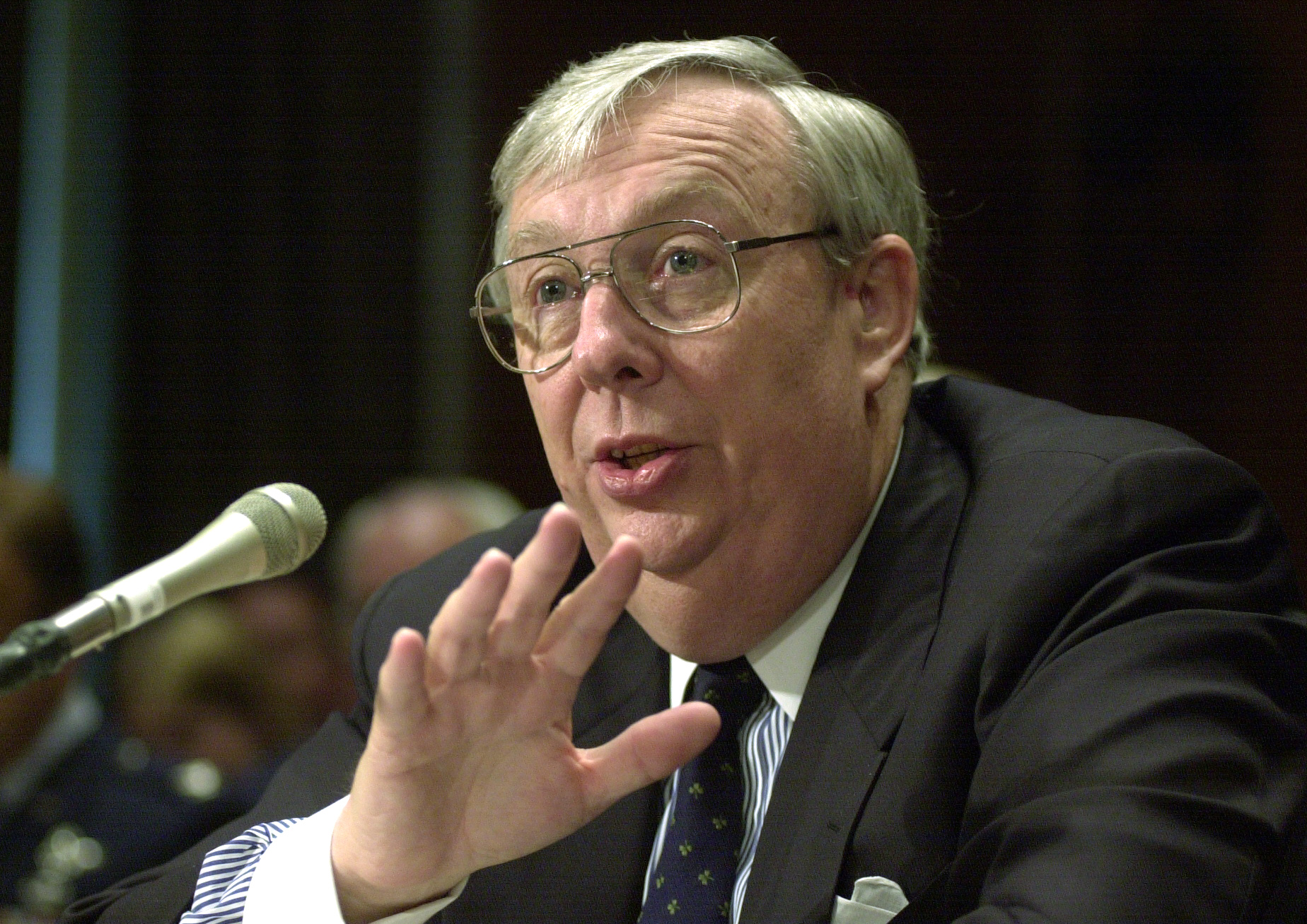
James G. Roche, who served as the 20th Secretary of the Air Force from 2001 to 2005, passed away on August 4 at the age of 86. His tenure as Secretary was marked by significant challenges and strategic shifts for the U.S. Air Force, particularly in the aftermath of the September 11, 2001, terrorist attacks.
As the top civilian leader of the Air Force, Secretary Roche guided the department through a pivotal period that included the initial responses to the 9/11 attacks, the subsequent military campaigns in Afghanistan starting in late 2001, and the 2003 invasion of Iraq. During these critical years, Roche championed several key initiatives aimed at modernizing the Air Force and adapting it to the demands of 21st-century warfare. These included fostering closer integration between air and space operations, enhancing military readiness, transitioning acquisition strategies from platform-centric to capabilities and networks-based systems, and advocating for the early adoption of combat drones designed to operate in conjunction with piloted aircraft—a concept that is now materializing as Collaborative Combat Aircraft.
Born in Brooklyn, New York, in 1939, Roche’s career was characterized by a diverse blend of military service, academic pursuit, and executive leadership in both government and industry. He earned a bachelor’s degree in humanities from the Illinois Institute of Technology in Chicago in 1960, receiving a Navy commission through the Reserve Officer Training Corps. His academic pursuits continued with a master’s degree in operations research from the Navy Postgraduate School in Monterey, California, completed in 1966, followed by a doctorate in business administration from Harvard University in 1972.
Roche served 23 years as a commissioned officer in the U.S. Navy, achieving the rank of captain. During his naval career, he commanded the guided-missile destroyer USS Buchanan. His assignments also included roles on the Senate Intelligence Committee staff and as a deputy to Andrew Marshall, then the Director of Net Assessment at the Pentagon, a position focused on long-range strategic competition. After retiring from the Navy in 1983, Roche transitioned to civilian government service, heading the Democratic staff of the Senate Armed Services Committee for a year.
In 1984, Roche entered the private sector, joining Northrop Corporation. He initially led the company’s analysis center in Washington D.C. for five years before ascending through various executive positions. These included serving as a vice president and assistant to then-CEO Tom Jones, followed by roles as vice president and chief of advanced development and planning, and ultimately as president of Northrop’s Electronic Sensors and Systems sector. It was from this position that he was appointed by President George W. Bush to serve as Secretary of the Air Force in 2001.
Before the September 11 attacks, Secretary Roche prioritized initiatives to improve the quality of life and professional appeal for enlisted Airmen, focusing on enhanced educational opportunities and living conditions. He also strongly advocated for a more cohesive integration of the Air Force’s air and space capabilities. Under his direction, plans were initiated to integrate air- and space-based sensor and communication networks and to expand the incorporation of space-derived capabilities into field operations. Additionally, he sought to bolster military readiness through increased exercises and greater funding for spare parts and maintenance.
A significant aspect of Roche’s forward-thinking approach was his early and ardent advocacy for unmanned combat aircraft. Inspired by then-Air Combat Command head Gen. John Jumper’s 2000 directive to arm MQ-9 Predator reconnaissance drones—tests of which began in early 2001—Roche envisioned armed, autonomous drones as a critical component of the Air Force’s future. He actively promoted the development of experimental programs like the X-45 Unmanned Combat Air Vehicle (UCAV) and, in numerous speeches and internal communications, urged Air Force leadership to prepare for a future where UCAVs would operate alongside piloted aircraft or independently execute combat missions.
While the UCAV experiment showed promise, it did not immediately become a top Air Force acquisition priority. It is speculated that aspects of the UCAV program may have transitioned into classified efforts in the subsequent years, eventually leading to the formal establishment of the Collaborative Combat Aircraft (CCA) program by Air Force Secretary Frank Kendall in 2022. Roche frequently highlighted the advantages of combat UAVs, noting their ability to undertake long missions without human fatigue or degraded “acuity,” and famously remarked that if a drone is lost in combat, “you don’t have to write a letter to the mother of a computer chip,” underscoring his view on their potential to reduce human risk.
In the immediate aftermath of the 9/11 attacks, Roche intensified the development and implementation of the Air Expeditionary Forces concept. He allocated more personnel, aircraft, and logistical support to this framework, shifting the Air Force’s operational emphasis from stateside garrison activities to forward deployments. He also pushed for the deployment of experimental unmanned aircraft, such as the RQ-4 Global Hawk and MQ-1 Predator, into the Southwest Asia theater. Collaborating with the Army, Roche fostered greater inter-service cooperation in the field, embedding Airmen within Army ground units to enhance the coordination of air attacks and close air support.
Roche also played a key role in increasing the operational involvement of the Air National Guard and Air Force Reserve in the Afghanistan campaign. He championed their closer integration with the Active-Duty force, establishing a day-to-day operational reliance on reserve components that the Air Force continues to maintain. Furthermore, he advocated for the establishment of more Air Operations Centers to develop Air Force and joint networks and integrated capabilities, and he worked to expand Air Force special operations capabilities to support other services.
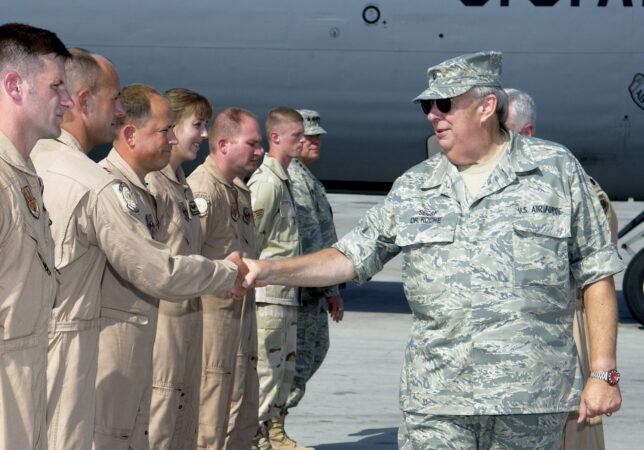
One notable controversy during Roche’s tenure involved a plan to acquire additional aerial refueling capabilities. Soon after 9/11, Roche supported a proposal by Senator Ted Stevens (R-Alaska) to lease new aerial tankers from Boeing, the manufacturer of the existing KC-135 and KC-10 fleets. The rationale was that leasing the aircraft would allow their acquisition through operations and maintenance accounts, rather than direct procurement, at a time when the Air Force faced modernization budget constraints. It was also believed that a lease arrangement could expedite the introduction of these jets into service. Senator Stevens, in turn, viewed the initiative as a means to support Boeing and the U.S. airline industry, both of which were struggling in the post-9/11 economic environment.
This plan, however, became embroiled in a procurement scandal. Although nominated by President George W. Bush to become Secretary of the Army in 2005, Roche ultimately withdrew his name from consideration. It became clear that his confirmation would face indefinite obstruction from congressional opponents due to the tanker lease controversy. While one of Roche’s acquisition officials was subsequently imprisoned and another resigned for acting improperly in pursuit of the leasing idea, Roche himself was not found to have engaged in any criminal conduct related to the matter.
Why This Matters
James G. Roche’s leadership as Secretary of the Air Force was formative, occurring during one of the most transformative periods in modern U.S. military history. His role in guiding the Air Force through the immediate aftermath of 9/11 and into the conflicts in Afghanistan and Iraq established operational precedents that continue to influence military strategy. His forward-looking vision for integrating air and space capabilities, embracing capabilities-based acquisition, and pioneering the concept of combat drones laid critical groundwork for the Air Force’s current technological advancements, including the development of Collaborative Combat Aircraft. Furthermore, his efforts to enhance airmen’s quality of life and integrate reserve components highlight a commitment to the force’s enduring strength. The controversy surrounding the tanker lease also serves as a lasting reminder of the complex ethical and oversight challenges inherent in large-scale defense procurement, underscoring the necessity for transparency and accountability at the highest levels of government. Roche’s legacy is thus defined by both his strategic foresight and the lessons learned from the challenges faced during his pivotal tenure.
WASHINGTON D.C. –Dr. James G. Roche, the 20th Secretary of the Air Force, whose tenure was marked by significant post-9/11 challenges and a controversial attempt to lease aerial refueling tankers, has passed away. Roche, a former Navy captain and defense industry executive, led the Department of the Air Force from 2001 to 2005, navigating a critical period for U.S. national security.
Roche assumed leadership of the Air Force in the immediate aftermath of the September 11, 2001, terrorist attacks. The attacks severely impacted the commercial aviation industry, leading to a precipitous drop in air travel and a wave of canceled orders for aircraft manufacturers, including Boeing, a major U.S. aerospace firm.
In this economic climate, Roche advocated for a plan to quickly acquire 100 new KC-767 aerial refueling tankers for the Air Force through a lease agreement with Boeing. His rationale was twofold: to provide a much-needed boost to the U.S. industrial base and to leverage Boeing’s recent design for a boom-type refueling system, which was essential for modern aerial refueling operations. The Air Force sought to replace its aging fleet of KC-135 tankers, some of which had been in service for decades.
However, the proposed sole-source lease quickly drew opposition. European aerospace giant Airbus, through its parent company EADS (now Airbus SE) and its North American subsidiary, lobbied members of Congress. EADS asserted its capability to quickly certify its own boom-type refueling system and establish a production line in the United States for its larger A330 multi-role tanker transport aircraft. EADS argued that it should be allowed to compete for the contract. Congressional pressure led the Air Force to agree to a “best value” competition, acknowledging that EADS’s A330, being a significantly larger aircraft than Boeing’s 767-based tanker, could not compete on unit price alone but might offer other advantages.
Subsequent investigations, particularly into internal communications, brought to light emails suggesting that Roche had favored a sole-source approach to Boeing from the outset. It was also noted that Roche reportedly held a personal animosity towards Ralph Crosby, who led EADS North America and was a former rival from Roche’s time at Northrop. Roche publicly expressed skepticism about EADS’s A330 offering, characterizing it as a predominantly European product merely adorned with a “Made in America” label.
Adding to the controversy, Roche reportedly had a long-standing feud with Senator John McCain (R-Ariz.), a powerful member of the Senate Armed Services Committee, dating back to their shared time in the Navy. Senator McCain became a vocal critic of the tanker lease plan, making it a personal crusade. He publicly denounced the proposed deal as a “sweetheart deal” for Boeing, arguing it would ultimately cost the U.S. government significantly more than a direct purchase. McCain’s persistent demands led to multiple investigations into the plan’s legality and financial prudence.
The scandal deepened with the revelations surrounding Darleen Druyun, then the Air Force’s Principal Deputy Assistant Secretary for Acquisition and Management. Investigations determined that Druyun, a key acquisition official for a decade, had a significant role in promoting the Boeing lease. It was found that she passed confidential information about EADS’s proposal to Boeing. Furthermore, Druyun was discovered to have leveraged her position, demanding an executive job for herself and employment opportunities for other family members from Boeing in exchange for favorable terms on the tanker lease and preferential treatment in other competitions. Her illicit activities also extended to steering favorable terms for Boeing on launch vehicle contracts and directing the initial Small Diameter Bomb contract to the company.
Druyun’s actions led to her arrest, and she subsequently served nine months in prison. While Roche’s conduct and judgment were scrutinized, investigations concluded that he had not directed Druyun to commit these contracting crimes and was unaware of her specific illegal activities. The fallout for Boeing was severe: one executive was also jailed, long-serving CEO Phil Condit resigned, and the company was compelled to pay a $615 million fine. Marvin Sambur, Druyun’s immediate supervisor, resigned from his post, though he was not found to have participated in her scheme.
The intense scrutiny from Senator McCain and other members of Congress significantly impeded Air Force operations. They held up promotions for several senior Air Force officers, demanding full transparency and the results of ongoing investigations into the tanker lease. Facing insurmountable opposition and ethical breaches, the Air Force ultimately abandoned the controversial lease plan in the fall of 2004. Instead, it moved to a direct purchase model, initially planning for 100 tankers. This new acquisition plan, however, underwent extensive modifications and multiple rounds of competition before Boeing was finally awarded a contract in 2011 to build 179 KC-46 tankers.
In the wake of the implosion of the tanker lease plan, President George W. Bush nominated Roche to become Secretary of the Army. However, Roche soon withdrew his name from consideration when it became evident that congressional opponents, still vocal about the tanker scandal, would indefinitely block his confirmation. Roche stated that it was unfair to keep senior officers awaiting promotion delayed due to his confirmation issues. He announced his resignation as Secretary of the Air Force in November 2004 and officially departed the position in January 2005, at the beginning of the second Bush term. Roche maintained that he had always intended to serve only one term and facilitated an overlap with his successor and General John Jumper.
Roche himself was found to have committed a minor ethics violation. He sent an email recommending a person for a job with Northrop. While the recommendation itself was not unethical, the use of his official government email, which bore his title and could imply government endorsement, constituted the infraction. Then-Defense Secretary Donald Rumsfeld considered the mistake inadvertent and did not pursue any sanctions.
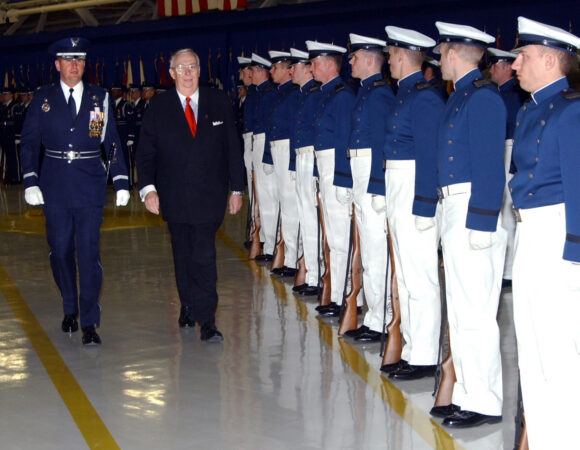
In retirement, Roche remained active in the defense and foreign policy sectors. He served on the board of Orbital Sciences Corp./Orbital ATK until its acquisition by Northrop Grumman. He was also a member of the Council on Foreign Relations and the Washington Institute for Near East Policy.
Following his passing, former colleagues and leaders offered tributes. Retired Lt. Gen. David Deptula, head of AFA’s Mitchell Institute for Aerospace Studies, who worked for Roche during the Air Force’s 2001 Quadrennial Defense Review, lauded him. “Secretary Roche’s impact on our national security cannot be overstated,” Deptula remarked. “Whether in uniform, in industry, or as Secretary of the Air Force, he was a most innovative, dedicated, and driven individual. He didn’t simply receive briefings—he understood the issues at a fundamental level, challenged assumptions, and pressed those of us on his staff to advance our thinking about air and space power. His command of strategy and policy, coupled with his deep interest in science and technology, was second to none. He made the Air Force and the nation stronger, and had a significant impact as a result.”
Air Force Chief of Staff Gen. Kenneth S. Wilsbach wrote on social media that Roche “led our Department … through one of its most consequential moments following September 11th, cementing air and space power as the linchpin of the Joint Force.” The current Secretary of the Air Force, Troy Meink, also acknowledged Roche, stating that his “leadership and commitment helped strengthen the Joint Force, leaving a true impression on our nation.”
Why This Matters
The saga of the Air Force tanker lease, prominently featuring James Roche, is a critical case study in government contracting, ethical oversight, and the complex interplay between defense policy, industrial interests, and political will. The events underscore several enduring challenges and principles:
- Ethical Standards in Government Procurement:The imprisonment of Darleen Druyun and the subsequent fines against Boeing serve as a stark reminder of the severe consequences for corruption and conflicts of interest in federal contracting. It highlights the vulnerability of procurement processes to undue influence and the necessity for robust ethical frameworks and vigilant oversight to maintain public trust and ensure fair competition.
- Congressional Oversight and Accountability:Senator John McCain’s relentless pursuit of transparency and accountability in the tanker deal demonstrates the vital role of congressional oversight. His actions forced investigations, exposed wrongdoing, and ultimately led to the cancellation of a deal widely perceived as flawed, preventing potential long-term financial detriment to taxpayers. This case illustrates how individual political will can challenge powerful defense establishments and industrial lobbies.
- Defense Industrial Base and Competition:The competition between Boeing and EADS/Airbus for the tanker contract showcased the intense global rivalry in the defense aerospace sector. It highlighted the challenges of balancing national industrial interests (boosting a domestic company like Boeing post-9/11) with the principles of fair and open international competition, especially when foreign companies propose U.S.-based production. This tension between economic stimulus and best value remains a recurring theme in defense procurement debates.
- Complexity of Modern Weapon Systems Acquisition:The protracted, decade-long process to finally award the KC-46 tanker contract after the initial lease plan collapsed reveals the inherent complexity, cost, and political sensitivity of acquiring major weapon systems. Delays, redesigns, and repeated competitions can significantly impact military readiness and budget planning, emphasizing the need for clear, consistent acquisition strategies.
- Legacy of Leadership:James Roche’s tenure, despite the tanker controversy, also reflects the intense pressures and strategic demands placed on defense leaders during periods of national crisis, such as post-9/11. His story exemplifies how individuals in high-stakes positions face scrutiny not only for policy decisions but also for their personal conduct and associations, impacting their careers and public perception. The mixed legacy, combining strategic contributions with ethical challenges, offers valuable lessons for future leaders in government and industry.