
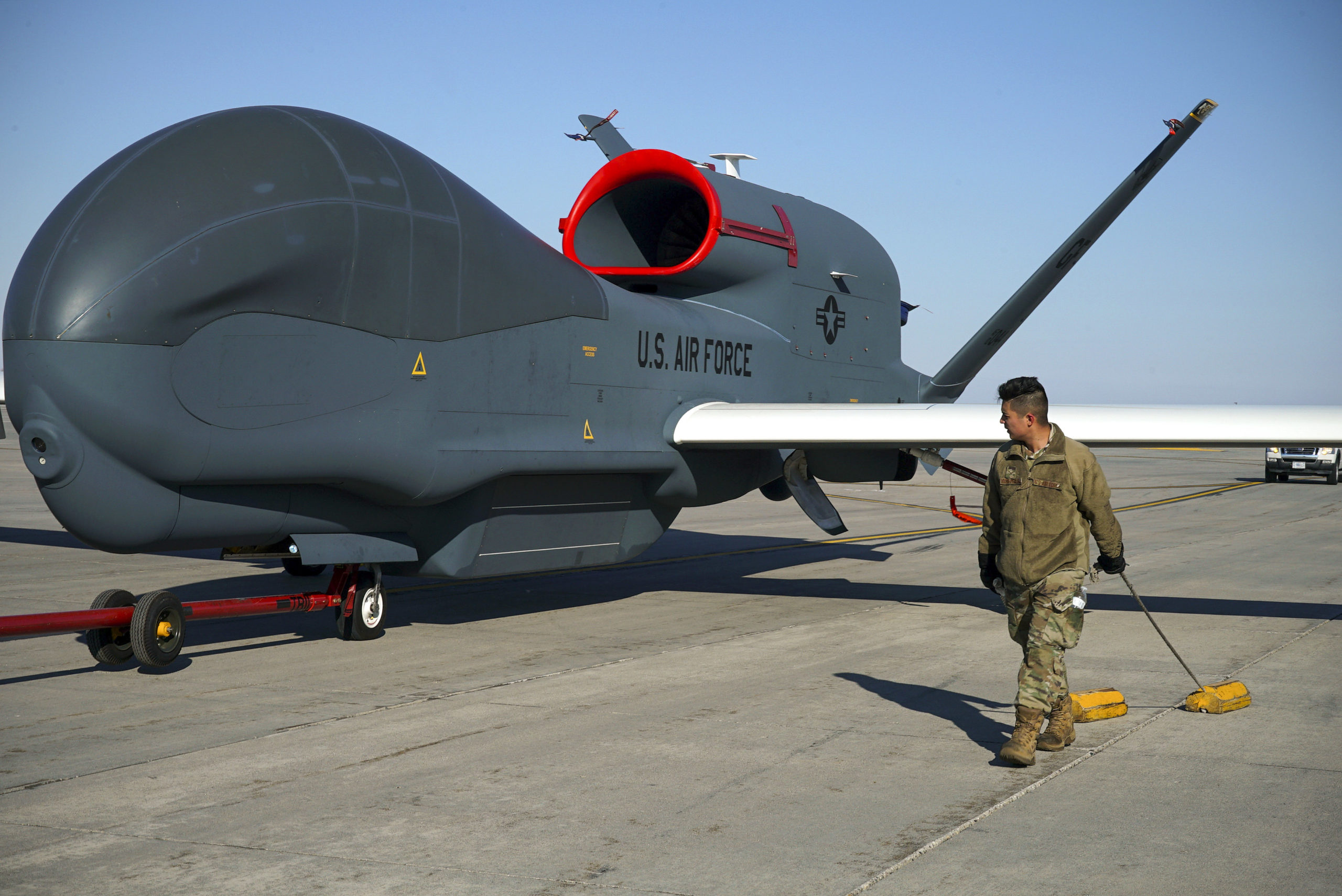
The United States Air Force is preparing to award a contract to Northrop Grumman that could enable the continued operation of its RQ-4 Global Hawk surveillance drones for an extended period, potentially until 2033. This move signals a potential shift in the service’s long-term strategy for the high-altitude, long-endurance intelligence, surveillance, and reconnaissance (ISR) platform, which has faced multiple previous proposals for retirement.
On August 17, the Air Force Life Cycle Management Center (AFLCMC) issued a presolicitation notice indicating its intent to award a sole-source contract to Northrop Grumman. This contract is designated for the comprehensive development, modernization, retrofit, and sustainment of the RQ-4 Global Hawk fleet. A sole-source contract implies that the Air Force believes Northrop Grumman is the only company capable of fulfilling these specific requirements, likely due to its role as the original equipment manufacturer and its proprietary knowledge of the system.
The scope of support activities outlined in the notice is extensive, encompassing critical areas necessary for maintaining an advanced aerial platform. These include program management, which involves overseeing the entire lifecycle of the system; hardware and software upgrades and sustainment, crucial for keeping the drones technologically relevant and operational; engineering and onsite support, providing expert technical assistance; logistics, which covers the supply chain and maintenance of parts; training development and administration for personnel operating and maintaining the aircraft; and various other test and integration activities to ensure system compatibility and performance. The comprehensive nature of these services underscores the Air Force’s commitment to fully support the remaining Global Hawk fleet.
This planned contract extends beyond previous legislative directives regarding the RQ-4’s service life. Congress, through its annual defense policy bill (specifically the 2026 defense policy bill mentioned in the original context, though this usually refers to the fiscal year for which the bill is passed, implying a future directive), had previously prohibited the Air Force from retiring any of its remaining nine RQ-4s until the conclusion of fiscal year 2030. The new presolicitation notice, with a potential contract duration extending to 2033, suggests the Air Force is now planning for an operational lifespan that surpasses this congressional mandate.
The contract is structured to span up to five and a half years. It is projected to commence in January 2028, with the possibility of continuing through the end of June 2033. The initial agreement will feature a one-year base period, followed by four optional one-year ordering periods. This arrangement would take the contract’s core duration through the end of 2032. Additionally, an option to extend the deal by up to six more months is included, providing further flexibility for the service.
Specific financial details regarding the potential value of this contract have not been disclosed. An Air Force spokesperson informed *Air & Space Forces Magazine* that cost information was not available for public release at this stage. The AFLCMC notice indicated plans to issue a formal solicitation in September, with responses from Northrop Grumman expected by February 2027. This timeline suggests a detailed negotiation and award process, reflecting the complexity and strategic importance of the platform.
Manufactured by Northrop Grumman, the RQ-4 Global Hawk is recognized as a strategic long-endurance, high-altitude unmanned aircraft system primarily designed for intelligence, surveillance, and reconnaissance missions. Its operational capabilities include capturing high-resolution imagery intelligence, collecting signals intelligence (SIGINT), and conducting ground moving target indication (GMTI). These capabilities allow it to provide persistent surveillance over vast areas, making it a valuable asset for monitoring activities on the ground and in the electromagnetic spectrum from a safe standoff distance.
Historically, the Air Force operated a larger fleet, at one point possessing 33 RQ-4s. These drones were strategically deployed globally, including at locations such as Yokota Air Base in Japan, Andersen Air Force Base in Guam, and various installations across the Middle East, underscoring their role in regional and global security operations. However, the Global Hawk fleet began to undergo significant downsizing in the early 2020s as the Air Force initiated efforts to divest older models, citing rising operational costs and perceived vulnerabilities in contested airspace scenarios.
In 2022, the service publicly announced its intention to retire the entire RQ-4 fleet by 2027. This plan, however, encountered consistent resistance and intervention from the U.S. Congress. Lawmakers have repeatedly extended prohibitions on these retirements, most recently through fiscal year 2030. This legislative pushback highlights a divergence in perspectives between the Air Force, which has sought to prioritize investment in next-generation, more survivable ISR assets, and Congress, which has emphasized the immediate need for the Global Hawk’s unique capabilities.
In a statement provided to *Air & Space Forces Magazine*, an Air Force spokesperson confirmed that the service no longer maintains a definitive projected retirement date for the RQ-4. This indicates a more fluid and responsive approach to the platform’s future. The spokesperson elaborated on the contract’s structure, stating, “To ensure operational continuity, this contract is structured with a one-year base period of performance followed by individual, one-year option periods. This structure grants Air Force leadership the flexibility to sustain the fleet as needed up to 2032, without committing to the full duration up front.” This flexible contracting mechanism allows the Air Force to adapt to evolving strategic requirements, technological advancements, and budgetary constraints without being locked into a long-term commitment that might become obsolete.
Why This Matters
The potential extension of the RQ-4 Global Hawk’s operational life until 2033 carries significant implications for U.S. national security, defense spending, and military strategy. Firstly, it underscores the persistent and critical demand for high-altitude, long-endurance intelligence, surveillance, and reconnaissance capabilities. Despite its age and the Air Force’s desire to transition to newer platforms, the Global Hawk continues to fill a vital gap, providing persistent wide-area surveillance that is difficult to replicate, especially in regions where manned aircraft or ground assets face access restrictions or heightened risks. Its ability to collect imagery and signals intelligence across vast distances remains invaluable for monitoring geopolitical hotspots and adversary activities.
Secondly, this decision highlights the ongoing tension between congressional oversight and military service autonomy in procurement and retirement decisions. Congress has consistently intervened to prevent the Air Force from divesting the Global Hawk, reflecting a belief that the drone’s capabilities are too valuable to lose without a proven replacement. This dynamic showcases how legislative bodies can shape defense policy and resource allocation, often prioritizing current operational needs over long-term modernization strategies advocated by the services. The contract’s flexible structure, with its option periods, represents a compromise that allows the Air Force to retain the capability while still having an exit strategy.
Finally, the extension impacts defense industrial base planning and future technological investments. Sustaining an older platform means continued expenditure on maintenance, upgrades, and support from prime contractors like Northrop Grumman, potentially diverting funds from research and development into next-generation ISR platforms designed for more contested environments. While ensuring a continued capability, it also raises questions about the pace of modernization and the Air Force’s ability to pivot towards advanced, more survivable systems necessary for future conflicts against peer competitors. This contract, therefore, is not merely about keeping an aircraft flying; it reflects a complex interplay of strategic necessity, political will, and the challenging realities of defense modernization in a rapidly evolving global security landscape.