
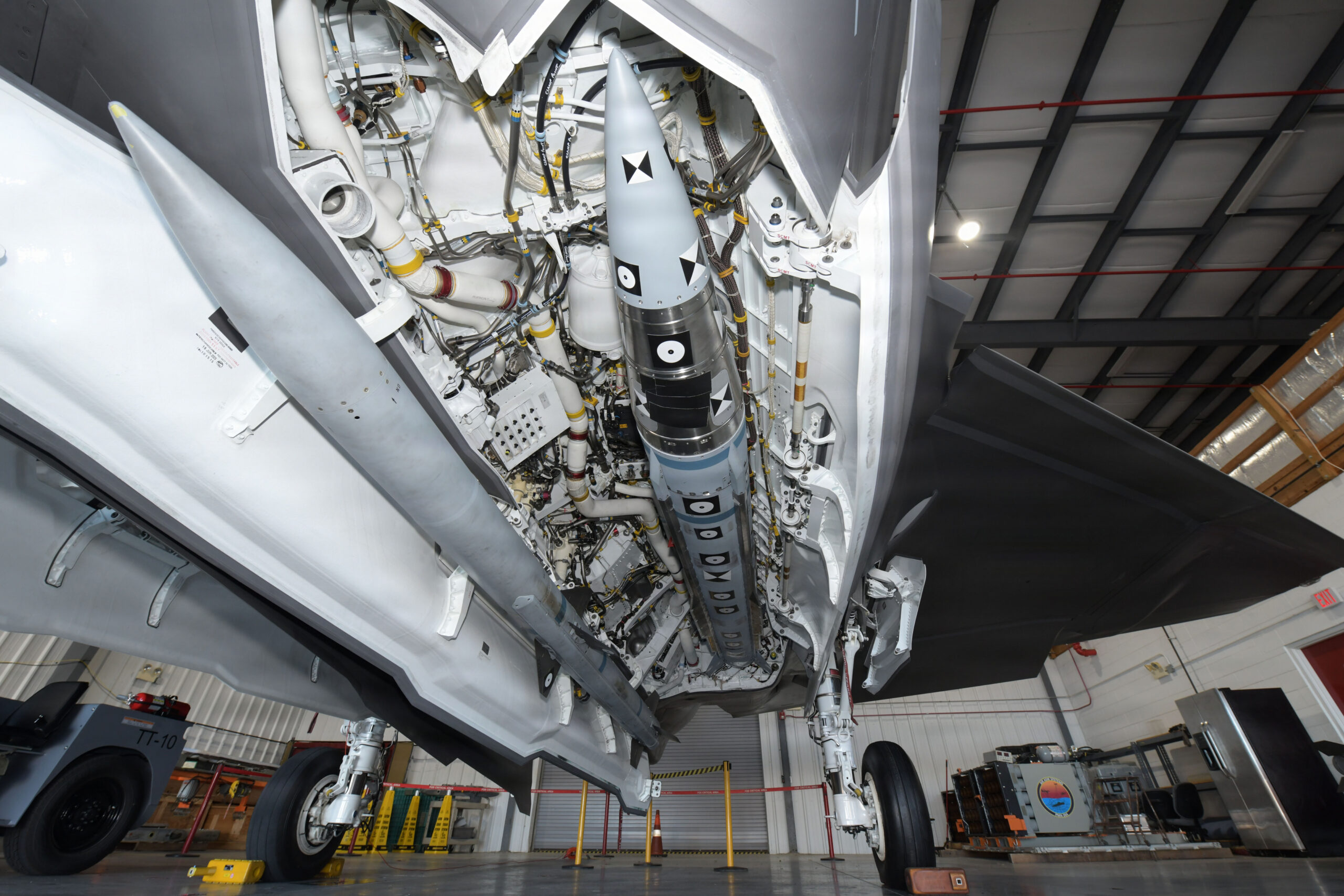
The U.S. Navy has introduced a new long-range air-to-air missile, the AIM-424, also known as Malice, which is designed to significantly extend the engagement capabilities of its fighter aircraft. This development could also address a similar need for long-range air combat weapons within the U.S. Air Force, potentially equipping its fourth-, fifth-, and future sixth-generation fighters.
Information regarding the AIM-424 Long Range Air-to-Air Missile (LRAAM) was first released online on August 22 by the Navy’s portfolio acquisition executive for munitions. The project was simultaneously unveiled at the service’s annual Tailhook Symposium in Reno, Nev., a prominent event for naval aviation.
Developed by Raytheon, the Malice missile is specifically engineered for Marine and Naval aviators, with compatibility across various fighter platforms. These include the Boeing F/A-18 Super Hornet and the Lockheed Martin F-35 Lightning II. A key characteristic of the missile is its stated range, which is “in excess of 250 nautical miles.”
According to a Navy statement provided to media outlets, Malice is intended to directly support the Department of Defense’s strategy of integrated deterrence. The statement highlights that the missile will enhance the range, lethality, and combat effectiveness for Marine and Naval Aviation forces involved in defending U.S. fleets, interests, and the homeland. The Navy has indicated that further specifics regarding the missile’s capabilities and deployment timelines remain classified to maintain operational security.
The advertised range of the Malice missile surpasses that of several other air-to-air missile programs currently in, or nearing, service. For instance, the Lockheed Martin AIM-260 Joint Advanced Tactical Missile (JATM), which the Air Force is leading in development for both services, is reported to have a range exceeding 120 miles. The Raytheon AIM-120D Advanced Medium-Range Air-to-Air Missile (AMRAAM), a long-standing staple in U.S. and allied air forces, has a range of approximately 100 nautical miles. Malice’s extended reach represents a substantial increase over these existing systems.
Phil Jasper, president of Raytheon, commented on the new missile in an email statement, asserting that “With increased range, lethality, and combat effectiveness for naval forces, the AIM-424 delivers a generational leap in long range air-to-air combat capability that can out range any threat.”
The AIM-424 Malice missile features a solid-propellant rocket motor, is 13.5 feet long, and has a diameter of 13.5 inches. Its wingspan measures 26.2 inches, and it weighs 1,500 pounds. As noted, its range is in excess of 250 nautical miles, and it is equipped with a blast fragmentation warhead. These specifications were provided by the U.S. Navy.
While Malice significantly enhances the range of current missile programs, it is important to note that it is not the most ambitious long-range effort underway. The Air Force is pursuing its own Long Range Weapon (AFLRW), which aims for distances exceeding 1,000 nautical miles, though this project is still in its early developmental stages. An Air Force spokesperson informed Air & Space Forces Magazine on August 24 that the service is “closely following the progress of the Navy on the AIM-424 Long Range Air-to-Air Missile Program” but declined to provide further comments or details.
Collaboration between the two services on missile development is not uncommon, with examples including the JATM, AMRAAM, and the AIM-9X Sidewinder. Retired Air Force Col. John “JV” Venable, a senior resident fellow at the Mitchell Institute for Aerospace Studies, highlighted this inter-service dynamic. He noted that while the Navy and Air Force have distinct operational requirements, they can mutually benefit from each other’s technological advancements, testing, and development in areas such as fighter-launched offensive weapons. Venable suggested that Malice appears to be another instance where parallel efforts can accelerate capabilities and deliver advantages across the Joint Force.
The Navy had previously developed the AIM-174B Gunslinger, a missile with a range of 150-200 nautical miles. However, the Gunslinger’s size limits its utility for the Air Force as it cannot be carried internally within the weapon bays of stealth aircraft like the F-35 and F-22. In contrast, the new Malice missile is reportedly designed for a wider array of aircraft, including future sixth-generation fighters such as the Navy’s unnamed F/A-XX and the Air Force’s parallel project, the Boeing F-47.
Venable, a former F-16 pilot and commander, emphasized the strategic importance of long-range missiles, likening the scenario to a “jousting contest” where the fighter with the longer lance possesses a significant advantage. He specifically noted that Chinese beyond-visual-range missiles are assessed to potentially outrange many current U.S. weapons, which could afford Chinese fighters a “shoot first” opportunity by dozens of miles. According to Venable, the Malice missile would “extend U.S. engagement range, improve first-shot opportunities, and help restore our tactical advantage against peer adversaries.”
Beyond tactical considerations, Venable indicated that a missile like Malice would provide commanders with greater flexibility in operational planning and help offset numerical disparities in a potential conflict with a peer adversary. He referenced the People’s Liberation Army Air Force (PLAAF), which he stated “already holds a significant advantage in the numbers of fighters it can generate over Taiwan compared with the U.S. and allied forces,” underscoring the need for “every technological advantage available to offset that numerical disparity.”
Reports from Aviation Week suggest that Malice incorporates a two-stage design, reminiscent of the Long Range Engagement Weapon (LREW) program initiated in the mid-2010s under then-Secretary of Defense Ash Carter. Flight Global previously reported that the LREW effort also involved a two-stage design and was intended to transition to multiple services. At the time, the Air Force was known to be working on the LREW alongside the JATM, with both initiatives aiming to replace the decades-old AMRAAM, which first entered service in the mid-1980s. While JATM is considered a direct replacement for fighters to carry instead of AMRAAM, the LREW’s two-stage design promised a far greater range, a characteristic now seen in Malice.
Why This Matters
The introduction of the AIM-424 Malice missile is a significant development in global military aviation, particularly within the context of intensifying great power competition. Its extended range, exceeding 250 nautical miles, fundamentally shifts the dynamics of air-to-air combat by allowing U.S. Navy and potentially Air Force fighters to engage adversaries from greater distances. This capability is critical for maintaining a qualitative edge against advanced military powers, such as China, which are actively developing and fielding their own long-range air-to-air missiles. The ability to “shoot first” from beyond an adversary’s engagement range offers a crucial tactical advantage, enhancing aircraft survivability and mission effectiveness.
Strategically, Malice contributes directly to the concept of “integrated deterrence” by strengthening the capabilities of U.S. naval and air forces. In potential conflict scenarios, particularly in regions like the Indo-Pacific, where the U.S. and its allies face numerical disadvantages against forces like the People’s Liberation Army Air Force, advanced weaponry like Malice can help offset these disparities. The missile’s compatibility with both current and future sixth-generation fighter platforms ensures its relevance for decades to come, providing a foundational capability for the evolving landscape of aerial warfare. Furthermore, the potential for inter-service adoption highlights a broader strategy of maximizing technological advantages across the Joint Force, ensuring that the U.S. military remains at the forefront of defense capabilities in an increasingly complex and contested global environment.