
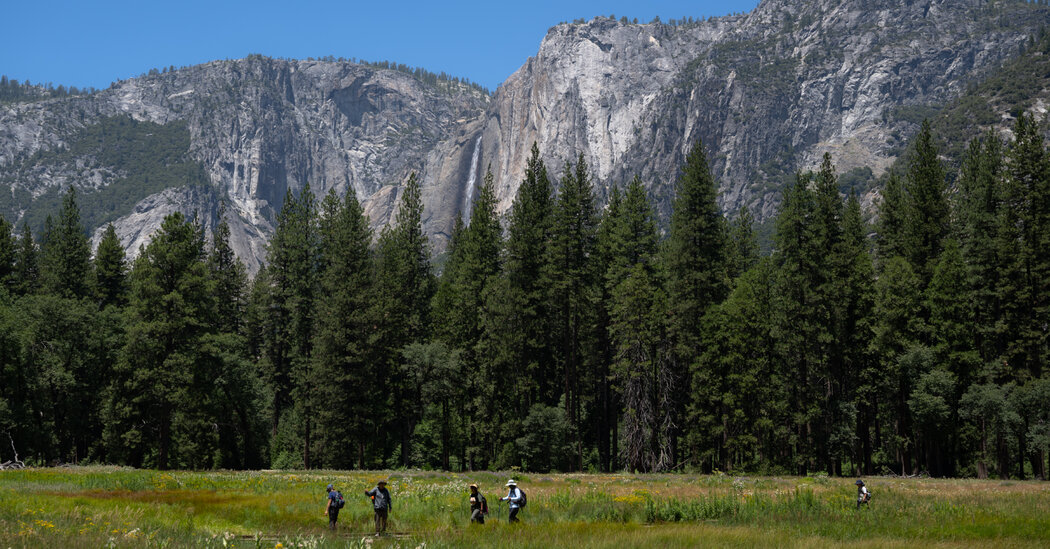
A contentious proposal involving a land swap within Yosemite National Park in California has drawn significant attention and concern from conservationists, former park officials, and members of Congress. The proposal, advanced during the Trump administration, seeks to transfer a small parcel of federal land to a private developer, Kingsbarn Realty Capital, in exchange for land of equivalent value elsewhere. This exchange would grant the developer easier access to build an upscale resort adjacent to the park’s western boundary.
According to federal officials and documents reviewed by The New York Times, the proposed deal involves transferring a parcel just inside Yosemite’s western boundary to an entity controlled by Kingsbarn Realty Capital, a real-estate private equity firm. Kingsbarn aims to construct a road and develop two 40-acre parcels it owns near the park, as outlined in documents submitted to Congress earlier this year.
In return for the park land, Kingsbarn Realty Capital would purchase land of equivalent value, located either near Yosemite or elsewhere in California, and then transfer ownership of this acquired land to the National Park Service (NPS). This mechanism, a land exchange, is typically used by the NPS to consolidate holdings, acquire critical wildlife habitat, or enhance park boundaries.
The potential transaction has generated alarm among conservation groups and former National Park Service officials. Critics argue that Yosemite, widely regarded as a “crown jewel” of the U.S. national park system, should remain off-limits to private development that would alter its boundaries or facilitate commercial access. Don Neubacher, a former supervisor at Yosemite and now on the executive council of the Coalition to Protect America’s National Parks, expressed strong opposition, recalling a similar proposal in the early 2000s that was ultimately rejected by the Park Service and later by courts.
Kingsbarn Realty Capital acquired the two parcels adjacent to Yosemite in early 2024 for $4 million through a limited liability corporation named Sanctuary at Yosemite. Campaign finance records indicate that Jeff Pori, the chief executive of Kingsbarn, made regular small-dollar donations totaling over $4,000 to President Trump’s 2024 campaign.
Lanny Davis, a Washington lobbyist and former adviser to President Bill Clinton, represents Kingsbarn. Davis stated that the firm intends to build an “upscale” development comprising cabins, homes, and commercial buildings. He argued that allowing a shorter connector road, enabled by the land swap, would reduce environmental impact by shortening travel distances for residents and customers entering the park, thus making the development more environmentally sound.
Davis also clarified that Kingsbarn initially sought to purchase the land outright, but Yosemite officials advised that a land swap was the only legally viable option. He reported that for the past two months, he has held weekly video meetings with park staff and officials, sometimes joined by Mr. Pori, though Interior Department officials in Washington have not participated directly in these meetings. Davis indicated that a survey has been completed, and the firm is in the final stages of assessing the value of the land for the proposed exchange, noting that their proposal is “almost done.”
Despite these ongoing discussions, the Interior Department, which oversees the National Park Service, emphasized that no final decision has been made. Aubrie Spady, a spokeswoman for the department, stated that “Any land exchange or access proposal involving National Park Service lands would be subject to all applicable federal laws, regulations and departmental policies, including required environmental review and public notification processes.”
Yosemite National Park is renowned globally for its dramatic landscapes, including immense waterfalls, towering sequoia groves, and glacier-carved granite monoliths such as Half Dome and El Capitan. It consistently ranks among the most visited national parks in the United States, experiencing increased visitation after the Trump administration eliminated a summer reservation system.
The proposed land exchange has been a topic of discussion among political appointees at the Interior Department for over a year, with some former Park Service officials indicating it was considered a “top priority.” These officials spoke anonymously due to fears of retaliation. The Interior Department also informed Congress this year that it was considering using the Land and Water Conservation Fund (LWCF) to cover costs associated with the exchange. This drew sharp criticism from Democrats, who contend that the LWCF is specifically intended to fund conservation programs on public lands and acquire new lands for preservation, not to facilitate private development access.
California’s two Democratic senators, Alex Padilla and Adam Schiff, have publicly denounced the proposal and are working with the Senate Appropriations Committee to try to block it. Senator Padilla described the current administration as “the most corrupt administration in history,” stating that “The Land and Water Conservation Fund exists to acquire land and interests in land in order to safeguard natural areas, water resources and cultural heritage — and to provide recreation opportunities for all Americans.”
Cicely Muldoon, who served as Yosemite’s superintendent from 2020 until her retirement in February 2025, voiced concerns regarding the public benefit of the proposed exchange. She highlighted that land exchanges are typically expected to provide a clear net benefit to the Park Service, such as additional wildlife habitat, a benefit she found unclear in this particular case. Muldoon also expressed apprehension about the precedent such a deal could establish for the more than 400 other national parks and historic sites across the nation. “Yosemite is kind of a bellwether for the national parks,” she remarked. “If this can happen in Yosemite, it can really happen anywhere in the national park system.”
The land in question has a history of development disputes stretching back to the late 1990s. At that time, developer Lewis Geyser purchased a rugged forested area on Yosemite’s western border, near the Big Oak Flat entrance, with plans to build a resort called Hazel Green Ranch. Initial efforts to collaborate with park officials for an off-site visitor parking and shuttle system failed.
Subsequently, Geyser sought an easement through a quarter-mile section of park property to provide more direct access to the park from his land. Following the park’s refusal, he filed a lawsuit in 2007. The federal government, supported by environmental groups like the Sierra Club, opposed the easement. The litigation concluded in 2012 when a federal appeals court in San Francisco ruled against the developer. Don Neubacher, who was Yosemite’s superintendent from 2010 to 2016, believed the issue was resolved. “It was a good ending, and we all thought it was dead,” he said, emphasizing the need to preserve Yosemite without overburdening its infrastructure.
However, after Kingsbarn acquired the land in 2024, the firm renewed discussions about a private road. According to Ms. Muldoon, the firm was informed that the Park Service could not legally permit such access. The situation evolved with a change in administration, and by spring 2025, the Interior Department began revisiting Kingsbarn’s request, with current and former federal officials noting that the proposal was being prioritized by political appointees in Washington.
Why This Matters
The proposed land swap in Yosemite National Park raises several critical issues with far-reaching implications for environmental conservation, public land management, and governance in the United States:
Precedent for National Parks:Yosemite is one of the nation’s most iconic and protected natural areas. A successful land exchange that facilitates private development access to park lands could set a significant precedent for other national parks and protected sites across the country. It could signal a shift in how federal agencies balance the mandate to preserve natural heritage with accommodating private commercial interests, potentially opening the door for similar proposals in other sensitive ecosystems.
Integrity of Public Lands:National Parks are held in public trust, managed by the federal government for the enjoyment and preservation of current and future generations. Altering park boundaries, even through an exchange, to benefit a private developer raises questions about the long-term integrity and purpose of these lands. Critics argue that such exchanges should only occur if they demonstrably provide a net conservation benefit to the park system, a point of contention in this proposal.
Environmental Impact:While the developer argues that a shorter access road could be “environmentally superior,” any new development and associated infrastructure near a national park inevitably carries environmental risks. This includes potential impacts on wildlife habitats, water quality, increased traffic congestion, and visitor experience within the park’s fragile ecosystems.
Use of Public Funds:The consideration of using the Land and Water Conservation Fund (LWCF) to cover costs related to this exchange has sparked controversy. The LWCF is a crucial program funded by offshore oil and gas revenues, specifically earmarked for acquiring and protecting natural areas, water resources, and cultural heritage, as well as providing recreation opportunities. Using it to facilitate private development access, even indirectly, is seen by many as a misuse of funds intended for conservation and public benefit.
Transparency and Political Influence:The involvement of a developer who has contributed to a presidential campaign, coupled with the apparent prioritization of the proposal by political appointees, raises concerns about transparency and potential political influence in decisions affecting public lands. Scrutiny will focus on whether the process adheres strictly to federal laws, regulations, and departmental policies, including rigorous environmental reviews and public notification, free from undue pressure.
Long-term Stewardship:This situation underscores broader debates about the stewardship of national parks and the balance between access, conservation, and economic development. Decisions made regarding Yosemite, a globally recognized natural treasure, will reflect on the nation’s commitment to preserving its natural heritage and will inform future debates about the management of all public lands.