
Key Takeaways
1. Accelerated Digital Displacement:Advanced AI video generation, spearheaded by tools like ByteDance’s Seedance 2.0, is rapidly displacing human actors and influencers in China’s vast gig economy, transforming content production and e-commerce models at an unprecedented scale.
2. Significant Cost Efficiencies & Scalability:AI offers businesses immense cost savings (up to 90% in some cases) and exponential increases in production volume and speed, enabling 24/7 operations and dramatically altering the competitive landscape for digital content creators and e-commerce platforms.
3. Emerging Legal & Ethical Headwinds:The practice of “distilling” human likeness and performance into AI models raises complex questions around intellectual property, fair compensation, and labor rights, signaling a new frontier for legal disputes and regulatory scrutiny in the AI-driven economy.
The relentless march of artificial intelligence continues to reshape global industries, and China’s vibrant, multi-billion-dollar gig economy is now experiencing its most profound disruption yet. A new generation of highly cost-effective, advanced AI video generation programmes is not merely augmenting human capabilities; it is actively threatening millions of jobs held by Chinese actors, online influencers, and livestreamers, fundamentally altering market dynamics in digital content creation and e-commerce.
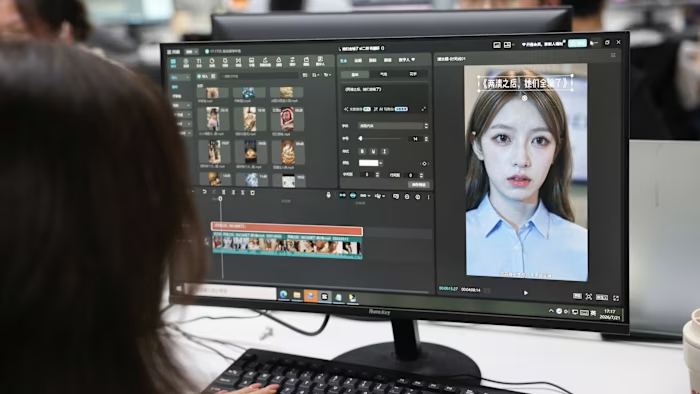
The release of powerful new AI-powered video software, exemplified by tech giant ByteDance’s Seedance 2.0 model, has ushered in an era where digital actors are rapidly replacing human counterparts. This technological leap enables the production of higher-quality original videos with unprecedented speed and efficiency, offering a stark competitive advantage to early adopters.
Greg Wollner, a short-drama actor and producer in Beijing, recounts the precipitous shift. Prior to Seedance 2.0, he was consistently engaged in three productions weekly. “And after that, everything just went.” This rapid digital takeover forced many of his peers to “quit doing what they love and change to something else,” highlighting the immediate and severe impact on the creative labor market.
The market penetration statistics are compelling. In May, a staggering 89 of the top 100 animated dramas on Douyin, ByteDance’s domestic Chinese version of TikTok, were AI productions, according to marketing analytics firm DataEye. This dominance underscores a swift and definitive pivot in content sourcing for major platforms.
The volume of AI-generated content is soaring. In the first quarter of 2026, China witnessed the release of approximately 128,000 short dramas. This figure represents more than three times the total for the entire previous year, with an astonishing 95 per cent of these productions being AI-generated, as reported by the China Netcasting Services Association. This exponential growth in output, driven by AI, indicates a profound shift in production economics and market supply.
The economic consequences for China’s vast creative and gig economy labor force are potentially dramatic. The short drama industry alone directly employs 690,000 people, according to a 2026 report from the National School of Development at Peking University. Furthermore, around 15 million people cite live streaming as their primary profession, a figure from a 2024 report by the China Netcasting Services Association. These segments of the labor market are now directly exposed to AI-driven displacement.
In the burgeoning livestreaming e-commerce sector, the market advantages of AI are equally pronounced. AI-generated digital hosts can operate around the clock, selling products continuously at roughly 10 per cent of the cost of their human counterparts, according to estimates in China’s state-owned media. This cost efficiency and scalability are game-changers for merchants. As of March, e-commerce platform JD.com reported that its digital hosts were being utilized by over 70,000 merchants, illustrating widespread commercial adoption.
The competitive threat is not confined to small-scale content creators. A digital double of prominent human streamer Luo Yonghao notably outsold the real person in several product categories, generating Rmb55mn ($7.7mn) in just seven hours, according to Baidu. This success story serves as a powerful case study for businesses seeking to maximize revenue and minimize operational costs through AI integration.
Professor Shen Yang, director of the metaverse laboratory at Tsinghua University and director of AI animation firm Zeelin, highlights the radical efficiency gains. A three- to five-minute drama production that would have required five people three months to produce in 2024 now takes a single employee one to two days with AI tools. The average production price has plummeted to Rmb600-800 ($90-$120) per minute, merely 10 per cent of the cost of human-led productions. Zeelin itself published approximately 8,000 one-minute short-drama episodes in May, showcasing the sheer volume now attainable.
Beyond job displacement, a more insidious market trend is emerging: the forced “distillation” of human performers’ images, voices, and performing styles into AI tools, often preceding their dismissal. A host of a popular children’s educational programme recounted being presented with an ultimatum in April: consent to the creation of an AI replica or face replacement by actors who would. This practice raises significant concerns regarding intellectual property rights, fair compensation for digital likeness, and the ethical boundaries of corporate leverage.
The unnamed host, who initially felt shamed by peers for considering such an agreement, now acknowledges the inevitability: “Now it seems that . . . change is unavoidable.” This sentiment encapsulates the broader market pressure pushing individuals to adapt or perish in the face of technological advancement. The issue extends beyond actors, with concerns mounting that other types of employees are also being coerced into training their AI replacements before being made redundant.
Lawyers are reporting a noticeable surge in AI-related labor disputes over the past two to three years. These disputes often revolve around the grounds for dismissal and the compensation due when AI replaces human workers. Jiang Xiaotong, a Zhejiang-based labor lawyer, successfully represented a worker in what is believed to be the first court case in China’s Hangzhou tech hub involving alleged AI replacement, resulting in higher compensation for the employee. The children’s educational programme host, initially offered 10 months’ salary for perpetual use of her likeness, eventually negotiated a five-year contract, one year’s salary, and veto rights, illustrating the nascent legal battlegrounds.
Actor Todd Kuhns observes a “general sense of frustration and resignation as we see our livelihoods stripped away from us using tools that have mined our own performances.” This sentiment reflects a growing crisis of morale and economic security within creative industries, underscoring the urgent need for new economic models and protections in the age of AI. ByteDance did not immediately return a request for comment, indicating the rapid and often opaque nature of this industry transformation.
Market Impact
The rapid proliferation of AI video generation tools in China signifies a profound and irreversible shift across the digital content and e-commerce sectors, with significant implications for investors, businesses, and the broader economy. For tech giants like ByteDance and JD.com, these AI capabilities translate into substantial operational efficiencies, reduced content production costs, and enhanced scalability, potentially boosting profitability and market share. Investors may see increased valuations for companies at the forefront of AI development and adoption, as these firms gain a significant competitive edge. However, the mass displacement of millions of gig economy workers poses a dual challenge: while businesses benefit from lower labor costs, the erosion of a significant consumer base’s income could lead to broader economic instability and potentially dampen overall consumption. Furthermore, the emerging legal landscape surrounding intellectual property rights for digital likenesses and AI-driven labor disputes will necessitate new regulatory frameworks and corporate governance strategies, introducing potential liabilities and compliance costs. This technological revolution, while promising unprecedented efficiency and innovation, demands a careful balancing act between economic growth and social responsibility to mitigate widespread labor market disruption.