
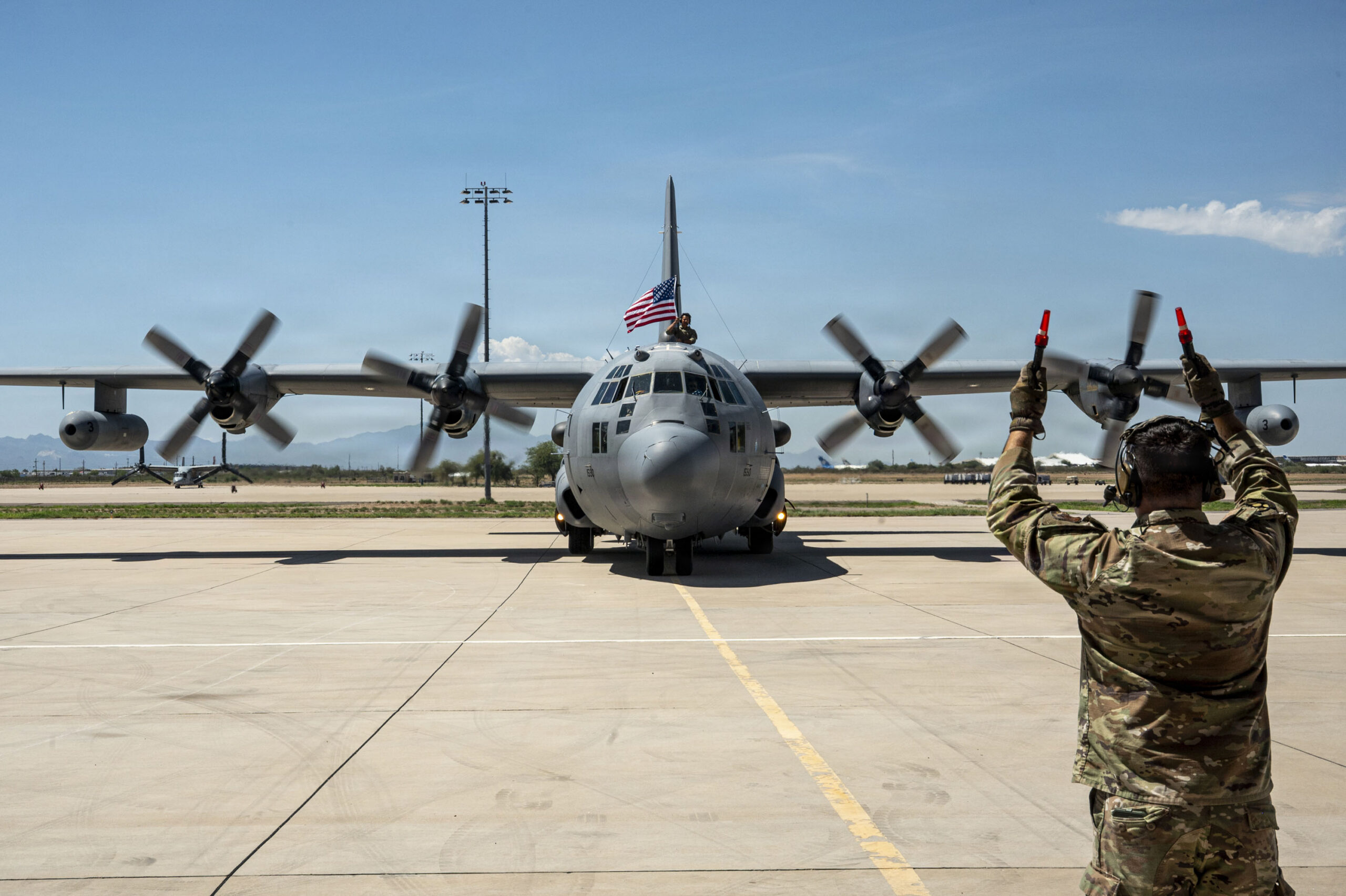
The United States Air Force has officially commenced a significant modernization of its electronic warfare capabilities with the retirement of the last active EC-130H Compass Call aircraft and the concurrent transition to the advanced EA-37B. This strategic shift marks the culmination of a decade-long plan to enhance the nation’s ability to dominate the electromagnetic spectrum in an increasingly contested global environment.
The final flight of an EC-130H Compass Call in the Air Force’s operational inventory took place on September 2, concluding over three decades of distinguished service for the specialized aircraft. This poignant event, often referred to as a “fini flight,” was confirmed by a spokesperson for the 55th Wing. A formal retirement ceremony is scheduled for September 18 at Davis-Monthan Air Force Base in Arizona, the home base for the EC-130H fleet and the new EA-37B.
Aviation photographer Steven Fortson captured images of this historic transition, notably photographing an EA-37B in flight alongside the retiring EC-130H, symbolizing the handover of a critical national defense mission.
The phasing out of the EC-130H has been a deliberate and extended process. Initial plans for its retirement were announced by the Air Force as early as 2014. This was followed by the awarding of a pivotal contract in 2017 to what was then L3 Technologies (now L3Harris Technologies) to transfer the EC-130H’s complex and mission-critical electronic warfare systems onto a new, more modern airframe. The first of the 14-aircraft EC-130H fleet began its retirement in 2021, with the remaining aircraft gradually decommissioned in the years that followed.
Despite the ongoing retirement process, the EC-130H and its highly skilled crews remained in high demand, underscoring the enduring necessity of electronic warfare capabilities. Converted from the robust C-130 Hercules transport aircraft in the early 1980s, the EC-130H Compass Call earned its reputation by effectively targeting, blocking, and jamming enemy communications, radar, and navigation signals, thereby disrupting adversary command and control and enhancing the safety and effectiveness of friendly forces.
The aircraft’s operational history is extensive and spans numerous global conflicts. It made its combat debut during Operation Just Cause in Panama in 1989. Subsequently, it played a crucial role in Operation Desert Storm in 1991, Operation Allied Force in Kosovo in 1999, and remained a constant fixture throughout the Global War on Terror in Afghanistan, Iraq, and Syria during the 2000s. Its relevance persisted right up to its final months, with aircraft spotters noting an EC-130H landing in the Caribbean last December, days before Operation Absolute Resolve, a high-stakes mission reportedly targeting Venezuelan President Nicolás Maduro. Furthermore, U.S. Central Command confirmed early this year that the EC-130H was utilized in the initial stages of Operation Epic Fury, the air campaign directed against Iran.
The mantle of this vital mission is now largely transferring to the EA-37B, a next-generation electronic warfare platform built upon a modified Gulfstream 550 business jet. This new aircraft is designed to integrate approximately 70 percent of the EC-130H’s existing electronic warfare systems without significant changes, ensuring continuity of critical capabilities while leveraging a more modern and capable airframe. The EA-37B operates with a combat crew of nine personnel, a reduction from the 13 required on the EC-130H, suggesting advancements in automation and operational efficiency.
The introduction of the EA-37B has been swift, reflecting the urgent demand for its capabilities. The first EA-37 arrived at Davis-Monthan Air Force Base in August 2024. Remarkably, the jets saw combat deployment to support Operation Epic Fury in late March, preceding their formal declaration of full operational capability. Further deployments occurred in July, with additional EA-37s dispatched to the United Kingdom as hostilities with Iran reportedly persisted, highlighting the rapid integration and immediate operational impact of the new platform.
Currently, the Air Force possesses five EA-37s from an initial order of 10 aircraft. However, ambitious plans are in place to significantly expand the fleet to 22 airframes, with procurement projected to continue through 2031. Air Force officials emphasize that this expanded fleet, which will ultimately be larger than the original EC-130H inventory, is imperative to meet the escalating demand from combatant commanders for electronic warfare capabilities in the face of increasingly sophisticated global threats.
Pentagon Editor Chris Gordon contributed to this report.
Why This Matters
The retirement of the EC-130H Compass Call and the full transition to the EA-37B represents a critical strategic evolution for the United States Air Force and its global defense posture. This modernization initiative addresses several key imperatives in contemporary warfare, with profound implications for military capabilities, geopolitical dynamics, and technological advancement.
Firstly, the shift from the C-130 turboprop platform to the Gulfstream 550 business jet significantly enhances the speed, range, and survivability of the U.S. electronic warfare fleet. The EA-37B’s higher operating altitude and speed allow it to reach operational areas more rapidly and conduct missions from greater stand-off distances, reducing risk to aircrews in increasingly contested airspaces. This is crucial for projecting power and disrupting adversary systems in scenarios involving sophisticated integrated air defense networks and peer competitors.
Secondly, this transition underscores the escalating importance of electronic warfare (EW) as a foundational element of modern combat. In an era where information dominance and control of the electromagnetic spectrum are paramount, the ability to jam enemy communications, radar, and navigation systems can blind, deafen, and disorient an adversary, creating windows of opportunity for friendly forces while denying the same to the enemy. The expansion of the EA-37B fleet signals a clear recognition by the U.S. military that EW is not merely a supporting role but a decisive factor in achieving victory across all domains of warfare.
Finally, the rapid deployment of the EA-37B, even before formal operational declaration, highlights the urgency of adapting to evolving global threats. The U.S. military faces adversaries continually investing in their own electronic warfare capabilities. By fielding a more advanced, agile, and effective EW platform, the U.S. maintains its technological edge, enhances its ability to deter aggression, and ensures its capacity to operate effectively in complex and challenging environments. This investment reflects a proactive approach to maintaining strategic advantage and safeguarding national security interests worldwide.