
U.S. Envoys Meet Putin in Moscow, Head to Kyiv Amidst Temporary Ceasefire and Ongoing Bombardment
President Vladimir V. Putin of Russia on Saturday ordered a 72-hour cessation of strikes on Kyiv, Ukraine’s capital, coinciding with the arrival of Trump administration envoys in Moscow. This pause in attacks was announced despite a large-scale Russian bombardment that struck various targets across Ukraine, including Kyiv’s two primary airports, just hours before the ceasefire was set to begin.
The American delegation, comprising Steve Witkoff, President Trump’s special envoy, and Jared Kushner, his son-in-law, landed in Moscow on Saturday for discussions with President Putin. Their itinerary includes a subsequent visit to Kyiv, Ukraine, with the stated objective of rekindling peace negotiations aimed at ending the protracted conflict in the region.
This marks the first diplomatic journey to Russia for Mr. Witkoff and Mr. Kushner since January. The previous U.S.-backed peace efforts had stalled significantly a month after that earlier visit, following a military confrontation involving the United States and Israel against Iran. That conflict subsequently absorbed a substantial portion of the Trump administration’s foreign policy focus, sidelining the Ukrainian peace process.
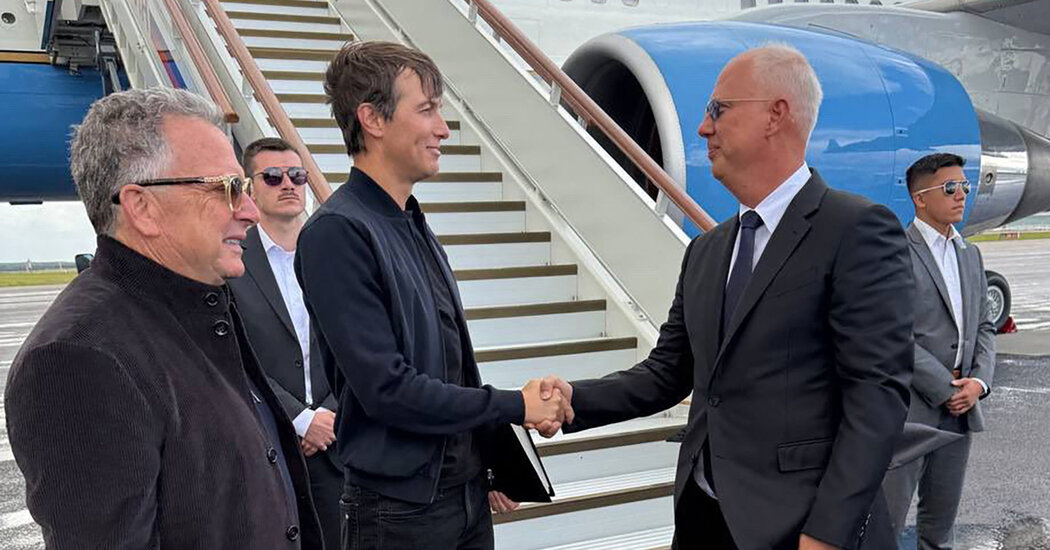
Upon their arrival at Moscow’s Vnukovo airport, the envoys were greeted by Kirill Dmitriev, a Russian official designated by President Putin to manage informal communications with the White House. Mr. Dmitriev publicly welcomed the American representatives on social media, referring to them as “peacemakers” and sharing images of their arrival.
Kremlin spokesman Dmitri S. Peskov confirmed shortly after the envoys’ arrival that a meeting with President Putin was scheduled. Mr. Peskov also elaborated on the Russian leader’s directive for a three-day halt to offensive operations targeting Kyiv, which commenced at midnight on Saturday. He explicitly linked this operational pause to “the preparations for the conduct of talks of Americans in Kyiv,” underscoring the diplomatic context for the military decision.
However, the announcement of the Kyiv ceasefire followed a night of intense Russian military activity. Earlier that day, Ukraine experienced a widespread Russian attack, which notably included strikes on Kyiv’s two main civilian airports. All civilian air traffic in Ukraine has been suspended since Russia’s full-scale invasion in 2022.
Ukrainian President Volodymyr Zelensky responded to these strikes, stating that they represented a Russian reaction to “discussions and preparations for the possibility of the U.S. side using an aircraft to travel to Ukraine.” He further vowed that Ukraine would retaliate against Russian airspace in the coming week. This statement came despite President Zelensky’s earlier commitment that Ukrainian forces would refrain from conducting airstrikes on Russia during the envoys’ visit, a pledge he accompanied with a call for President Putin to reciprocate by temporarily halting attacks on Ukraine.
In contrast to the previous night’s bombardment in Ukraine, the situation across Russia was notably calm. Russian airports, which have frequently been compelled to suspend operations due to Ukrainian drone attacks, were reported to be functioning normally on Saturday morning. Moscow’s Mayor, Sergei Sobyanin, confirmed that no drones had been detected or intercepted approaching the capital, marking an uncharacteristic period of tranquility for the Russian capital.
The diplomatic relationship between the U.S. envoys and the Russian leadership has a history. Mr. Witkoff has engaged in regular meetings with President Putin since President Trump assumed office in January 2025. By the end of that year, Mr. Kushner began to accompany Mr. Witkoff in these discussions with the Russian President. However, the planned journey to Kyiv represents a significant escalation in their diplomatic efforts, as it would be the first time either envoy has traveled to the Ukrainian capital.
This visit by U.S. envoys follows closely on the heels of another high-level American official’s trip to Moscow. Days prior, C.I.A. Director John Ratcliffe also traveled to the Russian capital, where he reportedly conveyed a pessimistic assessment regarding Moscow’s prospects in the ongoing conflict, urging Russian officials to seek an end to hostilities.
The current diplomatic efforts are unfolding against a backdrop of shifting military dynamics in the war. Since April, Ukraine has intensified its campaign, launching strikes targeting Russian fuel and logistics infrastructure. This strategy has aimed to bring the direct consequences of the conflict closer to the civilian population within Russia. Conversely, Russia has exploited what it identifies as a depletion in Ukraine’s arsenal of air-defense interceptors, enabling it to conduct more frequent and effective strikes across Ukraine, consequently elevating the danger of daily life in cities like Kyiv. A recent example of this vulnerability was a drone strike on Friday that hit the headquarters of Ukraine’s domestic intelligence service in the heart of the capital.
Both Russia and Ukraine are simultaneously contending with significant and escalating financial pressures to sustain a war that has become increasingly costly. Both nations are struggling to keep pace with the rapid advancements and procurement requirements of sophisticated military technologies, including advanced jet-powered drones and ballistic missiles.
Despite these extensive diplomatic and military developments, a comprehensive resolution to the conflict appears distant. Speaking on Friday, Mr. Peskov praised “the good will of the Americans” for their readiness to “continue their mediation efforts.” However, he reiterated Russia’s steadfast demand that Ukraine must withdraw its forces from the Donetsk and Luhansk regions in eastern Ukraine before any ceasefire agreement can be considered – a precondition that Ukraine has consistently rejected. President Putin echoed this sentiment on Thursday, asserting that regardless of American mediation, “Russia and Ukraine must first reach an agreement between themselves.”
Valerie Hopkins contributed reporting from Berlin, and Cassandra Vinograd from Kyiv, Ukraine.
Why This Matters
The visit by high-level U.S. envoys, Steve Witkoff and Jared Kushner, to Moscow and Kyiv represents a critical juncture in the ongoing conflict between Russia and Ukraine, carrying significant implications across diplomatic, military, humanitarian, and economic spheres. Their presence signifies a renewed push by the Trump administration to facilitate a resolution, a move that could potentially alter the trajectory of a war that has profoundly reshaped the global geopolitical landscape since 2022.
Diplomatic Significance:The fact that these envoys are meeting directly with President Putin and are slated to visit Kyiv underscores the United States’ continued, albeit complex, role as a potential mediator. The previous cessation of U.S.-backed peace talks following the U.S.-Israeli attack on Iran highlights the intricate web of global conflicts that can impact regional stability. A successful rekindling of dialogue could offer a rare pathway to de-escalation, while a failure might entrench positions further, leaving little room for a peaceful settlement. President Putin’s insistence on a direct Russia-Ukraine agreement, despite U.S. mediation, further complicates the role of external actors, suggesting that while dialogue is welcomed, core demands remain inflexible.
Military Dynamics and Humanitarian Impact:The contrasting events—a large-scale Russian bombardment of Ukrainian cities, immediately followed by a 72-hour ceasefire solely for Kyiv—illustrate the brutal reality of the conflict. While the pause in strikes on Kyiv offers a brief respite for its inhabitants, the preceding attacks, including on critical infrastructure like airports, emphasize the ongoing threat to civilian lives and infrastructure across Ukraine. This serves as a stark reminder of the humanitarian cost of the war, making any diplomatic effort to reduce violence critically important. The “uncharacteristically quiet” night in Russia, compared to the bombardments in Ukraine, also highlights the asymmetric impact of the war on both nations’ civilian populations, with Ukraine bearing the brunt of direct conflict.
Economic and Strategic Implications:Both Russia and Ukraine face immense financial strain, struggling to fund and equip their militaries with advanced technologies. This economic pressure is a significant factor driving the search for a resolution, as prolonged conflict threatens the long-term stability and development of both nations. Ukraine’s strategy of targeting Russian logistics and fuel infrastructure aims to increase the domestic cost of the war for Russia, potentially influencing public opinion and political will. Conversely, Russia’s exploitation of Ukraine’s air defense vulnerabilities demonstrates an evolving military strategy designed to maintain pressure and secure battlefield advantages. Any peace talks, regardless of outcome, will reflect these strategic calculations and economic realities.
Future of the Conflict:The deep divisions, particularly Russia’s demand for Ukrainian withdrawal from Donetsk and Luhansk, and Ukraine’s firm rejection, indicate that a comprehensive peace agreement remains a distant prospect. The envoys’ mission is therefore not just about brokering a peace, but potentially about identifying areas for de-escalation, prisoner exchanges, or humanitarian corridors. The outcome of these discussions, whether leading to incremental progress or a complete stalemate, will significantly influence international relations, the flow of aid to Ukraine, and the geopolitical standing of all parties involved. The world watches to see if this diplomatic overture can break the cycle of violence or if the war’s fundamental impasses will continue to define its tragic course.