

Ed Nightingale, vice president of Digital Products at General Motors, spoke to FOX Business about the OnStar AI Assistant, data privacy and safety.
Key Takeaways:
- **Strategic Valuation Shift:** General Motors is aggressively pivoting towards software-defined vehicles (SDVs) and recurring revenue streams, aiming to recalibrate its market valuation closer to tech companies by emphasizing digital services over traditional hardware margins.
- **Autonomous Tech Roadmap & Competition:** GM’s expansion of “eyes-off” autonomous driving to mass-market vehicles by 2028 signals a long-term commitment to a highly competitive and capital-intensive segment, directly challenging rivals like Tesla and demanding significant regulatory and safety assurances.
- **Software as a Revenue Engine:** With UBS projecting digital revenue to surge from $3.2 billion to $9.6 billion by 2036, GM’s investment in its centralized computing platform and OnStar AI Assistant underscores a critical strategy to monetize vehicle data and services, transforming the automotive industry’s traditional business model.
General Motors (NYSE: GM) is signaling a significant strategic pivot, expanding its autonomous driving technology and deeply embedding artificial intelligence (AI) and advanced software across its vehicle lineup. This aggressive move is not merely an incremental product upgrade but a foundational shift aimed at transforming the automaker into a dominant player in the software-defined vehicle (SDV) era, with the explicit goal of unlocking substantial, recurring revenue streams that could fundamentally alter its market valuation.
The automaker announced Wednesday at its “GM Forward” event that it plans to expand “eyes-off” autonomous driving capabilities – a sophisticated Level 2+ system allowing drivers to disengage from active steering and monitoring under specific conditions – to a broader spectrum of its portfolio, including high-volume pickup trucks, crossovers, and large SUVs. This technology, set to debut in the Cadillac Escalade IQ in 2028, initially targets highway driving before expanding to more complex road environments. This timeline and scope position GM squarely against competitors like Tesla’s Full Self-Driving (FSD) beta and other Level 2+ systems from Mercedes-Benz and BMW, while also navigating the complexities and recent setbacks seen in its own fully autonomous subsidiary, Cruise.
“We’re changing what it means to drive, and transforming your car into an intelligent partner that makes your life easier,” GM Chair and CEO Mary Barra articulated, emphasizing the consumer-centric vision behind this technological push. GM Chief Product Officer Sterling Anderson further detailed the rollout, stating, “It’ll land in light-duty pickups, it’ll land in crossovers. It’ll start on highways, and it’ll expand off the highways for the rest of your drive.” This widespread integration across its popular vehicle segments is critical for achieving scale and recouping the immense research and development costs associated with advanced driver-assistance systems (ADAS).
TRUMP REVEALS AUDI’S AMBITIOUS PLANS FOR A MAJOR EXPANSION IN THE US
General Motors Chair and CEO Mary Barra speaks at the automaker’s “GM Forward” event in New York City on Oct. 21, 2026.
GM’s longer-term vision extends beyond assisted driving, reaching into the realm of mission mode operations where vehicles could autonomously perform tasks without human occupants – such as picking up groceries or handling laundry drop-offs. “Eventually, your car will be able to operate in what we internally call mission mode. Handling tedious tasks on your behalf, like picking up groceries and dropping off laundry without you even in it,” Anderson added. While ambitious and facing significant regulatory, infrastructure, and societal hurdles, this illustrates the depth of GM’s commitment to unlocking new service-based revenue streams far removed from traditional vehicle sales.
This autonomous driving initiative is part of a much broader strategic overhaul focused on building a robust ecosystem of software and AI capabilities. A key enabler is GM’s new centralized computing platform, designed to underpin a wide range of future vehicles, providing the necessary computational power and connectivity for advanced features. Complementing this is the introduction of the OnStar AI Assistant, an in-vehicle tool designed to leverage AI for a more personalized and intuitive driver experience, understanding preferences, vehicle states, and context.
The OnStar AI Assistant is slated to launch in the 2027 Cadillac Lyriq, gradually expanding across the GM portfolio. This AI-powered assistant will initially focus on enhancing vehicle interaction, providing answers to vehicle-specific questions, controlling features, and offering personalized assistance. Ed Nightingale, GM’s vice president of digital products, emphasized this initial focus: “Initially, OnStar AI is really focused on deepening the vehicle experience.” This move is critical in the ongoing “digital cockpit” arms race, where automakers are striving to integrate advanced conversational AI to differentiate their offerings and improve user satisfaction, a space currently dominated by systems like Mercedes-Benz’s MBUX or Google’s Android Automotive OS integrations.
ELON MUSK SAYS TESLA VEHICLE DEMAND EXCEEDING PRODUCTION AHEAD OF DALLAS CYBERCAB LAUNCH
A 2025 Cadillac Escalade IQ electric SUV is displayed at the North American International Auto Show in Detroit on Sept. 14, 2023.(Rebecca Cook/Reuters)
Crucially, GM is also proactively addressing growing privacy and safety concerns surrounding connected and AI-powered vehicles. Nightingale affirmed that customers will retain control over their data, with transparency regarding sharing and explicit opt-in/opt-out options. Furthermore, the enduring presence of human OnStar advisors, particularly for emergencies, underscores GM’s commitment to a hybrid human-AI model, aiming to build trust amidst increasing automation. “We always still have a human available,” he said. “A human being is always there to help you.” This blend of advanced tech and human oversight is a critical differentiator in a market increasingly wary of algorithmic errors and data breaches.
GM is also packaging certain digital services with new vehicle purchases, recognizing the importance of initial adoption. Buyers will receive eight years of OnStar Basics, which currently includes Google Gemini integration and will soon encompass the OnStar AI Assistant. Another upcoming feature, OnStar-connected cameras, will enable drivers to access incident recordings with end-to-end encryption, accessible only by the authorized account holder – a feature designed to enhance safety and security, while also raising new questions about data storage and access protocols.
HYUNDAI RECALLS MORE THAN 94,000 VEHICLES OVER FIRE RISK
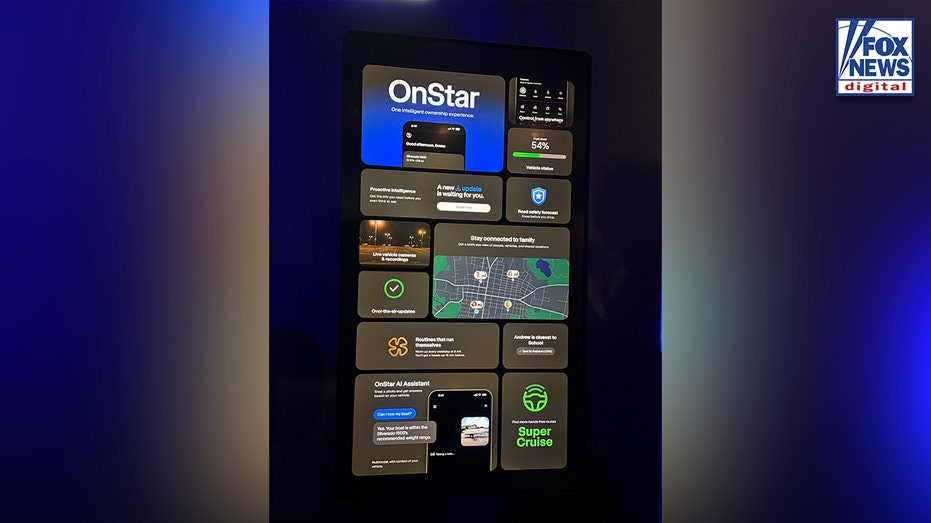
General Motors showcases its OnStar AI Assistant and connected vehicle features at its “GM Forward” event in New York City.(FOX Business )
These extensive investments in software, AI, and connectivity are not merely technological upgrades; they represent a fundamental reshaping of GM’s business model to capture significant digital revenue. UBS recently highlighted this potential, estimating GM’s digital revenue could soar from an estimated $3.2 billion this year to a robust $9.6 billion by 2036. The investment bank lauded GM’s digital capabilities as an “underappreciated and undervalued opportunity,” suggesting that the market has yet to fully price in the transformative potential of these recurring, high-margin revenue streams. This shift positions GM to challenge the traditional automotive valuation paradigm, which has historically lagged behind the multiples commanded by tech companies, and aims to close the gap with the likes of Tesla, which derives a significant portion of its perceived value from its software and autonomy potential.
GET FOX BUSINESS ON THE GO BY CLICKING HERE
Reuters contributed to this report.
Market Impact:
GM’s aggressive push into autonomous driving and AI-driven software services signals a clear intent to transition from a traditional hardware manufacturer to a diversified technology and mobility services provider. This strategic pivot, if executed successfully, could significantly re-rate GM’s stock, attracting investors who value recurring software revenue and higher margins over cyclical vehicle sales. The expansion of “eyes-off” technology to core vehicle segments and the projected tripling of digital revenue by 2036 directly address investor demands for sustainable growth and a more resilient business model. However, the path is fraught with challenges, including intense competition from tech giants and other OEMs, stringent regulatory hurdles, immense capital expenditure, and the critical need to build and maintain consumer trust in nascent autonomous and AI technologies. Failure to deliver on these ambitious technological and financial targets could lead to investor skepticism and pressure on valuation, while successful implementation could establish GM as a leader in the evolving software-defined vehicle landscape, potentially inspiring similar strategic shifts across the broader automotive industry.