
On Sunday, a tragic incident occurred at Miami International Airport involving an Amazon cargo jet, a Boeing 767-300, which overran the runway’s designated terminus. The accident resulted in the deaths of five individuals and injuries to five others, all of whom were in ground vehicles impacted by the aircraft. This event has brought renewed scrutiny to runway safety measures, particularly the installation of Engineered Materials Arresting Systems (EMAS), which were not present at the end of the runway involved in the Miami incident.
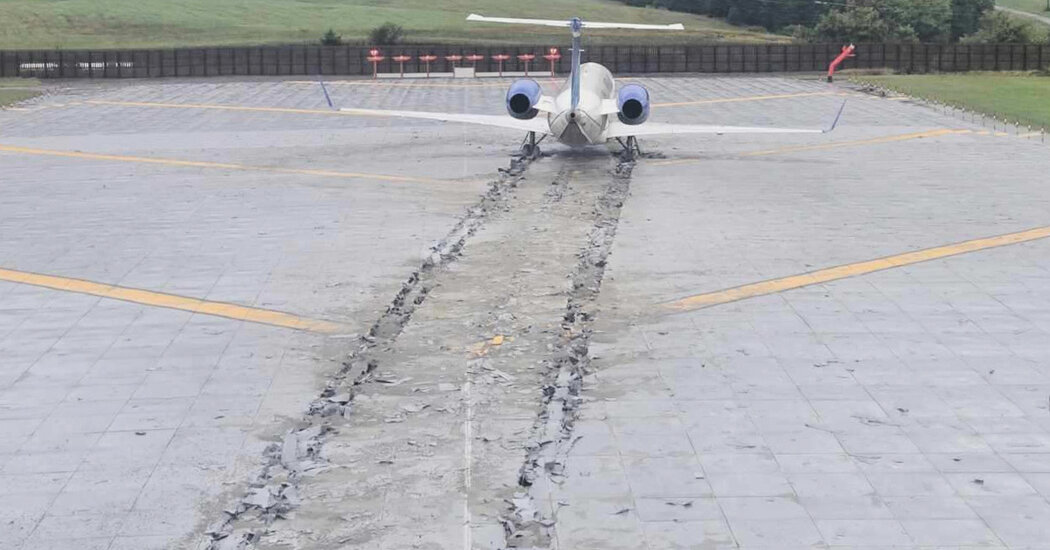
EMAS, also known as crushable concrete buffer areas, have been increasingly adopted at United States airports over the past three decades. These systems are strategically placed at the end of runways to decelerate and halt aircraft that overshoot their landings, preventing them from colliding with obstacles beyond the runway environment.
According to data from the Federal Aviation Administration (FAA), EMAS technology has been installed at a minimum of 70 U.S. airports since the 1990s. The agency credits these systems with successfully arresting 26 aircraft overruns, thereby safeguarding a total of 497 passengers. The FAA has long advocated for the installation of these buffers, stating in a 2005 advisory circular that the system had “demonstrated its effectiveness in arresting aircraft overruns.” A more recent statement from the agency last year affirmed that “EMAS has performed successfully every time, resulting in no loss of life and minimal damage.”
Despite these recommendations and its acknowledged success, the FAA has not mandated the universal installation of EMAS technology across all U.S. airports. The agency’s current regulatory framework determines that traditional paved runway safety areas (RSAs) — extensions at least 1,000 feet long and 500 feet wide at each end of runways — provide sufficient space to mitigate overrun risks. In a statement following the Miami accident, the FAA confirmed that Miami International Airport met these required length and width specifications for its runway safety areas.
The recent accident in Miami, however, has prompted aviation safety experts and regulators to question whether the existing 1,000-foot RSA standard remains adequate for all circumstances. Jennifer Homendy, chair of the National Transportation Safety Board (NTSB), indicated that a review of this standard would be a crucial component of their investigation. “Should EMAS be everywhere at every airport? That will be a key part of our investigation,” Homendy told reporters on Monday.
Michael O’Donnell, an aviation consultant and former FAA official who oversaw air traffic and airport safety, also weighed in on the discussion. O’Donnell, who signed the FAA’s most recent update to its buffer technology recommendations in 2012, noted, “I don’t know that I’ve seen any airport that has a 1,000-foot runway safety area and an EMAS bed.” He added, “Now this drives the immediate question: Was 1,000 feet enough in an accident like this?”
The core principle behind EMAS involves a bed of lightweight, crushable concrete that progressively collapses under the weight of an aircraft’s landing gear. This controlled collapse dissipates the aircraft’s kinetic energy, effectively slowing it to a stop. A key advantage of EMAS is its compact footprint; it requires less space than traditional paved RSAs, typically needing a minimum width equivalent to the runway and a length of crushable material extending 600 feet from the runway’s end. The FAA has compared the system’s function to the emergency off-ramps found on steep highways, designed to stop runaway trucks.
The installation of EMAS technology can be a significant financial undertaking, costing several million dollars per runway. To assist airports, federal funding initiatives, such as the Airport Improvement Program (funded by taxes on airline tickets and fuel), are available to help eligible airports defray these substantial expenses. Historically, airports facing geographical constraints that prevent the construction of extended 1,000-foot paved safety areas have been prioritized for EMAS installation.
Examples of such installations include Kennedy International Airport in New York, which became the first U.S. airport to implement the system in 1996, and LaGuardia Airport, which completed its EMAS installation in 2015 with the aid of a federal grant. The system recently demonstrated its effectiveness earlier this year at Teterboro Airport in New Jersey, successfully stopping a Learjet 60 that overran the runway, preventing a potentially more severe outcome.
Conversely, larger, more expansive airports like Miami International, which possess ample unencumbered land beyond their runways, have traditionally not considered EMAS an essential safety enhancement. Gregory Chin, a spokesman for the Miami-Dade Aviation Department, articulated this position, stating, “No U.S. airport has EMAS at a runway end that also maintains the full, unobstructed 1,000-foot safety area. EMAS is intended as an alternative, not as an additional layer on top of one.” Chin also affirmed that Miami International undergoes annual comprehensive FAA safety inspections and consistently adheres to federal airfield safety requirements. Michael McCormick, a professor at Embry-Riddle Aeronautical University and former head of the FAA’s air traffic operation, supported this perspective, noting that “the priority for the deployment of EMAS is going to be to those airports where the risks are greatest, and Miami would not be one of them.” He clarified, however, that airports like Miami International could still apply for federal grants or absorb the cost themselves for an EMAS installation.
Expert opinions vary on whether EMAS would have significantly altered the outcome of Sunday’s accident at Miami International. Scott Dunham, a former air safety investigator for the NTSB, expressed skepticism, suggesting that “EMAS might not even have worked” given the circumstances. He elaborated that the catastrophic nature of the cargo jet landing was “way beyond anything you’d expect to be from a minor problem.” EMAS systems are engineered to absorb momentum from most aircraft entering the buffer zone at speeds up to approximately 80.55 miles per hour (130 kilometers per hour). However, according to flight tracking data from Flightradar24, the Boeing 767-300 involved in the Miami accident was traveling at nearly 128.9 miles per hour (207.5 kilometers per hour) when it departed the paved runway area—a speed considerably exceeding the designed operational limit of EMAS technology.
The cargo plane ultimately traveled approximately 1,300 feet beyond the paved runway, colliding with a van belonging to an airport cleaning company, breaching the airport perimeter fence, and striking a Toyota Corolla on a nearby public street. The NTSB confirmed that all fatalities in the incident were occupants of these ground vehicles.
Despite the high speed of the aircraft, some experts maintain that EMAS could still have provided a crucial safety benefit. McCormick argued that “at a minimum, even if you have a large Boeing 767 barrel down a runway at 100 knots plus, it’s going to at least slow it down. So it’s going to minimize the risk of collision.” This perspective suggests that even if EMAS couldn’t completely halt the aircraft, a reduction in speed could have lessened the severity of the subsequent impacts and potentially mitigated the loss of life.
Why This Matters
The tragic accident at Miami International Airport underscores the critical importance of continuous evaluation and adaptation of aviation safety standards. This incident brings to the forefront the ongoing debate within the aviation industry regarding the adequacy of current runway safety area requirements and the role of advanced technologies like Engineered Materials Arresting Systems (EMAS).
For the traveling public, this discussion directly relates to their safety and confidence in air travel. The effectiveness of safety measures, whether traditional paved runway safety areas or cutting-edge EMAS, directly impacts the potential for catastrophic outcomes in the event of an aircraft overrun. Regulators, airport authorities, and airlines constantly balance safety imperatives with operational realities, including significant costs and geographical constraints.
The NTSB’s investigation into the Miami accident will be crucial in determining if current FAA standards, which prioritize traditional 1,000-foot paved safety areas, are sufficient for all airports and aircraft types, or if a more widespread adoption of EMAS should be mandated, particularly as aircraft technology evolves and air traffic increases. The outcome of this investigation could influence future FAA policy, lead to changes in airport design and infrastructure planning, and potentially alter the allocation of federal funding for airport safety enhancements. Ultimately, the lessons learned from this incident will shape the future of runway safety and contribute to the ongoing effort to make air travel as secure as possible.