
A significant escalation in the ongoing conflict between the United States and Iran occurred on September 8, following a series of retaliatory actions from both sides. U.S. Central Command (CENTCOM) announced that American forces conducted strikes that destroyed five Iranian oil tankers. In response, Iran launched ballistic missiles targeting a major U.S. military installation in Jordan.
U.S. officials stated that CENTCOM’s actions were taken in direct response to two separate incidents in the preceding 48 hours, during which Iran had reportedly fired ballistic missiles at a U.S. Navy warship. The U.S. military did not identify the specific vessel involved, but confirmed that the ship was not hit and no service members sustained injuries in those incidents. Despite the absence of direct hits or casualties, the United States proceeded with a substantial response targeting Iranian shipping assets.
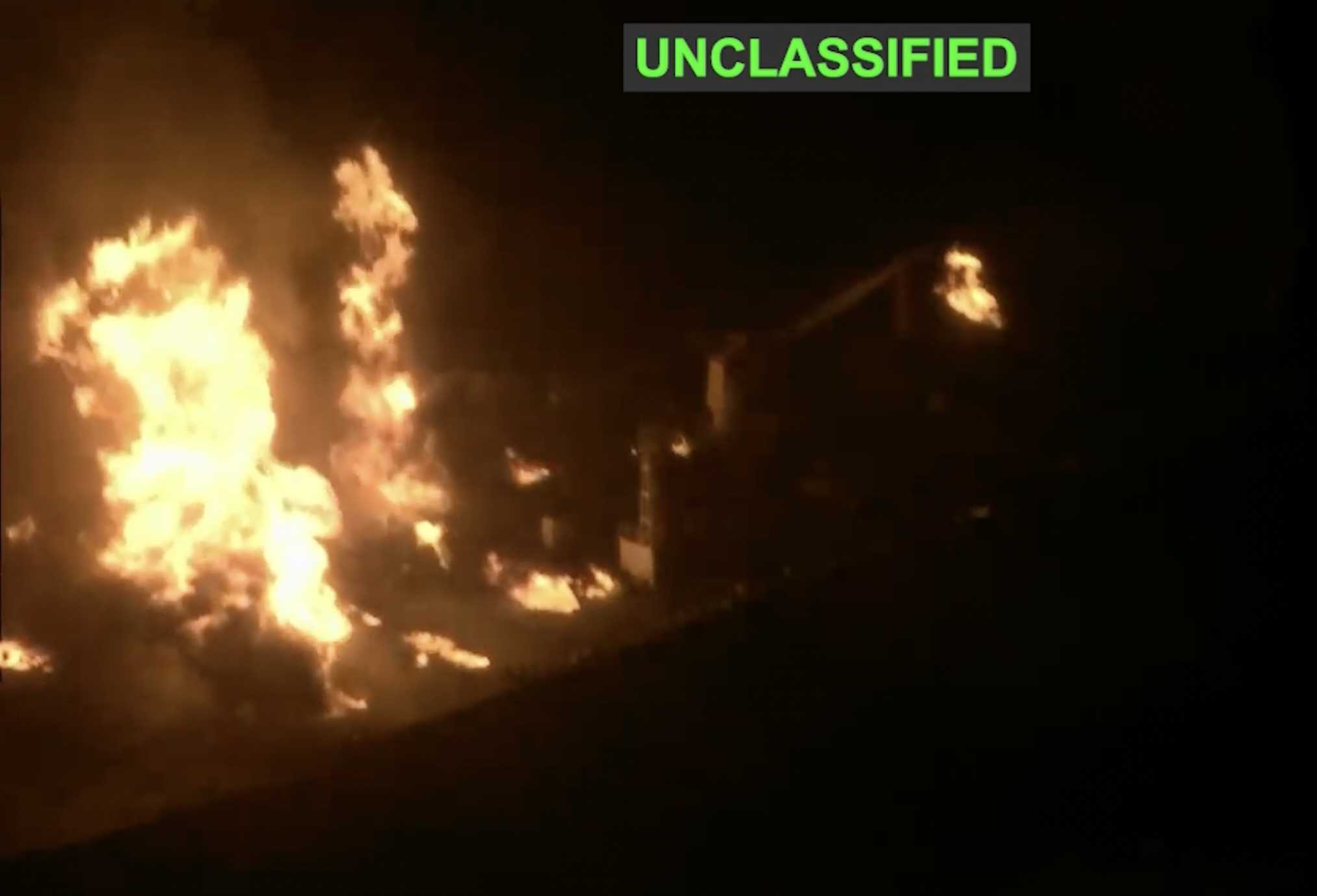
CENTCOM detailed the successful destruction of several vessels controlled by Iran’s Islamic Revolutionary Guard Corps (IRGC). “CENTCOM destroyed the IRGC crude oil carriers M/T Kaviz, M/T Charminar, M/T Horizon 1, and M/T Riesco in the Gulf of Oman as well as M/T Derya near Kharg Island,” the command stated in an official release. A video released by CENTCOM provided visual confirmation of the attacks, depicting multiple ships engulfed in flames.
The strikes on the Iranian vessels were executed by a combined force of U.S. Air Force and Navy fighter aircraft and unmanned aerial vehicles. Prior to the engagement, the U.S. military indicated that the crews of the targeted tankers were instructed to abandon their ships before the vessels were “rendered inoperable.”
CENTCOM further asserted that the targeted tankers were integral to a broader financial network. “Iran has used the tankers as part of a multibillion-dollar shadow network that funds the IRGC and its regional proxies,” the command added, emphasizing the strategic nature of the strikes. Accompanying this action was a stern warning issued to Tehran: “Iran has no means by which to defend these vessels.”
The recent exchanges represent an intensification of the “tit-for-tat” strikes that have characterized the conflict between the U.S. and Iran in recent days. These escalating actions have heightened concerns about a potential return to the full-scale hostilities observed during the initial weeks of the conflict, which is now in its seventh month.
The Trump administration has pursued a policy of targeting Iranian tankers, aiming to deter Iran from launching missiles against U.S. aircraft carriers and other naval assets operating in the region. On September 5, Admiral Brad Cooper, who leads U.S. Central Command, publicly warned that the U.S. would “impose an even higher economic cost” on Iran by striking its “limited and exposed oil fleet” if Tehran did not cease its attacks on U.S. forces. Iran did not appear to heed this warning, leading to the subsequent U.S. strikes.
In direct response to the latest U.S. attack on its tankers, the Iranian military vowed to conduct new strikes. Iranian officials specifically warned that they would target long-standing American allies in the region, including Jordan, Kuwait, and Bahrain. They also threatened to target commercial oil tankers operating near ports in these countries, justifying such attacks by claiming these ports were utilized by the United States for military operations.
Jordan bore the brunt of Iran’s retaliation, as dozens of ballistic missiles were reportedly fired at the country. Iran identified its primary target as Muwaffaq Salti Air Base (MSAB), a critical hub for U.S. airpower in the region. Videos circulating from Jordan depicted numerous ballistic missiles and interceptors illuminating the night sky. While the IRGC claimed, without providing substantiating evidence, that it had damaged American fighter aircraft at MSAB, initial accounts from U.S. officials indicated that no American personnel were killed during the intense barrage aimed at the base.
The Trump administration’s broader strategy has centered on the belief that increased economic sanctions and an ongoing naval blockade would compel Iran to cease its interference with shipping traffic in the Strait of Hormuz and make other significant concessions. However, Tehran has consistently demonstrated an unwillingness to yield to these pressures.
In light of the ongoing hostilities, the U.S. is reinforcing its military presence in the Middle East with fresh deployments of warplanes. F-35 Lightning II stealth fighters from the 115th Fighter Wing of the Wisconsin Air National Guard are currently deploying to the region and are expected to arrive in the coming days, according to individuals familiar with the matter. These F-35s will replace another unit, the 158th Fighter Wing of the Vermont Air National Guard, whose “Green Mountain Boys” recently concluded an approximately nine-month deployment that spanned operations in South America—where they supported the capture of Venezuelan president Nicolás Maduro—before being redeployed to the Middle East to engage in fighting against Iran. Airmen from the Vermont unit returned home on September 6 and were greeted by Chief of the National Guard Bureau, Air Force Gen. Steven Nordhaus.
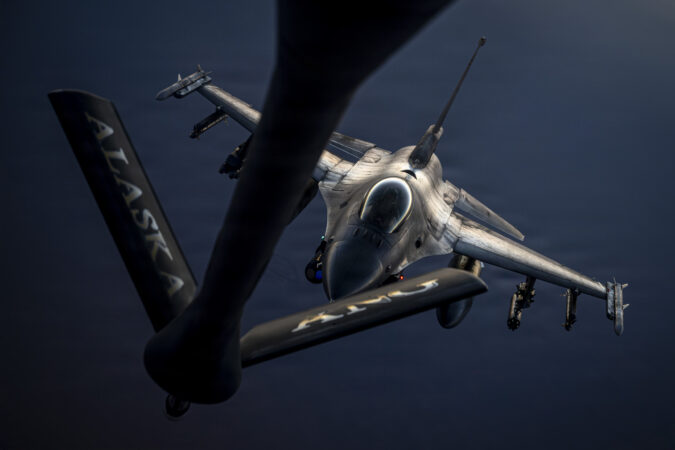
The arrival of F-35s is not the sole reinforcement to America’s air posture in the Middle East. F-16s from the Ohio Air National Guard’s 180th Fighter Wing also deployed to the region late last week. They are taking the place of F-16s from the 555th Fighter Squadron, part of the 31st Fighter Wing, which has now returned to Aviano Air Base, Italy. Nicknamed the “Triple Nickel,” the 555th Fighter Squadron had been deployed to the Middle East since last November, marking a longer deployment duration compared to the U.S. Air Force’s typical six-month rotations.
The U.S. Air Force maintains a substantial presence in the Middle East, including dozens of F-16, F-35, and F-15E Strike Eagle fighters, alongside A-10 Thunderbolt II attack planes, various support aircraft, and numerous refueling tankers. Further rotations of air assets are anticipated in the coming weeks.
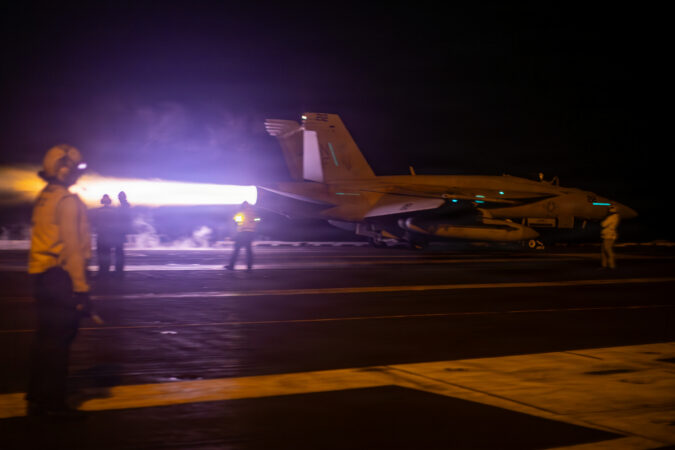
Complementing the Air Force’s deployments, the U.S. Navy also has two aircraft carriers, the USS George H.W. Bush and USS George Washington, along with their embarked carrier air wings and approximately 20 surface vessels, supporting operations in the Middle East. Similar to the Air Force, the Navy has engaged in extended deployments to the Middle East for operations against Iran. The USS Abraham Lincoln is currently en route home after a nine-month deployment. Prior to that, the USS Gerald R. Ford completed an 11-month deployment, which, like the Vermont Air Force unit, included supporting operations against both Venezuela and Iran.
Amidst the exchange of military actions between the U.S. and Iran, the U.S. Treasury Department announced new sanctions targeting companies accused of supporting Mahan Air, an airline that U.S. officials assert has direct ties to Iran’s Islamic Revolutionary Guard Corps. Further contributing to regional tensions, on September 8, the Iran-backed Houthi movement reportedly launched missiles and drones at energy facilities located in southern Saudi Arabia, marking another point of conflict in the volatile Middle East.
Why This Matters
The recent escalation between the United States and Iran carries significant implications for regional stability, global energy markets, and international relations. The direct targeting of military assets and economic infrastructure by both nations marks a dangerous intensification of a conflict that has already been ongoing for seven months.
Firstly, **Risk of Wider Conflict**: The “tit-for-tat” nature of these strikes increases the probability of miscalculation or unintended escalation. While both sides may seek to de-escalate after a show of force, the possibility of a critical error that leads to direct military confrontation between the U.S. and Iran, potentially drawing in regional allies, remains high. Iran’s threats against U.S. allies like Jordan, Kuwait, and Bahrain underscore the interconnectedness of regional security and the potential for a broader conflict.
Secondly, **Impact on Global Energy Markets**: The Strait of Hormuz, through which a significant portion of the world’s seaborne oil passes, is a critical chokepoint. Attacks on oil tankers and threats to commercial shipping, particularly near key ports in the Gulf, create immense uncertainty and could lead to substantial disruptions in global oil supplies. This directly impacts international oil prices, potentially causing economic instability worldwide and increasing costs for consumers and businesses.
Thirdly, **Regional Stability and Proxy Conflicts**: Iran’s use of proxy forces and its alleged funding networks, highlighted by CENTCOM’s targeting of IRGC-linked tankers, fuels ongoing conflicts across the Middle East. The simultaneous Houthi attacks on Saudi Arabia demonstrate the complex web of proxy warfare that can flare up in response to U.S.-Iran tensions. These proxy conflicts destabilize Yemen, Iraq, Syria, and Lebanon, leading to humanitarian crises and hindering peace efforts.
Fourthly, **Effectiveness of Deterrence and Sanctions**: The Trump administration’s strategy relies heavily on economic sanctions and military deterrence. Iran’s continued missile attacks on U.S. vessels and its direct retaliation for U.S. strikes suggest that current deterrence measures may not be achieving their desired effect of compelling Tehran to de-escalate or make concessions. The sustained Iranian resistance raises questions about the long-term viability and impact of this strategy.
Finally, **Military Burden and Readiness**: The ongoing, extended deployments of U.S. Air Force and Navy assets, including aircraft carriers and fighter squadrons, indicate a significant and sustained commitment of resources to the Middle East. These extended rotations, often exceeding typical deployment lengths, place considerable strain on military personnel, equipment, and readiness, potentially impacting other global U.S. strategic interests. The need for continuous reinforcement underscores the persistent nature of the threat.
In essence, these events are not isolated incidents but symptoms of a deeply entrenched and highly volatile geopolitical rivalry. The current trajectory points towards further uncertainty, with profound implications for peace, economic stability, and the balance of power in one of the world’s most critical regions.