
When you purchase through links in our articles, we may earn a small commission. This doesn’t affect our editorial independence.
Is the AI Gold Rush Slowing Down? New Data Suggests a Blip in Adoption
Key Takeaways
- Adoption Plateau:Business adoption of AI tools saw a minimal 0.4% increase in August, reaching 56% among Ramp customers, signaling a potential slowdown after rapid initial growth.
- Cost Compression:Intense competition and declining token prices (down to $0.68/million tokens from a peak of $1.15) are reducing AI spend per employee, particularly among top-tier firms, challenging model builders to maintain revenue growth.
- Shifting Focus:The data suggests a market benefiting AI users through accessibility and lower costs, while frontier labs are prompted to widen their user base beyond engineers and find new avenues for monetization amidst slowing high-end spend.
After a year of unprecedented hype, investment, and rapid integration, new data from payment processing company Ramp suggests a potential moderation in the furious pace of AI adoption among businesses. In August, the increase in companies paying for AI products was a mere 0.4%, nudging the overall adoption rate among Ramp’s clientele to 56%. While seemingly a minor deceleration, this blip in the growth curve arrives at a critical juncture for an industry built on colossal investments and sky-high expectations. The question now looms: Is this a temporary seasonal pause, or does it signal a more fundamental shift in the enterprise AI landscape?
Unpacking the Numbers: A Glimpse Behind the Hype
The 0.4% month-over-month increase in August might appear negligible, but it marks a significant departure from the steep growth trajectories witnessed earlier in the AI boom. Ramp’s “AI index,” a proprietary metric tracking spending across its 70,000 corporate customers, has proven to be a valuable, albeit niche, barometer for enterprise AI trends. Last year, the index experienced a similar lull between August and October before picking up steam again towards the year’s end. This historical context offers some reassurance, suggesting that such slowdowns are not unprecedented. However, the sheer scale of current investment in AI infrastructure, ranging from frontier lab R&D to hyperscaler chip orders worth hundreds of billions, means that even minor hiccups in adoption rates trigger immediate scrutiny. The hope for these massive outlays rests on a corresponding surge in enterprise revenue, making any hint of slowing adoption a cause for concern.
It’s crucial to acknowledge Ramp’s unique position. With a significant portion of its customer base leaning towards tech-forward businesses, its adoption figures — 56% in August — likely paint a more optimistic picture than the broader market. For instance, a recent U.S. Census Bureau survey updated in August indicated that only 22% of businesses across all sectors report using AI. While Ramp’s data may not be a perfect market proxy, its direct spending metrics provide one of the few real-time, granular insights into corporate AI expenditures, positioning it as a potentially leading indicator for future trends, especially within the innovation-driven segments of the economy.
The August Doldrums and Deeper Currents
August, often synonymous with summer vacations and reduced business activity, could partially explain the observed slowdown. Many industries experience a dip in activity during this period, and AI spending might not be immune to the “vacation effect.” Yet, Ramp economist Ara Kharazian points to more profound warning signs that extend beyond seasonal fluctuations, particularly for companies whose business models rely heavily on “token spend” – the computational units consumed when interacting with AI models.
The Price Compression Challenge
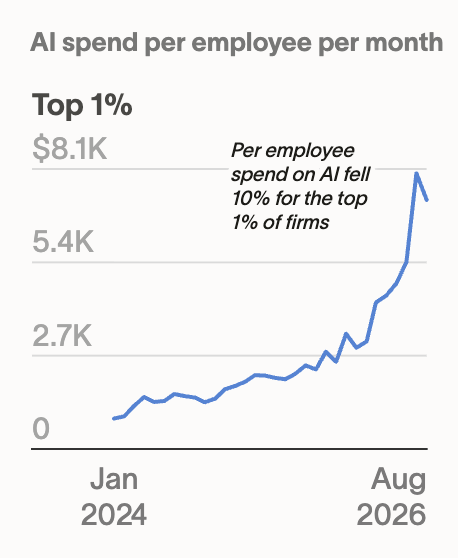
One of the most striking observations is a nearly 10% decline in AI spend per employee among the top 1% of firms in Ramp’s sample, falling to $7,205. While this could be influenced by the aforementioned vacation factor, it also strongly correlates with a significant drop in average token costs. Driven by intense competition between AI giants like OpenAI and Anthropic, the price per million tokens has plummeted to an average of $0.68 in August, a stark contrast to the peak of $1.15 observed in March. This aggressive price compression, while a boon for businesses consuming AI, presents a formidable challenge for the labs themselves, who are under pressure to recoup their colossal development and training expenditures.
The data suggests that these frontier labs have not yet managed to offset the reduced token prices with a corresponding increase in usage volume. Furthermore, the allure of cost savings is prompting many customers to opt for older, less powerful but significantly cheaper models, such as OpenAI’s ChatGPT 5.6-Terra and Anthropic’s Sonnet, over their latest, more advanced releases. For labs that invest billions in training cutting-edge models, much of the cost recovery is typically front-loaded into the initial weeks following a new model’s launch. Slower adoption of these premium models, exacerbated by the availability of more economical alternatives, directly threatens this critical revenue recoupment dynamic, potentially impacting future R&D cycles and market valuations.
Open-Weight Models and the Pursuit of Broader Adoption
Amidst ongoing discussions about the potential for open-weight models to disrupt the AI landscape, Ramp’s data indicates that their impact on broad business adoption remains relatively niche. In August, only 6.4% of AI-spending businesses utilized model-serving or inference platforms — the infrastructure often associated with deploying open-source or custom models. While this share is steadily growing, it’s not yet at a scale to fundamentally alter the market dynamics dominated by proprietary frontier models, suggesting that while the open-source movement gains traction, proprietary solutions still hold sway in the immediate enterprise adoption cycle.
As Kharazian concisely puts it, “We are showing that competition between OpenAI and Anthropic is making AI more accessible, and also driving the price down for companies—and not just driving the price down, but driving spend down at the top 1% of companies that previously the market was expecting to drive much of the growth going forward.” This insightful observation highlights a critical pivot point: the market’s previous assumption that a small cohort of high-spending, technically advanced firms would fuel the majority of AI growth is being re-evaluated, prompting a strategic rethink among AI providers.
This dynamic also sheds light on the strategic shift observed at many AI labs: a heightened focus on winning over non-technical users with intuitive AI co-working tools. If the deep-pocketed, technically proficient early adopters are spending less per employee, the path to sustained revenue growth lies in broadening the user base significantly, making AI indispensable to everyday workflows across all departments, not just engineering. This shift underscores a move towards democratizing AI, making it a ubiquitous utility rather than a specialized tool for a select few.
A Blip or a Bellwether? Varied Fortunes Ahead
This “blip,” as Kharazian cautiously labels it, carries vastly different implications depending on one’s position in the AI ecosystem. For model builders, particularly frontier labs, and hyperscalers with hundreds of billions of dollars tied up in chip orders, it could be a disconcerting sign. It signals a potential slowing of the hyper-growth narrative that justifies their immense investments and ambitious valuations. The pressure to demonstrate scalable, profitable pathways for AI technology becomes even more acute when early adoption metrics soften and per-employee spend declines, forcing a re-evaluation of long-term revenue projections and business models.
However, for the vast majority of companies leveraging AI, this trend is overwhelmingly positive. “If your company is using AI, it’s great,” notes Kharazian. Increased competition translates directly into more accessible, more affordable, and often more refined AI tools. Lower costs reduce barriers to entry, enable experimentation, and allow businesses to integrate AI more deeply into their operations without prohibitive expenses. This democratization of AI, driven by competitive pricing, could ultimately accelerate broader adoption in the long run, even if the immediate growth rate for model providers appears to cool. The benefits ripple outwards, fostering innovation and efficiency across diverse industries as AI becomes a more attainable resource for businesses of all sizes.
Bottom Line
The recent slowdown in AI adoption and the concurrent dip in enterprise spend per employee, while potentially a seasonal anomaly, underscore a maturing market dynamic. The initial gold rush, characterized by explosive growth and premium pricing, is giving way to a more competitive, cost-conscious environment. While this presents formidable challenges for the AI giants tasked with generating returns on monumental investments, it simultaneously heralds a new era of accessibility and affordability for businesses eager to harness AI’s transformative power. The future of AI adoption will likely be less about exponential month-over-month growth from a niche group of high spenders, and more about widespread, sustainable integration driven by value and cost-effectiveness across the entire enterprise landscape, fundamentally reshaping how businesses approach their AI strategies.
Source:{feed_title}