
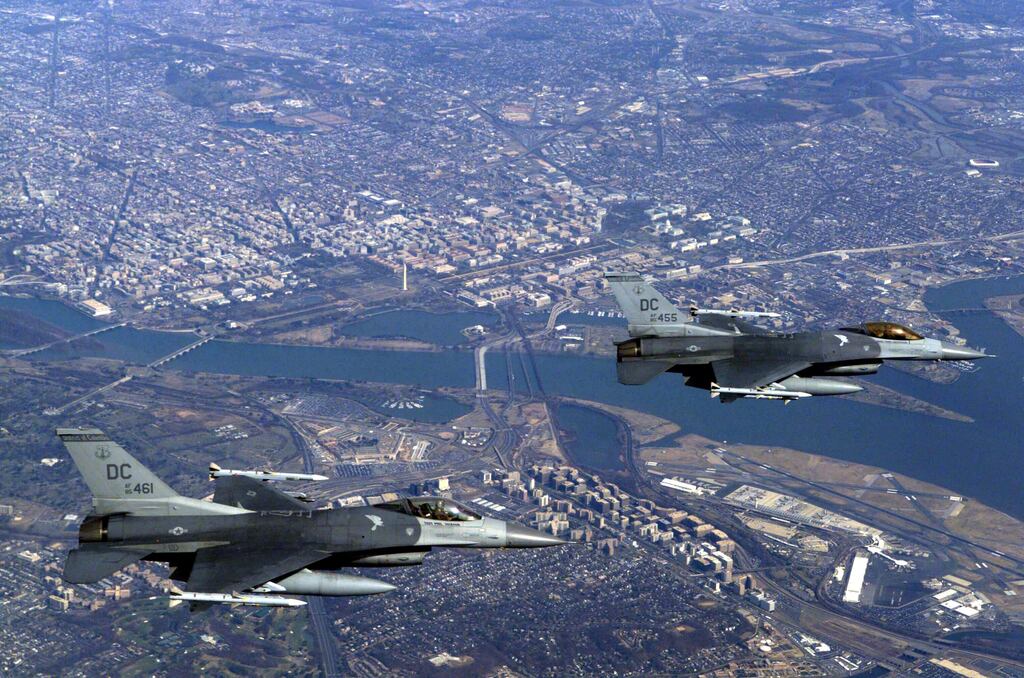
Three F-16 fighter jets that played a critical role in the defense of Washington, D.C., on September 11, 2001, are set to be retired from active service and preserved as museum artifacts. This decision, confirmed on the 25th anniversary of the 9/11 attacks, ensures the historical legacy of these aircraft will be maintained for future generations.
The three F-16s were part of the D.C. Air National Guard’s 121st Fighter Squadron, based at Andrews Air Force Base (now Joint Base Andrews). Two of these aircraft were among the first three jets scrambled in an unprecedented intercept mission over the nation’s capital, while the third later escorted Air Force One as it returned to Washington on that day.
On September 11, 2001, a series of coordinated terrorist attacks involving four hijacked commercial airliners targeted the United States. Two planes struck the World Trade Center towers in New York City, and a third crashed into the Pentagon near Washington, D.C. The fourth hijacked plane, United Airlines Flight 93, crashed in a field in Shanksville, Pennsylvania, after passengers and crew members confronted the hijackers, preventing it from reaching its intended target.
The National Guard Bureau officially announced the preservation plans, detailing the specific aircraft and their designated homes:
- Tail number 85-1438:This F-16, flown by then-Major Dan Caine (now General Caine, Chairman of the Joint Chiefs of Staff), was the third jet to scramble on 9/11. It will be transferred to the National Museum of the U.S. Air Force in Dayton, Ohio. This particular aircraft had remained in regular flying status with the Air National Guard’s 162nd Wing in Tucson, Arizona, until its impending retirement.
- Tail number 85-1461:Flown by then-Major Marc Sasseville (now retired Lt. Gen. Marc Sasseville), this jet served as the escort for Air Force One later in the day on 9/11. It will become a static display at Joint Base Andrews, where the D.C. Air National Guard is based.
- Tail number 86-0255:This F-16 was flown by then-Lieutenant Heather Penney (now director of research at AFA’s Mitchell Institute of Aerospace Studies). Penney’s aircraft was the second to scramble, flying in formation with Sasseville’s initial scrambled jet. It will be sent to the American Heritage Museum in Hudson, Massachusetts.
Preservation Efforts for Historic Aircraft
The initiative to preserve these F-16s began more than a year ago when members of the D.C. Air National Guard’s 121st Fighter Squadron undertook research to track the specific aircraft involved on September 11. This process involved locating historical flight records to identify tail numbers and subsequently determining the current status and location of those jets. Working in conjunction with the National Guard Association of the United States (NGAUS), a non-profit organization advocating for the National Guard, they approached the Air Force, Air National Guard, the White House, and other relevant entities. Their objective was to secure the preservation of these historically significant aircraft under the National Museum of the United States Air Force Heritage Program.
A significant challenge in the preservation effort arose from the operational status of some of the 9/11 F-16s. Investigations revealed that three other F-16s flown on that day had been converted into QF-16 Full-Scale Aerial Target (FSAT) drones. These drones are utilized for live-fire missile testing and other destructive ordnance tests, including programs like the AIM-260 Joint Advanced Tactical Missile, which aims to enhance air-to-air combat capabilities. One of these QF-16s, which was the jet then-Major Sasseville initially scrambled in, had already been destroyed in a missile test at the end of its operational life as a drone. The remaining two were slated for similar destruction.
Jon “Ice” Eisberg, Vice President at NGAUS, highlighted the collaborative nature of the effort to save the remaining QF-16s. “This was a team effort,” Eisberg stated, describing outreach to contacts within the National Security Council, the Office of Public Liaison in the White House, the Pentagon, and Capitol Hill to raise awareness of the issue. The conversion of F-16s into QF-16 drones is a costly process, estimated at approximately $5 million per aircraft, and these drones represent a finite resource for the Air Force’s testing programs. The last of 127 conversions by contractor Boeing was delivered in April 2025, according to Air & Space Forces Magazine’s 2026 USAF & USSF Almanac.
Despite the operational requirements for QF-16s, the Air Force ultimately recognized the historical imperative of preserving the 9/11 aircraft. A solution was devised to allow the QF-16s destined for preservation to complete their programmed flying hours. Once their operational flying time is fully expended, these aircraft will be transferred to museums for static display, rather than being used in destructive tests.
The September 11 Intercept Mission
The events of September 11, 2001, placed the D.C. Air National Guard in an unprecedented role. In a video produced by the National Guard Bureau for the 25th anniversary, General Caine recounted his experience. Caine, then a major and the wing’s weapons officer, stated, “I was running our flying program” that day. Upon witnessing the second plane strike the World Trade Center on television, he recalled, “it was clear that the United States was at war.”
Caine immediately initiated a request for live weapons to be readied on the flightline, a process that requires significant time. Shortly thereafter, the White House issued an urgent directive for aircraft to get airborne. Caine, alongside then-Major Sasseville, the wing’s operations director, and two junior pilots, Lieutenants Penney and Brandon “Igor” Rasmussen, rapidly formulated what Caine described as “a hasty, quickly constructed gameplan.”
As they awaited official launch authority, weapons preparation was still underway. Sasseville, who would later serve as Vice Chief of the National Guard Bureau, informed Penney that if they intercepted the hijacked airliner before weapons could be loaded, their mission would involve ramming the aircraft. Sasseville emphasized the immediate and comprehensive support from their unit: “We had an entire wing of support behind us, getting things moving that day, reacting to that terrible attack. The White House communicated with us because we were one of the few units in a position to actually do something. … We took off as soon as we could.”
Penney, a young lieutenant and the daughter of an experienced fighter pilot, reflected on her selection for the mission. “I like to think it was because I was a good pilot,” she said in a recent conversation, “But I think it was because I was single. It was just me and a dog.” Sasseville noted the adrenaline-driven environment, stating, “No one asked any questions.”
Upon reaching the flightline, the pilots bypassed routine pre-flight checks, directly climbing into their F-16s, relying on their maintenance crews to have prepared the aircraft. Penney had no prior experience scrambling an aircraft or training for such an emergency intercept. They launched without clear rules of engagement, which were subsequently established once airborne. Their initial objective was to locate and intercept what was then believed to be Flight 93, heading towards Washington, D.C.
Unbeknownst to the scrambling pilots at the time, Flight 93 had already crashed in Shanksville, Pennsylvania, following the passengers’ resistance against the hijackers. Penney recalled their flight path up the Potomac River, northwest of Andrews Air Force Base, stating, “We understood what the threat was. We were looking for a rogue airliner, flying low. We knew they had turned off their transponders.”
With no live missiles or ammunition – the F-16s were only loaded with training rounds for their guns – the pilots’ only means of preventing the hijacked airliner from reaching its target was through a physical ramming maneuver. Sasseville instructed Penney on their plan: he would target the cockpit to neutralize the terrorists, while Penney would aim for the tail to maximize the chances of bringing the aircraft down.
As the Federal Aviation Administration (FAA) issued an unprecedented order for all aircraft in U.S. airspace to land, information gradually clarified that Flight 93 had indeed crashed. Upon returning to Andrews Air Force Base, Penney observed a base that had mobilized immediately. She noted the full parking lots and lines of cars, with Guardsmen arriving at their units without formal orders, driven by a clear sense of national duty. “Guardsman came to their units without needing orders, without waiting for paperwork,” she said. She highlighted how they prepared aircraft, established temporary operational facilities, and provided sustenance. The D.C. Air National Guard subsequently conducted air combat patrols over Washington for the next 90 consecutive days. Penney concluded, “They just told their employers, ‘You know, boss, my nation’s calling,’ and they went.”
The preservation of these F-16s ensures they will stand as enduring symbols of that day, commemorating the swift response and profound sense of duty displayed by these Airmen when the United States faced an unprecedented attack.
Why This Matters
The decision to preserve these F-16 fighter jets holds significant importance for several reasons:
- Historical Preservation:These aircraft are tangible artifacts of a pivotal moment in American history. They represent the immediate, reactive phase of national defense on September 11, 2001, a day that profoundly reshaped U.S. domestic and foreign policy. Their preservation ensures that future generations can directly connect with this history, moving beyond textbooks and digital records to confront the physical remnants of the event.
- Symbol of Sacrifice and Duty:The F-16s symbolize the extraordinary sense of duty and potential sacrifice of the pilots and ground crews involved. The pilots’ readiness to undertake a mission of self-sacrifice—ramming a hijacked airliner without live weapons—underscores the commitment of military personnel in times of crisis. These aircraft serve as a testament to the selfless actions taken to protect the nation’s capital.
- Educational Value:Placed in prominent museums, these F-16s will serve as powerful educational tools. They can help inform the public, particularly younger generations, about the events of 9/11, the nature of national defense, and the rapid, often improvised, responses required during unforeseen threats. They provide a focal point for understanding the military’s role in homeland security.
- Commemoration of a National Trauma:The attacks of September 11, 2001, were a national trauma. Preserving these aircraft is part of a broader effort to remember and commemorate the victims, the responders, and the profound impact of the attacks. It maintains a collective memory, ensuring that the lessons and experiences of that day are not forgotten.
- Recognition of the National Guard’s Role:The story of these F-16s specifically highlights the critical role of the Air National Guard. Often seen as a reserve force, the D.C. Air National Guard was the first line of aerial defense on 9/11, demonstrating the readiness and integral function of Guard units in national emergencies.
By saving these F-16s, the United States not only preserves military hardware but also the narratives of courage, rapid response, and unwavering commitment that defined one of the most challenging days in modern American history.