
JOINT BASE SAN ANTONIO-LACKLAND, Texas—The U.S. Air Force is significantly overhauling its Basic Military Training (BMT) to incorporate more realistic, hands-on experiences, preparing recruits for the complexities of modern air warfare. This initiative involves constructing mock airbases at Joint Base San Antonio-Lackland, Texas, where trainees can interact directly with retired aircraft and simulate operational scenarios under various conditions.
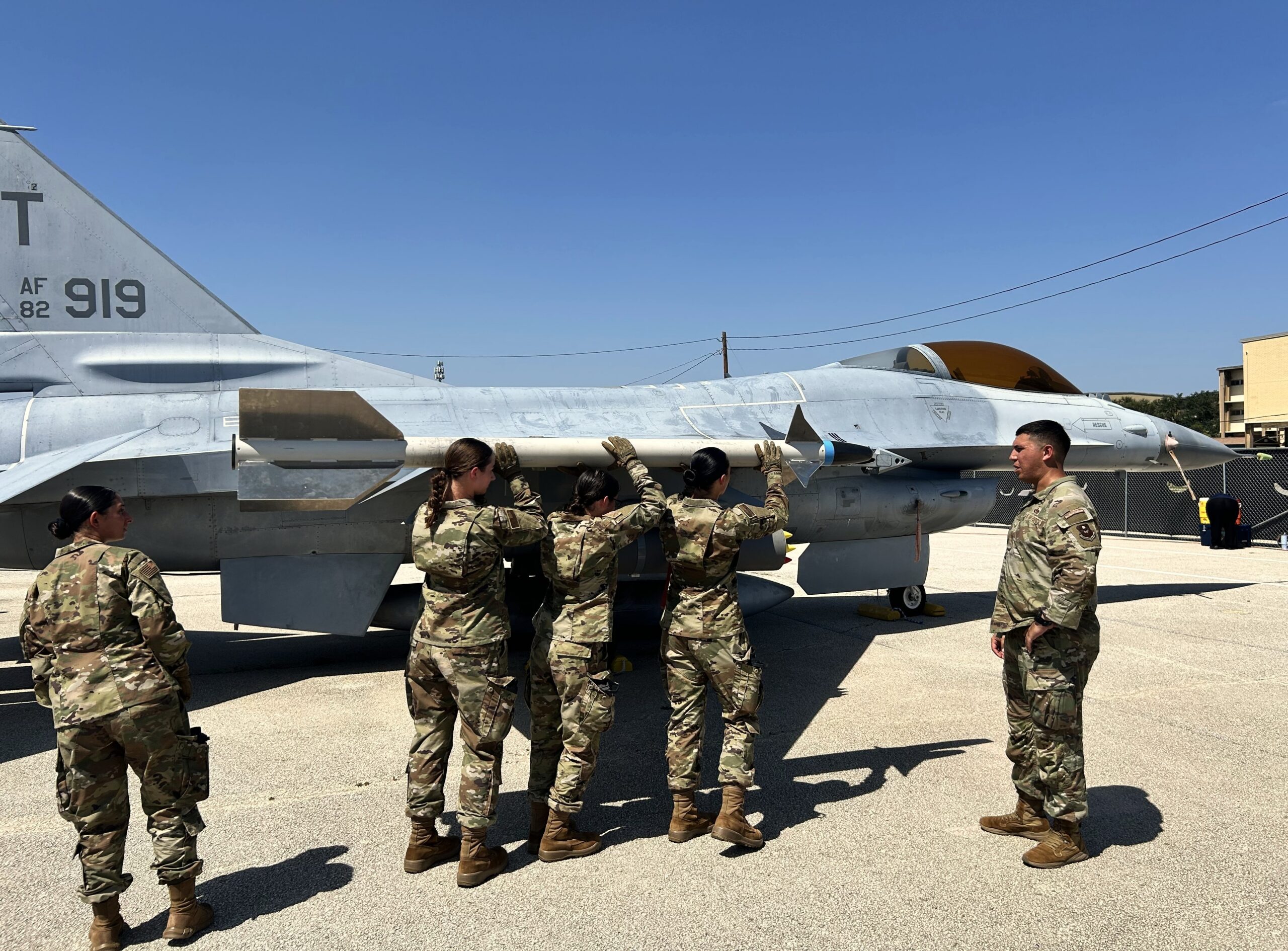
Under a late summer sun, Air Force basic trainees recently engaged in practical exercises at one such site, practicing the safe rearming of a retired F-16 Fighting Falcon with mock AIM-9 Sidewinder missiles. Simultaneously, ground preparations are underway for the expansion of this inaugural airbase training range.
Col. Kellie Courtland, commander of the 37th Training Wing, which oversees Basic Military Training, confirmed in a Sept. 2 interview that two retired C-130 Hercules aircraft, delivered to the base in late August, are slated to join the F-16 on the completed mock airbase tarmac. The target for operational readiness of this initial range is set for December or early 2027. “We’re within months of all of that happening,” Courtland stated.
Plans for this intensified realism in BMT were first unveiled by officials from the 2nd Air Force in January. The overarching objective is to establish four similar training areas, each equipped with one F-16 and two C-130s. Additionally, a more expeditionary training range, featuring dirt airstrips, is part of the long-term vision.
This project is a core component of a broader effort within BMT to cultivate “airmindedness” among new Airmen. This concept emphasizes a foundational understanding of airpower generation and sustainment, particularly under contested conditions where an airbase might come under attack. The goal is to foster adaptability and a proactive approach to mission accomplishment, even when personnel or resources are compromised.
“We want Airmen that are going to rise to the occasion,” Courtland explained. “What we don’t want is an Airman to say, ‘OK, he’s out of the game, she’s out of the game, and he’s out of the game, therefore the game’s done and we’re not going to do the mission.’ No, what we want is you to say, ‘She’s out. I may not do her job, but that maintainer that’s over there working, I can hand him the wrenches, or that Airmen that’s got to go out there and fuel that plane now, I can help him pull that hose out and make sure that jet is grounded.’”
Hands-on training with the F-16 commenced in April. Trainees are assigned a mission to rearm the fighter, requiring them to organize into small groups, develop a plan, brief Military Training Instructors (MTIs) on their strategy, and then execute the mission. The training is supported by two containerized stations on site, which house instructional videos and mock munitions, including AIM-9 missiles and 2.75-inch rockets for the Advanced Precision Kill Weapon System.
While the mock munitions are significantly lighter than live ordnance, MTIs emphasize the operational reality that an actual AIM-9 missile requires a three-person lift, and a 2.75-inch rocket requires two. Tech Sgt. Johnny Ngo, an MTI with the 322nd Training Squadron, highlighted this distinction: “These are training rounds; they’re not weighted … but we highly emphasize the fact that ‘hey, you will do a three-person lift’ just some sense of realism because in reality those missiles weigh about 400 pounds.”
The immersive nature of the training has resonated with instructors. Tech. Sgt. Brandon Cruz, an MTI with the 331st Training Squadron, recalled the excitement he felt during his technical training as a loader and noted that current BMT trainees are experiencing a similar impactful moment much earlier in their careers. “These trainees are getting that experience in BMT within the first five weeks of actually being here. They’re getting that surreal reality check,” Cruz commented.
Tech Sgt. Jeremy Hudson, an MTI from the 322nd Training Squadron, contrasted the current BMT with his experience in 2014, which he described as primarily focused on “drill, dormitory, and discipline.” He noted the profound difference for new recruits: “Five weeks ago, six weeks ago, they were civilians, and now they get to see an F-16 firsthand.”
Despite the overall progress, Courtland acknowledged the inherent logistical challenges of implementing multiple significant changes simultaneously. “You’re trying to build a new curriculum at the same time, you’re trying to do the construction at the same time, and you’re trying to train the MTIs so that they can train the trainees,” she stated. However, she affirmed that the project has the necessary Air Force support to navigate these complexities.
Upon completion, the initial mock airbase training range will feature 16 containerized training stations designed to teach eight critical tasks:
- Arming fighter aircraft
- Refueling
- Casualty transfer and evacuation
- Cargo loading
- Post-attack and repair
- Aircraft marshaling
- Aircraft familiarization
- Airbase entry control
The vision extends further, with a plan to expand the airbase into a four-quadrant training range by 2031. Each quadrant will replicate the initial setup, featuring two C-130s and an F-16, according to Courtland.

Additionally, BMT officials are developing a forward airbase training range, scheduled for completion by 2031, which will feature a more expeditionary environment. This range will be integrated into PACER FORGE, the final field training exercise of BMT, designed to test trainees’ agile combat employment skills. Command Chief Master Sgt. Caleb Vaden of the 37th Training Wing outlined plans for two intersecting dirt airstrips, a towable aircraft fuselage, an F-16, and a C-130.
Currently, the simulated airbase at PACER FORGE employs hard structures for skills like perimeter defense. The new forward airbase will build on this, according to Vaden: “It’s going to have a hangar in the middle, so some of those same types of things they’ll be training on here, like well, it’ll split your team up, and hey, some of you are going to be supporting airfield ops. Some of you are going to be supporting a repair team, should there be damage that you have to go out and assess, and those types of things.” He added that the aim is to replicate “reduced resources like we’ve had in real life, and just a lot of chaos going on to really kind of stress them out.”
Why This Matters
The U.S. Air Force’s investment in transforming its Basic Military Training reflects a critical strategic pivot in military readiness. In an era characterized by resurgent great power competition and the proliferation of advanced threats, the ability of military forces to operate effectively in contested environments is paramount. This revamped training paradigm directly addresses the demands of “Agile Combat Employment” (ACE), a core doctrine emphasizing dispersed operations, rapid re-posturing, and multi-capable Airmen who can perform tasks outside their primary specialty.
By introducing realistic mock airbases and hands-on interaction with aircraft from the earliest stages of an Airman’s career, the Air Force aims to cultivate a force that is not only proficient in its individual roles but also deeply understands the broader implications of airpower generation and sustainment. This shift moves beyond traditional, specialized training to foster a versatile and resilient workforce capable of responding to unexpected challenges, such as airfield damage, personnel casualties, or rapid operational shifts under hostile fire.
This initiative matters because it enhances the operational resilience of U.S. airpower. Future conflicts are anticipated to involve highly contested airspace and sophisticated adversaries capable of targeting fixed installations. By training Airmen across various disciplines – from aircraft arming and refueling to post-attack repair and casualty evacuation – the Air Force ensures that its personnel can maintain combat operations even when traditional support structures are disrupted. This holistic approach to training is crucial for projecting power globally and maintaining a decisive advantage in complex geopolitical landscapes. Furthermore, by immersing recruits in these realities early on, the Air Force aims to instill a higher level of confidence, adaptability, and mission-focused mindset essential for success in an unpredictable global security environment.