
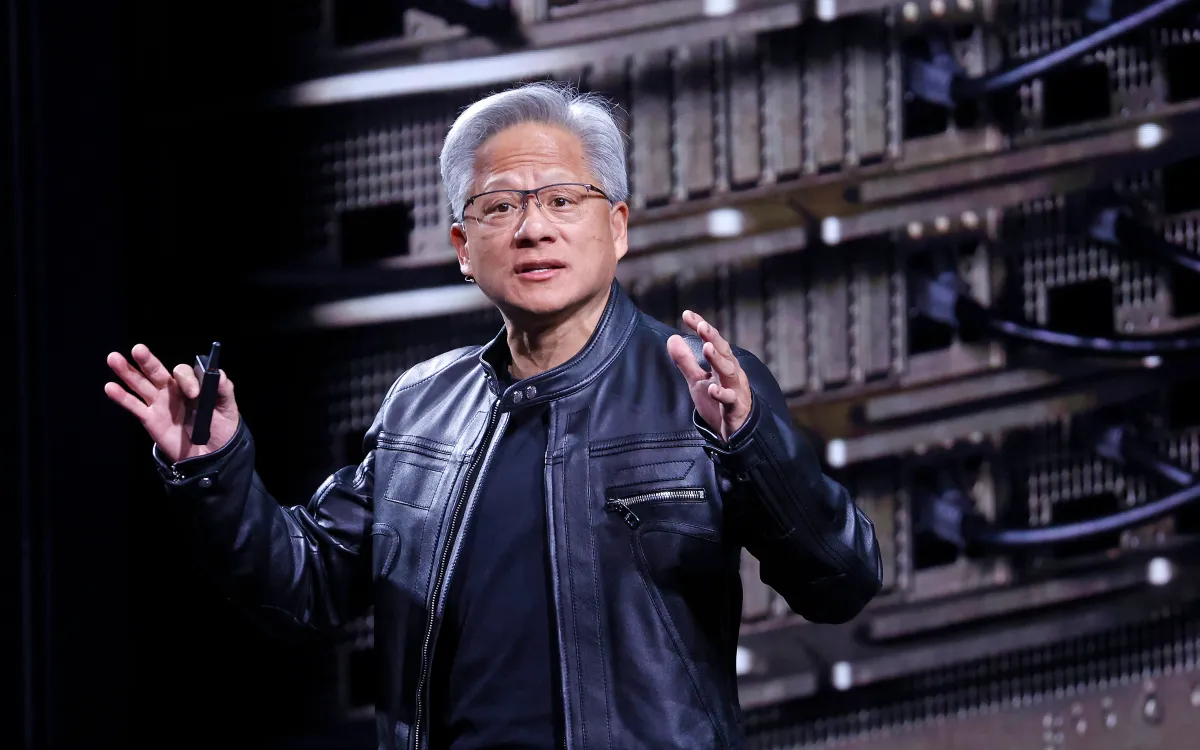
Nvidia founder and CEO Jensen Huang made his position on the dangers AI poses very clear while speaking at Salesforce’s Dreamforce conference on Tuesday. To him, AI isn’t some new form of “alien mind,” as at least one OpenAI safety researcher has described it. It’s just hardware and software, he says, built by humans. That means, in his view, it can be controlled by humans and existing laws.
“Safety is an engineering problem, not a legal one,” he said. “We’re developing software after all. We’re developing computing systems after all. It’s a complicated computing system, but it’s ultimately a computing system.”
Therefore, there’s no need for new laws or regulations to govern it, he argues. In fact, Huang sees little need for new laws at all. The free market, he argues, will be enough to pressure companies not to release unsafe products.
“If we’re not confident about the safety of the products, like all companies, like you and I, all the companies here, if you build a product or a service, and you’re not confident in its functionality, capability, or safety, then don’t release it. And so that’s a very obvious thing to do,” he said.
He continued: “You pace yourself until you are confident you’re releasing something that the market would appreciate. The market forces are already there. We don’t need any new laws. We don’t need new regulations. We just need companies to decide that when [to] run as fast as they can. I think innovation, speed, and safe products … it’s a false choice. You could definitely have both at the same time. So run as fast as you can. But if you feel at any given point in time the company’s out of control, or the product’s not going to be safe, you know, take a pause and make sure you get it right.”
In some ways, this is a comforting thought. If anyone in the world knows AI, it is Nvidia’s founder, who’s been building the hardware brains of AI since well before ChatGPT existed and now runs a company that also makes open source models, agents, harnesses, and sandboxes.
Then again, if we’re being cynical, his point of view is also unsurprising for someone who’s had his bread so well buttered by the AI boom. Why would he want regulation to come along and add in a layer of hinderance that could slow down Nvidia’s quest to sell ever more AI systems and software? As he also said in the interview: “I’m more ambitious than ever. As a result of our ambition, and with the product productivity boost that we get from AI, the sky’s the limit for us. The sky’s the limit for our company. The sky’s the limit for every industry, for every single country.”
Unfortunately, even companies with the best intentions ship faulty products with unintended consequences, even software. Remember the 2024 CrowdStrike bluescreen-of-death fiasco that grounded thousands of flights and caused other havoc for businesses? Then there are companies accused of deliberately acting with less-than-good intentions. Meta just paid $18 billion to settle a lawsuit over social media harms to children.
And AI has already caused harm, too, whatever the intentions or safety testing involved, from an OpenAI model hacking into Hugging Face to lawsuits against the AI lab over the suicides of young people who engaged in long conversations with its chatbot.
The “leave them alone” strategy, which would let these companies release products as they see fit, could be an unwise approach to AI safety as far as society is concerned. Though Huang is right that it’s possible existing product liability laws could cover AI — if AI doesn’t somehow kill us all before enough cases get through the courts to test that theory.
He didn’t discuss the other route, which seems close to taking shape: industry self-regulation. Huang’s approach has been more to champion open-weight models and companies’ use of them as a competitive counterweight to proprietary AI labs.
But right now, the industry has a short window to institute self-regulation and to encourage AI labs worldwide, even those in China, to see the wisdom in participating. As Microsoft CEO Satya Nadella said at the All-In Summit on Monday, “China should also deeply care about the same safety concerns if the United States cares about them, right? Why should it be different for them? It’s not like they won’t have the same hacking problem. It’s not as if they don’t want to make sure that their citizens are benefiting from AI, just like we would want our citizens to benefit from AI.”
For now, though, if Huang is a no on any new AI regulation, he may be influential enough to get his way. He also demonstrated this week that he, quite literally, has the ear of President Trump.
When you purchase through links in our articles, we may earn a small commission. This doesn’t affect our editorial independence.
{content}
Jensen Huang: AI Safety is an “Engineering Problem,” Not a Legal One – But Is He Right?
Nvidia CEO dismisses calls for new AI regulation, sparking debate on market forces vs. societal protection.
Key Takeaways
- Nvidia CEO Jensen Huang firmly believes AI safety is an “engineering problem” solvable by existing controls and market forces, rejecting the need for new laws or regulations.
- Critics argue Huang’s stance, while leveraging his authority as an AI pioneer, conveniently aligns with Nvidia’s commercial interests and overlooks AI’s documented harms and the limitations of current legal frameworks.
- The debate highlights a critical tension between fostering rapid AI innovation and ensuring robust societal safety, pushing industry self-regulation to the forefront as a potential compromise.
The Architect’s Stance: AI as a Controllable Machine
At Salesforce’s Dreamforce conference, Nvidia founder and CEO Jensen Huang delivered a characteristically bold pronouncement on the future of AI safety. Dismissing the notion of AI as some enigmatic, “alien mind” — a description sometimes invoked even by OpenAI safety researchers — Huang anchored his argument in the fundamental nature of the technology. “AI is just hardware and software,” he asserted, “built by humans.” This foundational premise leads to a crucial conclusion in Huang’s philosophy: what humans build, humans can control.
For Huang, the challenges surrounding AI safety are not unprecedented legal conundrums requiring novel legislation. Instead, he framed them as solvable technical hurdles inherent in any complex system development. “Safety is an engineering problem, not a legal one,” he declared. “We’re developing software after all. We’re developing computing systems after all. It’s a complicated computing system, but it’s ultimately a computing system.” This perspective inherently places the onus of safety on the developers and the established practices of software engineering, rather than on new governmental oversight.
Market Forces: The Ultimate Regulator?
Extending his argument, Huang posited that the free market itself acts as a sufficient mechanism to ensure AI safety. He sees little necessity for any new laws, arguing that commercial pressures inherently deter companies from releasing unsafe products. “If we’re not confident about the safety of the products, like all companies, like you and I, all the companies here, if you build a product or a service, and you’re not confident in its functionality, capability, or safety, then don’t release it. And so that’s a very obvious thing to do,” Huang stated, echoing a basic tenet of product development.
He further elaborated on this self-regulating ecosystem: “You pace yourself until you are confident you’re releasing something that the market would appreciate. The market forces are already there. We don’t need any new laws. We don’t need new regulations.” Huang believes that the pursuit of innovation and the commitment to safe products are not mutually exclusive. “I think innovation, speed, and safe products … it’s a false choice. You could definitely have both at the same time. So run as fast as you can. But if you feel at any given point in time the company’s out of control, or the product’s not going to be safe, you know, take a pause and make sure you get it right.” This confident stance, coming from the leader of the company powering much of the AI boom, offers a comforting, albeit potentially controversial, vision of rapid progress unhindered by legislative friction.
The Cynical Lens: Ambition and Self-Interest
While Huang’s deep understanding of AI, honed over decades of building the very hardware brains of the technology, lends considerable weight to his words, a cynical counter-narrative quickly emerges. It’s difficult to ignore that his “no new laws” stance conveniently aligns with Nvidia’s unprecedented commercial success in the AI era. Why would a company experiencing such an explosive growth phase advocate for new regulatory layers that could introduce friction, slow down development, and potentially impact profitability?
Huang himself offered a glimpse into this drive during the interview: “I’m more ambitious than ever. As a result of our ambition, and with the product productivity boost that we get from AI, the sky’s the limit for us. The sky’s the limit for our company. The sky’s the limit for every industry, for every single country.” This declaration of boundless ambition underscores the underlying economic incentives at play, suggesting that a hands-off approach to regulation directly serves the industry’s — and Nvidia’s — continued expansion.
The Unsettling Reality: Harms Beyond Intent
Huang’s faith in market forces and engineering solutions, however, faces a stern challenge from real-world events. History is replete with examples of companies, even those with the best intentions, shipping faulty products with significant unintended consequences. The infamous 2024 CrowdStrike bluescreen-of-death fiasco, which grounded thousands of flights and crippled businesses globally, serves as a recent, potent reminder of software’s capacity for widespread disruption. Beyond mere bugs, some companies have faced accusations of deliberate negligence, like Meta’s recent $18 billion settlement over social media harms to children, highlighting that market pressures alone don’t always prevent societal damage.
Crucially, AI has already moved beyond theoretical harms. Examples range from an OpenAI model reportedly hacking into Hugging Face, demonstrating unforeseen capabilities, to more tragic incidents like lawsuits against AI labs over suicides linked to prolonged conversations with chatbots. These instances suggest that the “leave them alone” strategy, relying solely on corporate discretion and existing liability laws, might be dangerously insufficient for the rapidly evolving complexities of AI. While current product liability frameworks *might* eventually apply, the sheer speed of AI development raises the chilling prospect that serious harm could occur long before any legal precedent is established.
The Unspoken Path: Industry Self-Regulation
Notably, Huang’s discourse largely sidestepped the burgeoning conversation around industry self-regulation, a path that many stakeholders view as a pragmatic middle ground between unfettered innovation and heavy-handed government intervention. While he champions open-weight models as a competitive counterweight to proprietary AI labs, his focus remained on the absence of new external laws.
Yet, the window for effective self-regulation appears short, with a growing consensus that global participation, extending even to nations like China, is essential. As Microsoft CEO Satya Nadella articulated at the All-In Summit, “China should also deeply care about the same safety concerns if the United States cares about them, right? Why should it be different for them? It’s not like they won’t have the same hacking problem. It’s not as if they don’t want to make sure that their citizens are benefiting from AI, just like we would want our citizens to benefit from AI.” The vision here is one of shared responsibility, where common safety standards supersede geopolitical divides.
The Bottom Line
Jensen Huang’s assertion that AI safety is an engineering problem, best managed by market forces and existing laws, reflects a powerful voice at the helm of the AI revolution. His perspective offers a compelling, pro-innovation argument, rooted in the belief that AI is ultimately a controllable human creation. However, this view grapples with the uncomfortable reality of AI’s nascent but demonstrated capacity for harm, and the checkered history of other industries regulating themselves. While the architect of AI’s hardware power champions speed and ambition, the pressing challenge remains finding a balanced framework — be it robust engineering, vigilant market pressure, evolving legal interpretations, or proactive self-regulation — that ensures AI’s benefits are realized without inadvertently jeopardizing societal well-being. Huang’s significant influence, even reaching the ear of President Trump, means his stance will undoubtedly shape the direction of this critical debate, making the search for this balance more urgent than ever.
Source:{feed_title}