
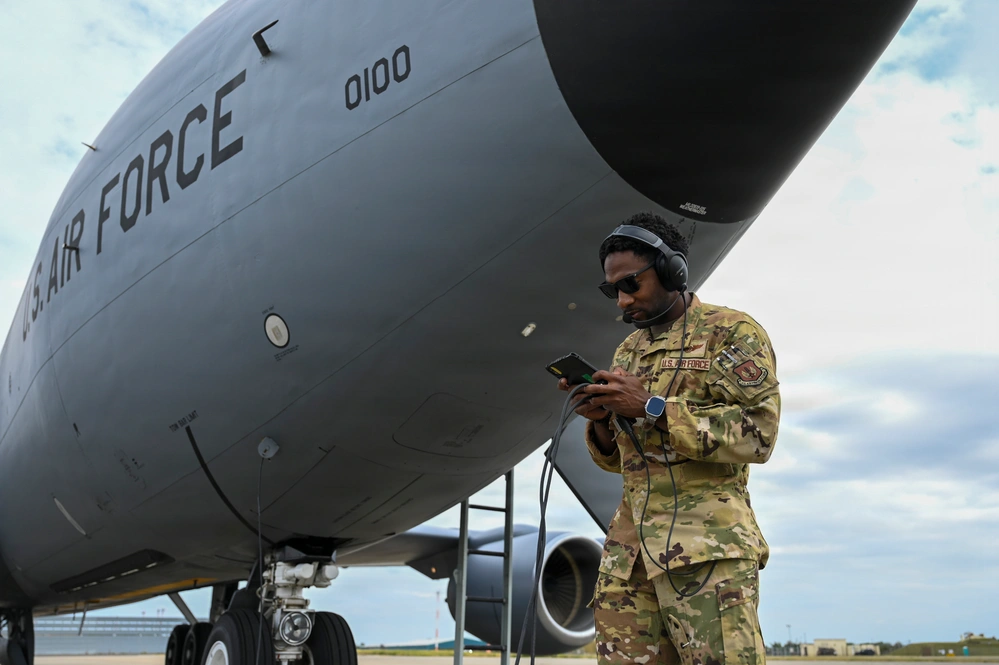
NATIONAL HARBOR, Md.—In a significant shift in military logistics, the U.S. Air Force adapted its traditional maintenance protocols during the protracted “Operation Epic Fury,” a conflict with Iran. Traditionally, Air Force depots are designed for extensive, long-duration overhauls and repairs, with aircraft often remaining out of service for weeks or months. However, facing sustained battle damage closer to the front lines, the service temporarily deployed heavy maintenance capabilities forward, closer to the area of operations, to rapidly repair damaged aircraft and return them to combat.
The strategic adaptation became imperative as the conflict with Iran extended beyond initial projections of weeks into several months. This prolonged engagement compelled Air Force leadership to fundamentally rethink and adjust its aircraft maintenance strategy to sustain high-intensity operations over an extended period.
The Air Force typically relies on three primary maintenance depots located at Hill Air Force Base, Utah; Robins Air Force Base, Georgia; and Tinker Air Force Base, Oklahoma. These facilities are responsible for conducting major maintenance overhauls, in-depth inspections, and complex repairs on a diverse fleet, including fighters, bombers, airlifters, and other specialized aircraft. This centralized system is optimized for comprehensive, planned maintenance cycles rather than rapid, battlefield-responsive repairs.
During “Operation Epic Fury,” U.S. forces operating in the Middle East faced intense barrages of missile and drone attacks from Iranian forces. These attacks inflicted levels of battle damage that, under normal circumstances, would have necessitated the lengthy and costly transportation of affected aircraft back to stateside depots for repair. This traditional approach would have significantly reduced the operational fleet size and imposed substantial delays in returning critical assets to the fight.
To counteract this challenge, the Air Force Materiel Command (AFMC) implemented an innovative solution: temporarily surging a depot-level repair capability to RAF Mildenhall in the United Kingdom. This forward deployment allowed battle-damaged aircraft to undergo essential repairs and modifications much closer to the combat zone, significantly reducing turnaround times and enabling their quicker re-entry into active service. Lt. Gen. Linda Hurry, Commander of AFMC, outlined this strategic pivot during a presentation this week at AFA’s 2026 Air, Space & Cyber conference.
“Most people envision depots solely as Tinker, Robins, and Hill; however, their function doesn’t need to be confined to those locations,” Hurry stated at the conference. “We recognized a critical need for this capability at Mildenhall… and questioned, ‘what if we pushed that forward?'” This inquiry underscores a broader initiative within the Air Force to challenge conventional wisdom and seek more agile solutions. “That’s precisely what we’ve been asking all our Airmen—how can we operate smarter? How can we deliver capabilities faster? It doesn’t always have to originate 7,000 miles away.”
The effectiveness of this forward-deployed maintenance strategy was validated by Lt. Gen. Daniel Tulley, the new head of Air Mobility Command. Tulley specifically highlighted the rapid repair of damaged aerial refueling booms on KC-135 Stratotankers as a prime example of the strategy’s success. “I believe we repaired 30 [booms] without having to transport them all the way back to the continental United States,” Tulley noted, commending it as an outstanding illustration of “generating readiness in contact”—the ability to maintain and enhance combat readiness while actively engaged in operations.
The intense operational tempo against Iran placed significant strain on the Air Force’s fleet. Air Force Secretary Troy E. Meink and Chief of Staff Gen. Kenneth S. Wilsbach, who both assumed their roles last year, have made readiness a paramount priority. The consequences of “Operation Epic Fury” are expected to necessitate extensive heavy maintenance overhauls across a large portion of the fleet in the post-conflict phase to restore optimal readiness levels.
Addressing the broader issues of sustainment and supply, the Air Force’s proposed 2027 budget allocates $4.2 billion for the Consolidated Sustainment Activity Group, which is responsible for the critical management and procurement of spare parts. Despite this allocation, Lt. Gen. Hurry underscored a significant deficiency. “We unequivocally require additional funding for spares,” Hurry asserted, revealing a substantial “current $14 billion deficit in supply.”
Acknowledging the challenge of securing such a large sum immediately, Hurry stated, “I understand we won’t receive it all at once, … but even if we secure a single penny, we must be prepared to execute effectively.” This readiness involves establishing long-term contracts to inject stability into the supply chain and ensure predictable access to necessary components. Furthermore, the Air Force is actively pursuing diversification in its supply base. “Another objective we are pursuing is securing multiple sources of supply; the era of monopolies is over. We cannot rely on a single entity producing one critical part,” Hurry emphasized. “I need five producers because when we face critical situations, we must have a robust inventory to effectively fight globally.”
Concurrently, AFMC has begun integrating advanced technologies to enhance its logistics capabilities. Hurry detailed the adoption of artificial intelligence (AI) tools to significantly improve forecasting accuracy for maintenance needs. “We are utilizing various methods to ensure a better understanding of where needs exist and how to strategically position those critical assets around the world,” she explained. Additive manufacturing, commonly known as 3D printing, is another key tool AFMC has embraced, enabling the “reverse engineering of some of the parts that we require,” thereby alleviating dependencies on external suppliers for obsolete or hard-to-find components.
However, technology alone is not considered a panacea. Hurry stressed the importance of “process improvement” as a fundamental approach to resolving numerous operational challenges. “Frankly, if we can comprehend a process, decompose it to identify constraints, and then mitigate those constraints, the collective throughput of the entire system improves dramatically,” Hurry elaborated. “That is precisely what is happening within our depots. And that is exactly what we executed when we surged operations for [Epic Fury].” This holistic approach, combining forward deployment, strategic resourcing, technological innovation, and process optimization, proved critical in sustaining U.S. air power during a demanding and prolonged conflict.
Why This Matters
The U.S. Air Force’s adaptation of its maintenance strategy during “Operation Epic Fury” represents a pivotal shift in military logistics and readiness, holding significant implications for future conflicts and defense planning. This event underscores several critical points:
Strategic Agility in Modern Warfare:The ability to rapidly reconfigure logistics and maintenance capabilities closer to a conflict zone is paramount in an era of dynamic and unpredictable threats. Traditional, centralized depot systems, while efficient for peacetime overhauls, proved inadequate for the pace and distributed nature of a prolonged, high-intensity conflict. This experience highlights the necessity for military forces to maintain flexible, adaptable support structures that can be quickly deployed and scaled.
Sustainment as a Warfighting Imperative:The narrative of “Epic Fury” reinforces that sustainment is not merely a support function but a core warfighting capability. The rapid repair of damaged aircraft directly contributed to maintaining operational tempo and force availability. Without this forward-deployed maintenance, the U.S. Air Force’s ability to project power and sustain combat operations would have been severely hampered, demonstrating that successful engagement relies as much on logistical resilience as it does on advanced weaponry.
Addressing Supply Chain Vulnerabilities:The revelation of a “$14 billion hole in supply” for spare parts exposes a critical vulnerability in the U.S. defense industrial base. Dependence on single-source suppliers and insufficient stockpiles can cripple military operations. The Air Force’s push for diversified supply chains and long-term contracts is a direct response to this, aiming to build resilience against disruptions, whether from conflict, natural disasters, or geopolitical tensions. This effort directly impacts national security and the ability to respond to global crises.
Integration of Technology and Process Innovation:The adoption of artificial intelligence for forecasting and additive manufacturing for parts production signals a broader trend towards leveraging advanced technologies to enhance military readiness and efficiency. These innovations can reduce reliance on traditional manufacturing cycles, shorten lead times for critical components, and provide better predictive maintenance capabilities. Alongside this, the emphasis on “process improvement” underscores that technological solutions must be paired with operational efficiencies and a culture of continuous improvement to achieve optimal results.
Budgetary Priorities and Readiness:The call for increased funding for sustainment, particularly for spare parts, directly links to the ongoing debate about defense spending priorities. Commanders on the front lines are articulating a clear need for investment in the logistical backbone of the military. Failure to adequately fund sustainment can lead to reduced readiness, extended aircraft downtime, and ultimately, a diminished capacity to deter or respond to threats. This situation prompts a critical examination of how defense budgets are allocated to balance acquisition of new systems with the maintenance of existing fleets.
Implications for Future Conflicts:The lessons learned from “Operation Epic Fury” will undoubtedly influence future U.S. military doctrine and posture, especially regarding potential conflicts with peer or near-peer adversaries. The experience suggests a future where maintenance capabilities might need to be even more distributed, clandestine, and capable of operating in contested environments. This could lead to further investment in agile combat employment concepts, modular repair teams, and closer integration with allied infrastructure, such as RAF Mildenhall, to ensure global reach and sustained presence.