
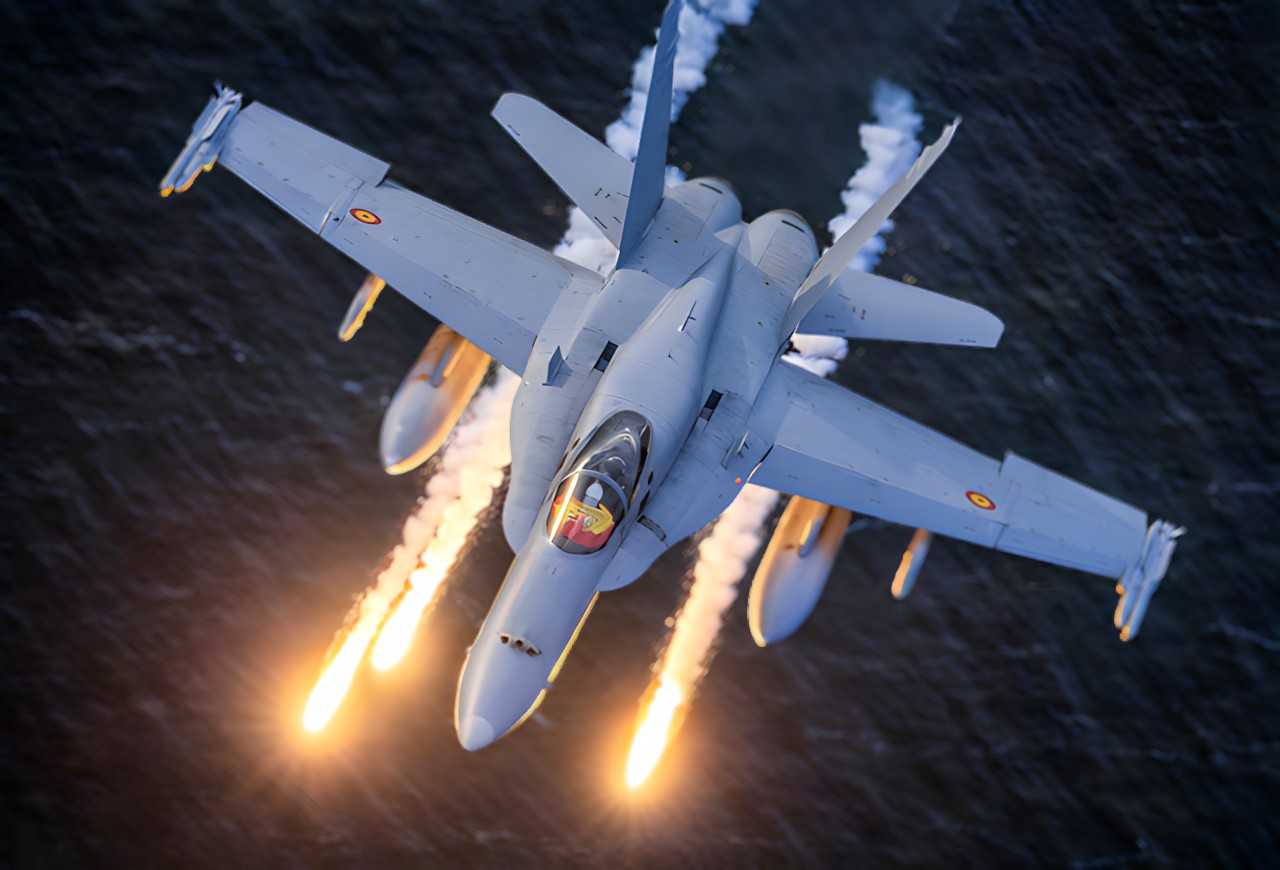
Spanish F-18 Fighters Conduct First Drone Shootdown During NATO Quick Reaction Alert in Romania Amid Heightened Eastern Flank Activity
Spanish F-18 fighter jets, operating as part of NATO’s Quick Reaction Alert (QRA) mission in Romania, have carried out 15 Alpha Scrambles within their first month of deployment. This period included a notable mission on August 16 during which an unidentified drone was successfully intercepted and neutralized after it entered Romanian airspace, according to a statement from NATO Allied Air Command. This incident marks a significant event for NATO’s air policing and defense posture on its eastern flank.
Since August 7, Spain’s “Paznic” Detachment has maintained a continuous, 24-hour QRA posture from Mihail Kogălniceanu Air Base. This critical mission involves Spanish aircraft and flight crews being held at constant readiness to respond swiftly to any unidentified or potentially threatening aerial activity detected along NATO’s strategically vital eastern border. The operational tempo for the detachment proved high, with the 15 Alpha Scrambles – instances where fighters are launched rapidly in response to an alert – occurring within their initial 30 days of operations.
The most serious alert during this period unfolded in the early hours of August 16. Spanish F-18s were scrambled following the detection of an unidentified aerial track that had penetrated Romanian national airspace. Leveraging NATO’s sophisticated, integrated command-and-control (C2) network, the Spanish fighter pilots were able to effectively locate and positively identify the target, despite the challenging conditions of nighttime operations. This seamless coordination underscores the advanced interoperability within the Alliance’s defense architecture.
Following positive identification of the aerial intruder and subsequent authorization to engage, a critical assessment was conducted regarding any potential risks to civilian populations or infrastructure on the ground. Once these safety considerations were addressed, one of the Spanish F-18 aircraft proceeded to neutralize the drone. This decisive action highlights the robust nature of NATO’s air defense capabilities and its commitment to protecting the airspace of its member states. The Spanish deployment itself is an integral component of NATO’s ongoing air defense mission in Romania, designed to provide a rapid and effective response to a diverse range of aerial threats, including unidentified aircraft, drones, and other potential incursions into Alliance airspace.
Lieutenant Colonel Alberto B. Calvo López, who commands the eAP-72 Spanish Detachment, emphasized the foundational principles guiding their mission. “Effective deterrence requires real presence, responsiveness, and interoperability,” he stated. His remarks underscore the necessity of having highly capable forces physically stationed in strategic locations, ready to act, and able to work seamlessly with allied nations.
Lt. Col. Calvo López further elaborated on the practical implications of their readiness. “Thirty days on alert and 15 Alpha Scrambles show what readiness means in practice: trained people, aircraft, and NATO command and control working together around the clock,” he added. This statement highlights the intricate synergy between human expertise, advanced military hardware, and the overarching command structure that defines NATO’s collective defense capabilities.
Beyond their operational Quick Reaction Alert duties, the Spanish detachment has also been actively engaged in comprehensive training missions. These exercises include “Flexible Deterrent Option” sorties, which simulate various response scenarios to potential threats, and work centered on “Agile Combat Employment” (ACE) principles. ACE strategies focus on making air operations more flexible, resilient, and adaptable by dispersing assets and operating from austere locations. To further enhance the operational reach and flexibility of the F-18s, a Spanish A400M transport aircraft has been deployed to provide essential air-to-air refueling (AAR) support. This capability extends the endurance and operating range of the fighter jets, granting the detachment greater strategic flexibility during both live alerts and demanding training missions.
The combined operational and training flights have seen the Spanish detachment accumulate over 200 flying hours since their deployment commenced. This mission also reflects a significant strategic evolution within NATO, moving beyond a traditional “air-policing” model – primarily focused on identifying and intercepting aircraft – towards a more comprehensive and integrated “air-defense posture.” This modern approach is fully integrated within the Alliance’s broader Integrated Air and Missile Defence (IAMD) framework, designed to provide a layered defense against all aerial threats.
Under this advanced IAMD approach, QRA fighter aircraft are not merely isolated interceptor forces. Instead, they are much more closely connected and integrated with a wider network of NATO sensors, command-and-control systems, and other air-defense assets, including ground-based missile systems. This networked approach allows them to respond as a cohesive part of a larger, multi-faceted defense system, providing a more robust and adaptive shield. The Spanish aircraft’s presence in Romania is part of NATO’s ongoing commitment to maintaining permanent air surveillance and rapidly deployable fighter forces across its eastern member states, with the F-18 detachment serving as one of the Alliance’s standing responses to unidentified aerial activity in the increasingly sensitive Black Sea region.
Why This Matters
The deployment of Spanish F-18s to Romania and the subsequent interception and neutralization of an unidentified drone underscore several critical aspects of current European security and NATO’s evolving role:
- Reinforced Deterrence and Readiness:The high operational tempo, evidenced by 15 Alpha Scrambles in a month, demonstrates NATO’s heightened state of readiness and its commitment to deterring aggression along its eastern flank. The ability to rapidly detect, identify, and neutralize a threat like an unidentified drone sends a clear message about the Alliance’s protective capabilities.
- Adaptation to Evolving Threats:The drone incident highlights the growing challenge posed by unmanned aerial systems (UAS) in modern warfare and reconnaissance. NATO’s response indicates its adaptation to these new forms of aerial threats, moving beyond traditional aircraft interception to include effective countermeasures against drones. This incident is particularly significant as it represents one of the first publicly confirmed instances of NATO forces engaging and neutralizing an unidentified drone in its operational area in this manner.
- Enhanced Alliance Interoperability:The seamless coordination between Spanish aircrews, Romanian airspace, and NATO’s integrated command-and-control network exemplifies the high degree of interoperability within the Alliance. Such cooperation is crucial for effective collective defense, ensuring that forces from different member states can operate as a unified entity.
- Shift Towards Integrated Air and Missile Defence (IAMD):The mission reflects NATO’s strategic shift from a pure “air-policing” role to a more comprehensive “air-defense posture” integrated with its IAMD framework. This holistic approach, linking fighters with a broader network of sensors and command systems, provides a more resilient and multi-layered defense against a full spectrum of aerial and missile threats.
- Security of NATO Airspace:The incident reaffirms NATO’s unwavering commitment to the territorial integrity and sovereignty of its member states. By actively patrolling and defending Romanian airspace, the Alliance ensures the security of its borders and protects its populations from potential incursions or threats, contributing to regional stability in a volatile geopolitical environment.