
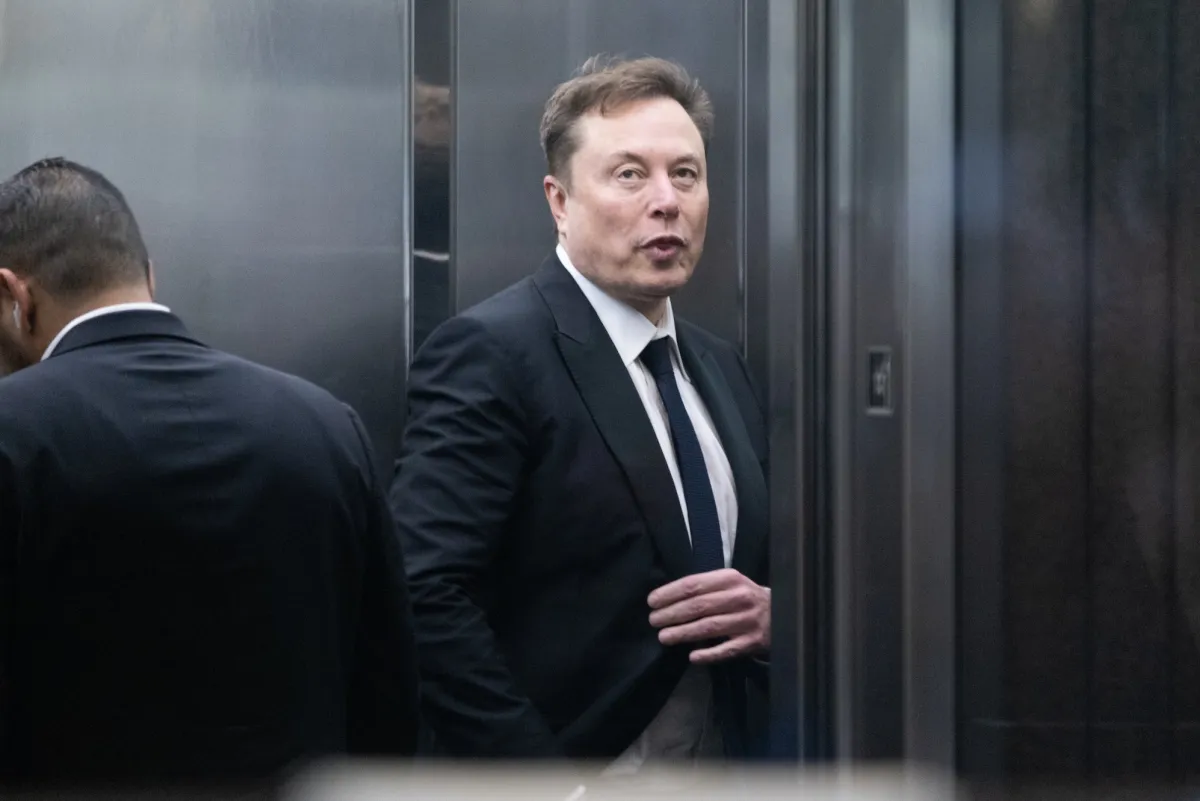
Elon Musk recently claimed that his tunneling startup The Boring Company is working on “a simple precursor Hyperloop” between Austin and San Antonio that will reduce the journey between the two cities to less than 30 minutes.
The Boring Company account shared Musk’s statement and said it “would be excited and honored to build this massive infrastructure project.”
Many of The Boring Company’s announced projects — including tunnel systems in Chicago, Los Angeles, and between New York City and Washington, D.C. — have not materialized. However, it does operate a transportation system combining tunnels and surface routes in Las Vegas, and it recently raised a $3 billion round led by the United Arab Emirates.
Musk’s comments about a potential Austin-San Antonio Hyperloop were actually in reply to an AI-generated video depicting a generic science fiction future with human colonies on other worlds. Musk re-posted the video and declared, “This is the future we shall bring into being”.
Musk’s critics have argued that his vision of the future is apparently inspired by pulp science fiction and comic books; historian Jill Lepore recently told me that he seems to favor sci-fi that “completely defeats and defies all of his political beliefs.”
{content}
Key Takeaways:
- Elon Musk’s Boring Company (TBC) has announced an ambitious “simple precursor Hyperloop” project aiming to connect Austin and San Antonio in under 30 minutes.
- TBC’s track record is a mixed bag, with several high-profile projects failing to materialize, while its Las Vegas Loop operates but falls short of the original Hyperloop’s speed and vacuum-tube vision.
- Musk’s futuristic visions, often fueled by science fiction, continue to inspire skepticism among critics who question their practical feasibility, regulatory alignment, and long-term societal benefits.
Musk’s Latest Vision: A Texan “Precursor Hyperloop” Promises Sub-30 Minute Travel
Elon Musk, the prolific entrepreneur known for ventures spanning electric vehicles, space exploration, and brain-computer interfaces, has once again captured headlines with a bold transportation claim. This time, the focus is on his tunneling startup, The Boring Company (TBC), and an ambitious project to revolutionize travel between two major Texan cities. Musk recently asserted that TBC is actively developing a “simple precursor Hyperloop” system designed to link Austin and San Antonio, slashing the current journey time to an impressive less than 30 minutes.
The statement, initially a reply to an AI-generated video depicting a fantastical sci-fi future – which Musk reposted with the declaration, “This is the future we shall bring into being” – quickly gained traction. The Boring Company’s official account amplified Musk’s vision, expressing its eagerness to undertake what it termed a “massive infrastructure project.” If realized, such a system would transform the corridor between these burgeoning Texas hubs, offering a tantalizing glimpse into a hyper-connected future.
Unpacking the Hyperloop Vision and TBC’s Iterations
The original Hyperloop concept, first publicly outlined by Musk in a 2013 white paper, envisioned passenger pods traveling at immense speeds through near-vacuum tubes. The absence of air resistance would allow for speeds exceeding those of commercial aircraft, making inter-city travel incredibly fast and efficient. This vision promised to fundamentally alter regional commutes, supply chains, and urban development.
However, The Boring Company’s practical applications of this vision have evolved, or perhaps, diverged. While the Hyperloop dream remains at the periphery, TBC’s most tangible achievement to date is the Las Vegas Convention Center (LVCC) Loop. This system, operational since 2021, transports passengers in modified Tesla vehicles through a network of underground tunnels. While innovative in its deployment of electric vehicles in a dedicated underground infrastructure, it is notably *not* a Hyperloop. The Teslas are human-driven (albeit with automated driving features), operate at relatively modest speeds of around 35 mph, and the tunnels are not depressurized vacuum tubes. It’s more accurately described as a high-capacity, dedicated underground roadway for EVs, a significant departure from the hypersonic, vacuum-sealed pods Musk initially proposed. This distinction is crucial when evaluating the “precursor Hyperloop” claim for Texas. Will it be a true step towards vacuum-tube travel, or another iteration of the underground Tesla network?
The Boring Company’s Uneven Track Record
The excitement surrounding the Austin-San Antonio announcement is tempered by The Boring Company’s history of grand pronouncements that have yet to fully materialize. Several high-profile projects, initially met with considerable fanfare, have either stalled indefinitely or been quietly abandoned.
Take, for instance, the proposed Chicago O’Hare Express Loop. Announced in 2018 with the promise of shuttling passengers from downtown to the airport in just 12 minutes, the project envisioned a high-speed, underground transit system. Despite a conceptual agreement and significant media attention, progress has largely evaporated, leaving the project in a state of indefinite limbo. Similarly, early plans for extensive tunnel networks in Los Angeles, including a comprehensive “Loop” system for the city, have not moved beyond a single test tunnel in Hawthorne and an initial, limited “Loop” at the Las Vegas Convention Center. The ambitious East Coast Loop, intended to connect Washington D.C. and New York City at Hyperloop speeds, also remains firmly in the realm of concept rather than construction.
This pattern of bold announcements followed by limited execution has led some critics to label TBC’s pipeline as “vaporware,” questioning the company’s ability to deliver on its most ambitious promises. Yet, TBC recently secured a substantial $3 billion funding round, led by entities from the United Arab Emirates. This significant injection of capital indicates continued investor confidence in Musk’s vision, or at least in TBC’s potential to disrupt traditional infrastructure development, even if the “Hyperloop” part remains elusive. The funding could empower TBC to push harder on new projects, but it also raises the stakes for tangible results.
Musk’s Sci-Fi Muse and Public Scrutiny
Musk’s inspiration for these grand projects often appears to be drawn directly from the pages of science fiction, a point highlighted by his enthusiastic reposting of the AI-generated video. This embrace of futuristic, often fantastical, imagery fuels both his public persona and the ambitious scope of his companies. However, this romanticized view of technology is not without its detractors.
Historian Jill Lepore has been particularly vocal, suggesting that Musk’s preferred brand of sci-fi “completely defeats and defies all of his political beliefs.” This critique implies a disconnect between the inspiring, often utopian, imagery of science fiction and the complex, often messy, realities of public policy, urban planning, and democratic processes. Building massive underground infrastructure, especially for public use, involves navigating a labyrinth of regulatory hurdles, environmental impact assessments, community opposition, and immense capital expenditure, issues rarely simplified in pulp sci-fi narratives.
The question arises: Is Musk’s reliance on sci-fi merely a powerful marketing tool, or does it genuinely shape his engineering philosophy? While inspiring, critics argue that this approach can sometimes lead to an underestimation of real-world complexities, fostering a culture of announcing “revolutionary” solutions before fully grappling with the practicalities of implementation, safety, and long-term public benefit. For a project like Austin-San Antonio, the journey from AI-generated fantasy to functional reality will involve far more than just digging tunnels.
Challenges and the Road Ahead for Texas
For the Austin-San Antonio “precursor Hyperloop” to move beyond a tweet, TBC faces an array of formidable challenges. Technically, even a “simple precursor” system would need to demonstrate significant advances beyond the Las Vegas Loop in terms of speed, capacity, and cost-effectiveness to justify the immense investment. Land acquisition for portals and rights-of-way, navigating Texas’s complex regulatory environment, and securing local government approvals will be monumental tasks.
Economically, the project needs to prove its long-term viability. What will be the ticket price? How will it compete with existing transportation modes? And what about the safety implications of high-speed underground travel, particularly in a region prone to geological complexities? The public’s skepticism, cultivated by past unfulfilled promises, also represents a significant hurdle. For many, seeing will truly be believing when it comes to Musk’s latest hyper-loop dream.
Bottom Line
Elon Musk’s latest declaration for a “precursor Hyperloop” between Austin and San Antonio is another testament to his unwavering commitment to grand, transformative visions. While the idea of a sub-30-minute journey between these two bustling Texan cities is undeniably appealing, it must be viewed through the lens of The Boring Company’s uneven track record. The gap between Musk’s inspiring, sci-fi-fueled pronouncements and TBC’s concrete, scalable achievements remains substantial. For this Texan dream to become a reality, TBC will need to move beyond ambitious claims and demonstrate a clear, executable path forward that addresses the formidable technical, regulatory, and economic challenges of building the infrastructure of tomorrow. The future, as Musk envisions it, is exciting – but the path to building it is often less glamorous and far more complex than a sci-fi video suggests.
Source:{feed_title}