
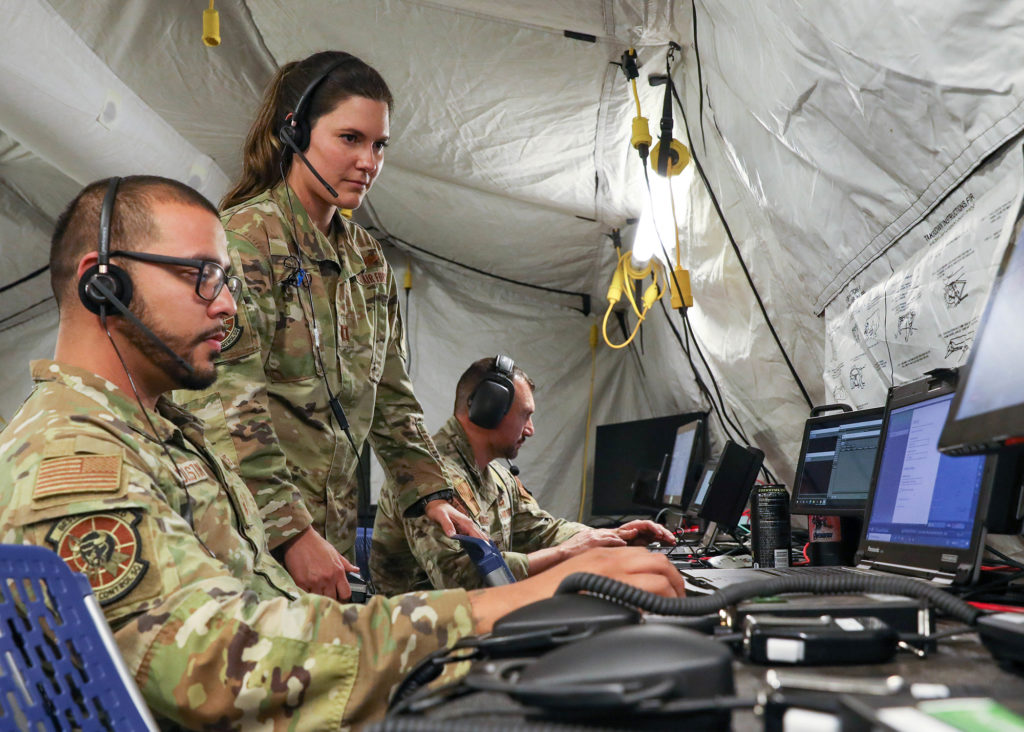
NATIONAL HARBOR, Md.—The U.S. Air Force is set to significantly enhance its ground-based air battle management capabilities with the imminent rollout of its next-generation Tactical Operations Center-Light (TOC-L) system. Developed as a compact, rapidly deployable solution, the TOC-L is designed to modernize how the Air Force commands and controls air assets in dynamic operational environments.
Deliveries of the second major iteration of the TOC-L, designated Material Release 2 (MR2), are slated to commence by the end of this year, with 70 units planned for distribution to Air Force units. This marks a crucial step in replacing legacy systems, offering a more agile and technologically advanced platform for air battle management.
Development and Evolution of TOC-L
The journey to the TOC-L MR2 began several years ago when the Air Force initiated contracts with Lockheed Martin and L3Harris to develop the initial prototypes. These first 16 prototypes, known as Material Release 1 (MR1), started delivery in 2023. The MR1 prototypes served as essential testbeds, allowing Airmen to gain hands-on experience and provide critical feedback on the system’s capabilities and operational effectiveness.
Building on the insights from MR1, the Air Force later awarded Booz Allen Hamilton a $315 million rapid prototyping contract for the development and scaling of the MR2 version. Brig. Gen. Joshua Williams, program acquisition executive for command, control, communications, and battle management (C3BM), highlighted the distinction between the two releases. Speaking at the Air & Space Forces Association’s Air, Space & Cyber conference on September 16, Williams stated, “Material Release 1 is, ‘hey, how do we get the capability they need now so they can fight tonight?’ Material Release 2 is focused on deeper integration, improved edge connectivity, and more mature support.” MR2 is intended to be the standardized kit for near-term air battle management operations.
Advanced Capabilities and Connectivity
The TOC-L MR2 represents a significant leap forward in connectivity and adaptability. According to Patrick Hamilton, vice president for defense technology at Booz Allen Hamilton, the system is designed to connect seamlessly with all major aircraft and capabilities deployed by the Air Force. It also maintains backward compatibility through the Department of the Air Force (DAF) Battle Network, ensuring interoperability with existing infrastructure.
“This is the next-generation C2 system that the Air Force is going to deploy that hopefully will be in place for the next 30 to 40 years for the new C2 fight,” Hamilton noted during the conference. A key advantage of the TOC-L is its software-defined architecture, which allows for more rapid integration of new capabilities, applications, and updates from the DAF Battle Network. This contrasts sharply with legacy ground systems, such as the Control and Reporting Center (CRC), which are less amenable to swift software modifications.
A notable feature of the TOC-L is its ability to draw and fuse data from multiple security “enclaves”—separate environments for classified and unclassified information. This capability enables users to integrate disparate data sources, such as unclassified civilian radar feeds, into a secure, classified common operating picture. Hamilton explained, “So, if you have something coming in, let’s say from an FAA unclassified radar, and you want to put that on the situational awareness [common operating picture] that the user is looking at, which is in a secret enclave, you need the ability to move that data up.” The TOC-L facilitates this critical data movement.
Furthermore, the system incorporates advanced data security protocols. Based on National Security Agency (NSA) data-at-rest standards, the TOC-L can render its enclaves unclassified when powered off. This eliminates the time-consuming and labor-intensive process of physically removing, labeling, and storing sensitive drives after each mission or shift, a practice common with older systems. Mike Lewis, Booz Allen Hamilton’s chief engineer for TOC-L, emphasized the operational benefits: “There are a lot of logistics and risk in that type of scenario, so with data at rest being unclassified, it’s a real key to making this tactically relevant from a speed perspective and from a cyber perspective.”
Operational Rollout and Future Iterations
Operational Air Force units have actively participated in testing the TOC-L systems “downrange” over the past year, providing valuable real-world feedback. Col. Bai Lan Zhu, senior materiel leader for the Advanced Battle Management System (ABMS), indicated that while Booz Allen Hamilton plans to deliver 70 MR2 units under the current contract, the total number of TOC-Ls to be deployed across the Air Force remains dynamic. “The exact quantities are something that the operational community is going to refine over time,” Zhu stated.
The development of the TOC-L is an ongoing, iterative process. Feedback gathered from ABMS and the user community worldwide will inform future enhancements. Hamilton anticipates that over the next 12 to 24 months, this feedback will help define the requirements and priorities for Material Release 3 (MR3).
A Paradigm Shift: Replacing the Cold War-Era CRC
The TOC-L is designed to directly replace the venerable but aging Control and Reporting Center (CRC), a system rooted in the Cold War era and centered around the bulky AN/TPS-75 radar. The operational differences between the two systems highlight a profound shift in military logistics and operational readiness:
- Transport:The legacy CRC required up to six C-17 Globemaster III transport aircraft to move all its components, including large radar dishes, heavy vehicles, and nearly two dozen power generators. In stark contrast, the TOC-L fits on a single pallet, with an additional pallet for its generator, and can be transported by a single C-130 Hercules aircraft.
- Personnel:Setting up and operating a CRC traditionally demanded hundreds of Airmen. The TOC-L significantly reduces this requirement, needing only about 10 Airmen for operation.
- Setup/Teardown Time:Deploying and dismantling a CRC could take anywhere from 24 to 72 hours. The TOC-L can be set up or torn down in less than an hour, dramatically improving response times.
This remarkable reduction in footprint, personnel, and setup time is attributed to advances in electronics and the TOC-L’s ability to leverage the DAF Battle Network and other external networks for radar and data feeds, rather than relying on its own integrated radar systems. The shift towards allowing non-proprietary equipment to integrate with the TOC-L system also contributes to a drastic reduction in the amount of specialized hardware needed for critical functions.
Why This Matters
The deployment of the Tactical Operations Center-Light (TOC-L) marks a pivotal modernization effort for the U.S. Air Force, with significant implications across operational, logistical, and strategic domains:
- Enhanced Operational Readiness and Agility:The TOC-L dramatically improves the Air Force’s ability to establish command and control in austere and contested environments. Its rapid deployability (less than an hour setup time) and reduced logistical footprint mean that air battle management capabilities can be brought to bear far more quickly and in a wider range of locations than ever before. This agility is crucial for responding to fast-evolving threats and maintaining air superiority in modern conflicts.
- Logistical Efficiency and Cost Savings:By replacing a system that required hundreds of personnel and multiple heavy-lift aircraft with one that needs only a handful of Airmen and a single C-130, the TOC-L slashes logistical demands. This translates into substantial cost savings in fuel, maintenance, personnel training, and transportation. It also frees up valuable strategic airlift assets for other critical missions.
- Technological Superiority and Future-Proofing:The TOC-L’s software-defined architecture and deep integration with the Department of the Air Force Battle Network position it as a future-proof system. Its ability to readily incorporate new software, applications, and data streams from various classified and unclassified sources ensures that the Air Force’s command and control capabilities can evolve rapidly to counter emerging threats and leverage new technologies without needing costly hardware overhauls. The secure data fusion and advanced data-at-rest protocols also enhance cybersecurity and operational flexibility.
- Strategic Advantage in Distributed Operations:In an era of great power competition, the ability to operate effectively from dispersed and resilient locations is paramount. The TOC-L enables smaller, more mobile teams to conduct sophisticated air battle management, reducing vulnerability to large-scale attacks on fixed installations. This distributed operational model enhances survivability and ensures continuity of command and control in a high-intensity conflict.
- Personnel Optimization:By reducing the number of personnel required for setup and operation, the TOC-L allows the Air Force to reallocate skilled Airmen to other critical functions, optimizing its human capital. The streamlined operational procedures also reduce the burden on personnel, allowing them to focus more on tactical execution and less on complex logistical tasks.
In essence, the TOC-L is not merely a hardware upgrade; it is a fundamental transformation of the Air Force’s approach to air battle management, aligning with modern warfare requirements for speed, flexibility, and technological adaptability, thereby ensuring the service remains prepared for the next generation of air combat.