
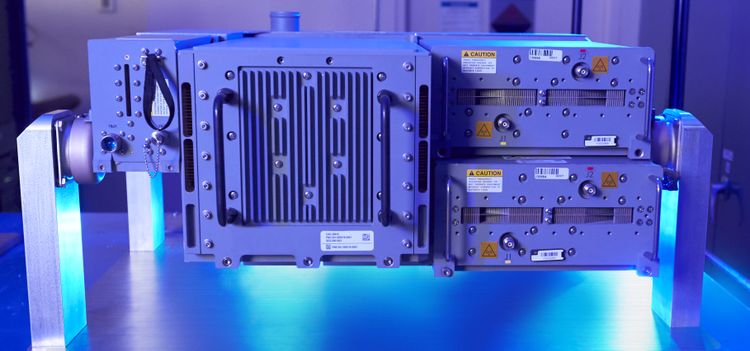
The U.S. Air Force has allocated an additional $87.4 million to enhance the electronic warfare capabilities of its F-16 Fighting Falcon fleet. This investment aims to bolster the fighter jet’s self-protection mechanisms against a growing array of sophisticated aerial threats.
This latest funding brings the total value of the program to $1.92 billion and is specifically designated for the low-rate initial production (LRIP) of the AN/ALQ-257 Integrated Viper Electronic Warfare Suite, known as IVEWS. This advanced electronic warfare system is designed for seamless integration into the F-16’s airframe.
The initial production batch of upgraded F-16s is intended for deployment in the Middle East, aligning with strategic priorities set by the U.S. military’s Central Command (CENTCOM). Production work on this LRIP batch is being carried out at Northrop Grumman’s facility in Illinois, with completion anticipated by the end of 2029. The Air Force Lifecycle Management Center, based at Wright-Patterson Air Force Base in Ohio, is responsible for overseeing the contract.
The Strategic Imperative for Modernization
The development and fielding of the new electronic warfare system are deemed critical for the F-16’s continued relevance in future combat scenarios. According to Shalini Gupta, vice president of electronic warfare and targeting at Northrop Grumman, a modern EW suite is essential for operations within contested airspace. Gupta stated, “You cannot defeat what you cannot see. We are producing fully functional, flight-proven systems now. From day one, our customers gain the ability to geolocate threats with a single aircraft, and the confidence that comes with having a U.S. program of record system on board.”
While the F-16’s existing electronic warfare systems have proven effective against certain threats, such as those encountered from Iranian air defenses, the emergence of peer adversaries equipped with more advanced and integrated air defense systems necessitates a significant upgrade. The U.S. Air Force identified an urgent operational need for enhanced F-16 self-protection in 2025. This assessment led to a congressional allocation of $187 million in the fiscal year 2026 reconciliation bill, accelerating the system’s qualification and flight testing phases.
Following CENTCOM’s subsequent operational need statement, the modernization effort involving Northrop Grumman and the Air Force was prioritized. Lt. Gen. Derek France, who served as commander of Air Forces Central in September 2025, underscored the importance of the initiative, stating that it is “one of many efforts to keep our fourth-gen platforms competitive as the adversary advances.”
The recently announced $87.4 million LRIP modification is crucial for initiating the production of these advanced IVEWS suites. This initial batch is slated to be followed by full-rate production to equip the entire 450-aircraft F-16 fleet. The initial tranche of production for the Air Force is expected to outfit 72 Block 50 F-16s with IVEWS, with further deployments anticipated as production scales up, according to Jim Conroy, Northrop Grumman’s vice president of targeting and survivability, in a 2025 interview.
The challenges posed by evolving air defense systems have been evident in various operational contexts. For instance, Iran operates a mix of radar-guided and electro-optical/infrared (EO/IR) air defense systems. Additionally, U.S. aircraft, including F-16s, have faced particular difficulties from non-traditional air defense systems deployed by groups like the Houthis in Yemen, as observed during recent operations against the group. The F-16 Block 50 variant has historically played a critical role in Suppression of Enemy Air Defenses (SEAD) missions, often referred to as “Wild Weasel” operations. These F-16s are equipped to carry AGM-88 anti-radiation missiles and utilize HARM Targeting System (HTS) pods, a capability not present on the F-15E Strike Eagle, another fourth-generation fighter in the Air Force inventory.
Advanced Capabilities of the IVEWS System
The IVEWS is characterized as an ultra-wideband electronic warfare system with advanced capabilities encompassing radar warning, active jamming, and the detection, identification, and precise location of threats. Its design principles are such that it is also considered suitable for integration into fifth- and sixth-generation aircraft platforms.
A significant advancement offered by IVEWS is its capacity for single-aircraft autonomous geolocation. This means a single F-16 equipped with IVEWS can independently identify and map the location of an enemy radar while simultaneously employing its onboard jammer. This marks a substantial improvement over older systems, which typically required multiple aircraft to triangulate a radar’s position and often necessitated pilots to temporarily deactivate jammers when mapping threats, exposing them to greater risk.
Furthermore, the IVEWS adheres to the U.S. Air Force’s “Big Iron” software compliance standard. This allows for rapid updates to the system’s software files without requiring hardware modifications or extended aircraft downtime, which previously could ground aircraft for days, weeks, or even months. This feature significantly enhances the system’s adaptability to evolving threats.
Flight testing for IVEWS commenced in 2024. As of July, the system had undergone over 550 hours of testing across more than 300 sorties during operational assessments, as reported by Mike Minahan, Northrop Grumman’s Vice President for Mission Systems, during a call with reporters.
The IVEWS operates in conjunction with other critical F-16 upgrades, including the AN/APG-83 Scalable Agile Beam Radar (SABR). The SABR radar utilizes Active Electronically Scanned Array (AESA) technology, enabling faster and more accurate target tracking. As of mid-May, Northrop Grumman had delivered 1,000 SABR radars to its F-16 customers. This new digital tracking radar replaces the legacy AN/APG-66 and AN-APG-68 radars, offering enhanced performance.
These three key upgrades—IVEWS, the SABR radar, and the upgraded LITENING LA targeting pod—are considered vital for maintaining the combat readiness of the aging F-16 fleet. The LITENING LA pod, an enhancement over the existing LITENING pod, provides a 50 percent increase in the range of the aircraft’s targeting system. This pod is also integrated into other U.S. military aircraft, including the F-15E Strike Eagle, A-10 Thunderbolt II, B-52 Stratofortress, and the Navy’s F/A-18 Super Hornet. Northrop officials indicated that the LITENING LA entered flight testing in December.
Why This Matters
The U.S. Air Force’s significant investment in upgrading the F-16 Fighting Falcon’s electronic warfare capabilities holds substantial implications for global security and military strategy. This modernization effort underscores a critical response to the evolving nature of aerial combat and the proliferation of advanced air defense systems worldwide.
**Extending the Lifespan of a Workhorse:** The F-16, a fourth-generation fighter, has been a cornerstone of U.S. and allied air forces for decades. As peer adversaries develop sophisticated fifth-generation aircraft and integrated air defense networks, the F-16 faces increasing obsolescence if not continuously updated. The AN/ALQ-257 Integrated Viper Electronic Warfare Suite (IVEWS), alongside upgrades like the AN/APG-83 Scalable Agile Beam Radar and the LITENING LA targeting pod, are not merely incremental improvements. They are essential to extending the F-16’s operational relevance, allowing it to operate effectively and survive in highly contested airspace that would otherwise be impenetrable. This prolongs the operational life of hundreds of aircraft, offering a more cost-effective solution than immediate full-fleet replacement with newer, more expensive fifth-generation fighters.
**Maintaining Air Superiority and Deterrence:** The ability of U.S. and allied air forces to conduct missions, particularly Suppression of Enemy Air Defenses (SEAD), is paramount to achieving air superiority in a conflict. The enhanced electronic warfare capabilities of IVEWS, allowing for single-aircraft autonomous geolocation and active jamming, significantly improve the F-16’s ability to detect, identify, and neutralize enemy radar threats. This capability is vital for protecting strike packages, intelligence-gathering assets, and ground forces. By maintaining a robust deterrent capability, particularly in regions like the Middle East where geopolitical tensions remain high, these upgrades contribute to regional stability and reinforce the credibility of U.S. military power.
**Adapting to Evolving Threats:** The “urgent operational need” statement and the rapid funding allocation highlight the immediate and pressing nature of the threat landscape. Modern air defense systems, including those deployed by state actors and increasingly sophisticated non-state actors, are becoming more agile and difficult to counter with legacy systems. The IVEWS’s “Big Iron” software compliance standard, allowing for rapid updates, is crucial for adapting to new threats as they emerge. This agility ensures that the F-16 remains capable against constantly evolving electronic warfare tactics and advanced radar technologies.
**Economic and Industrial Impact:** The nearly $2 billion program represents a substantial investment in the defense industrial base, supporting high-tech manufacturing jobs and fostering innovation. For Northrop Grumman, it solidifies its position as a key provider of advanced electronic warfare systems. The scale of the program, with plans to equip a full 450-aircraft fleet, ensures long-term production and sustainment contracts, impacting numerous suppliers and skilled labor across the defense sector.
In essence, this modernization effort is a strategic imperative. It addresses immediate operational needs, prolongs the effectiveness of a critical military asset, and ensures that the U.S. and its allies can maintain a technological edge in an increasingly complex and contested global environment.