
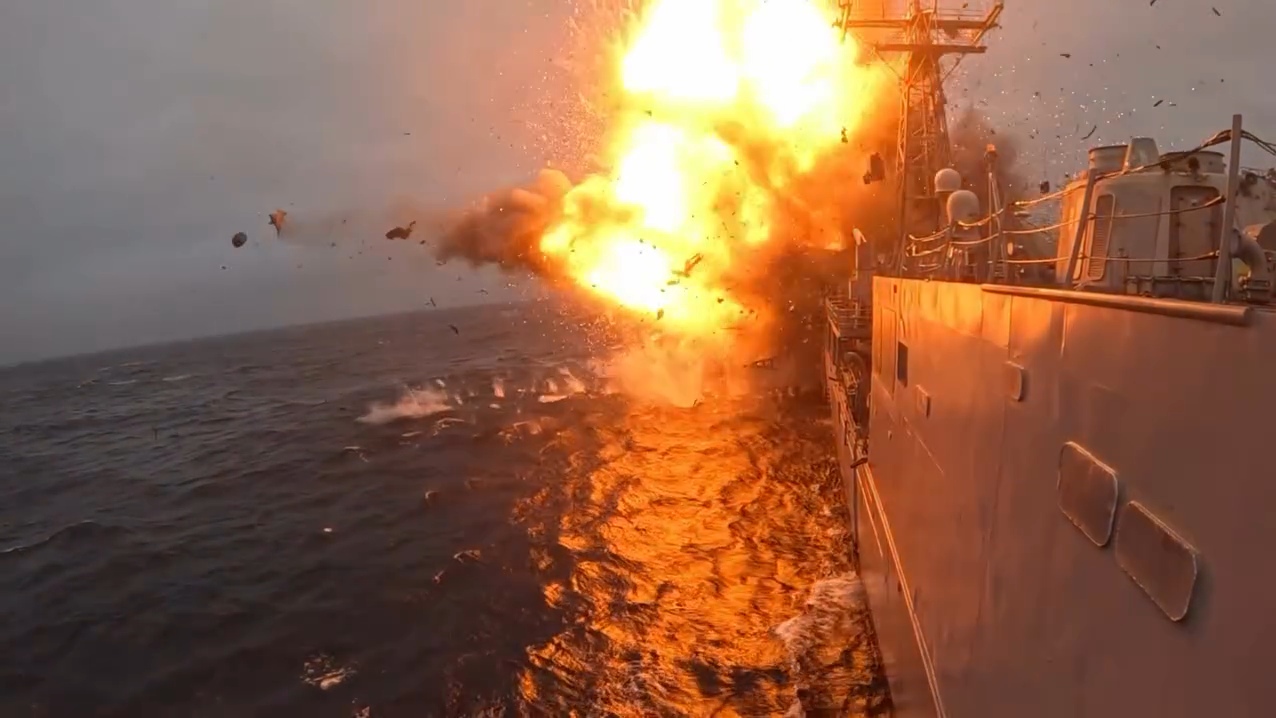
US and UK Forces Conduct Advanced Live-Fire Exercise off Scottish Coast, Sinking Decommissioned Frigate
Off the remote coast of the Scottish Hebrides, the United States Navy destroyer USS Paul Ignatius has successfully engaged and struck a decommissioned frigate, the former USS Klakring, as part of a complex multinational live-fire exercise known as Atlantic Thunder 26. The kinetic demonstration, which also involved other surface vessels and aircraft, represents a significant event in validating advanced naval warfare capabilities between the United States and the United Kingdom.
The USS Paul Ignatius (DDG-117) is an Arleigh Burke-class Flight IIA destroyer, one of the most capable and versatile warships in the U.S. Navy’s fleet. Commissioned in July 2019 and named after former Secretary of the Navy Paul Ignatius, the destroyer is equipped with the advanced Aegis Combat System. This system enables it to conduct simultaneous air defense, anti-surface warfare, and anti-submarine warfare operations, providing critical multi-mission capabilities. Since June 2022, the Paul Ignatius has been forward-deployed to Naval Station Rota in southern Spain. Its deployment underscores its strategic role in Europe, where it contributes to ballistic missile defense and undertakes a broad range of tasking across the eastern Atlantic and Mediterranean, supporting NATO and U.S. interests.
The target for this live-fire engagement was the former USS Klakring, an Oliver Hazard Perry-class frigate. This class of frigates served as a workhorse for the U.S. Navy for decades, providing general-purpose escort and anti-submarine capabilities before their gradual decommissioning. The Klakring itself was decommissioned in 2013 and had been in long-term storage at the Philadelphia Naval Inactive Ship Maintenance Facility. In preparation for Atlantic Thunder 26, the vessel began its journey on August 12, being towed down the Delaware River before embarking on an Atlantic crossing. Its initial destination in Scotland was Campbeltown. The use of decommissioned vessels like the Klakring in such exercises provides a realistic and cost-effective means for naval forces to test weapons systems and operational procedures against actual ship structures, offering invaluable data that cannot be fully replicated by simulations.
Atlantic Thunder 26, originally scheduled for a May window, was rescheduled for the second half of September, taking place at the QinetiQ Hebrides range in north-west Scotland. This remote and specialized range is frequently utilized for advanced military testing and exercises due to its expansive waters and controlled environment, making it ideal for large-scale kinetic demonstrations. A Request for Information (RFI) issued by the Ministry of Defence in August 2025, inviting industry participation, described Atlantic Thunder 26 as “a US-UK multi-domain exercise designed to validate SUW kill chains, build resilient kill webs and deliver strategic messaging through kinetic demonstration.” This description highlights the exercise’s focus on integrating various military assets across air, surface, and potentially sub-surface domains to achieve specific tactical and strategic objectives.
In military parlance, ‘SUW kill chains’ refer to the precise sequence of steps involved in detecting, tracking, targeting, and engaging enemy surface vessels. ‘Resilient kill webs’ denote a more advanced concept, where multiple sensors and shooters are networked together, allowing for redundancy and adaptability in targeting processes, even if some elements of the chain are compromised. The term ‘kinetic demonstration’ directly refers to the use of live ordnance to achieve a physical effect, in this case, the sinking of a target vessel. The phrase ‘strategic messaging’ indicates that beyond the technical validation, the exercise aims to project a clear message of military capability, readiness, and interoperability to both allies and potential adversaries.
The strike on the former USS Klakring, while a central component, is only one phase of the broader exercise. Following the impact, the Klakring is expected to settle at a depth of approximately 6,000 feet. A critical subsequent phase, emphasized by the Ministry of Defence in its approach to industry, involves the deployment of uncrewed underwater vehicles (UUVs). These autonomous platforms are tasked with conducting detailed battle damage assessment (BDA) on the sunken frigate and performing comprehensive seabed survey work. This BDA provides invaluable data on weapon effectiveness and structural integrity, while seabed surveys can inform future salvage operations, environmental impact assessments, or advanced research into deep-sea recovery and observation techniques, further enhancing understanding of modern naval warfare’s physical consequences and capabilities in challenging environments.
Atlantic Thunder 26 builds upon the precedent set by previous iterations, most notably Atlantic Thunder 22. Held off the same Hebrides range in September 2022, that exercise culminated in the sinking of the former USS Boone. Atlantic Thunder 22 involved a wide array of international assets, including the Royal Navy’s HMS Diamond, the U.S. Navy’s USS Arleigh Burke, Royal Air Force Typhoons, and U.S. Navy P-8 Poseidon maritime patrol aircraft. At the time, it was described as the most complex multinational sinking exercise ever staged in UK waters. The continued staging of such sophisticated, multi-domain exercises underscores the commitment of the U.S. and UK to enhancing their combined naval and air power capabilities, refining interoperability, and maintaining a robust defense posture in a dynamic global security environment.
Why This Matters
The successful execution of Atlantic Thunder 26 holds significant implications for international security and defense strategy.
Firstly, it serves as a powerful demonstration ofinteroperability and alliance strengthbetween the United States and the United Kingdom. The ability of two major naval powers to seamlessly integrate diverse platforms – from destroyers and aircraft to uncrewed underwater vehicles – in a complex live-fire scenario reinforces their strategic partnership and shared commitment to collective defense. This collaboration is crucial in an era of evolving global threats and highlights the deep trust and operational cohesion between these key NATO allies.
Secondly, the exercise is vital forvalidating advanced naval warfare concepts and technologies. By testing “SUW kill chains” and “resilient kill webs” with live ordnance, forces can assess the effectiveness of their command, control, communications, computers, intelligence, surveillance, and reconnaissance (C4ISR) systems and weapon systems against realistic targets. The subsequent battle damage assessment by UUVs also pushes the boundaries of autonomous underwater operations, providing critical data for future weapon development and operational tactics. This focus on kinetic demonstration and post-strike analysis is essential for maintaining a technological edge and adapting to new maritime challenges.
Thirdly, Atlantic Thunder 26 delivers a clearstrategic message. The public demonstration of sophisticated, destructive capability in a multinational context acts as a deterrent, signaling to potential adversaries the readiness and resolve of allied forces to defend their interests and deter aggression. This messaging is particularly relevant in the current geopolitical climate, where naval power projection, freedom of navigation, and sea control are increasingly contested, and the capability to project force decisively is a cornerstone of international stability.
Finally, these exercises contribute directly toforce readiness and training. While simulations are valuable tools, nothing replicates the pressure and learning experience of a live-fire event involving real ships and advanced weaponry. Such training ensures that naval personnel are proficient in their roles and that complex operational procedures are thoroughly tested under realistic conditions, ultimately enhancing the combat effectiveness of both the U.S. and UK navies and ensuring they are prepared for any contingency.