
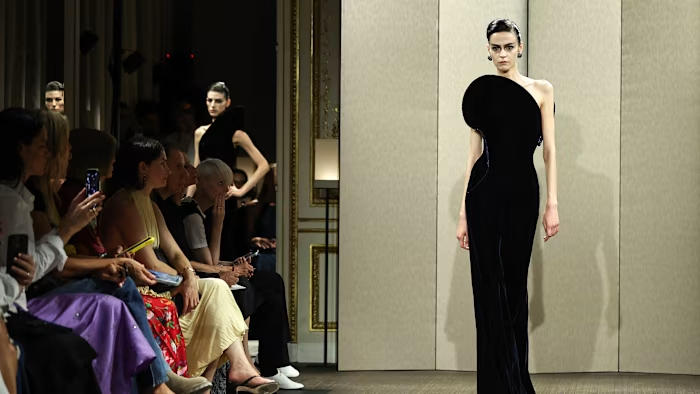
In a pivotal moment for the luxury sector, the iconic Italian fashion house Armani is set to initiate formal discussions with three formidable players—LVMH, L’Oréal, and EssilorLuxottica—over a potential minority stake sale. This strategic move, mandated by the will of its late founder, Giorgio Armani, marks the beginning of a new era for a company that has fiercely guarded its independence for half a century. The forthcoming negotiations unfold against a backdrop of a global luxury market experiencing a significant slowdown, adding layers of complexity to a succession challenge that epitomizes the struggles of many founder-led Italian brands.
Key Takeaways
- **Post-Founder Transition Amid Market Headwinds:** Armani’s move to sell a minority stake is driven by its founder’s will, forcing a critical succession and institutionalization process. This occurs during a pronounced downturn in global luxury spending, complicating valuation and investor appetite.
- **Strategic Suitors with Diverse Motivations:** LVMH, L’Oréal, and EssilorLuxottica are at the table, each with distinct strategic interests. Their motivations range from securing lucrative licensing agreements to exploring potential brand synergies, rather than a straightforward desire for outright acquisition, influencing the likely outcome of the stake sale.
- **Valuation Gap and Growth Strategy Under Scrutiny:** A significant valuation disparity exists between Armani’s internal estimate (€10bn) and potential investors’ assessment (€3-7bn). The company’s new leadership is focused on refining brand positioning, expanding high-margin accessories, and revitalizing key lines like Emporio Armani to demonstrate sustainable growth without its legendary founder.
Scheduled meetings in late September or early October will see Armani engage with these three potential investors regarding the sale of an initial 15 percent stake. This directive, a surprising twist from a designer renowned for his iron grip on the business, aims to ensure the brand’s longevity and institutionalization beyond his singular vision. However, sources close to the preferred suitors suggest that a substantial, immediate investment into the sprawling Armani empire—which encompasses fashion, haute couture, hotels, restaurants, and home furnishings—is not a certainty, especially given the current market climate.
One informally discussed option hints at a collaborative approach, where the 15 percent stake could be divided among LVMH, L’Oréal, and EssilorLuxottica. “No one wants to jump on it but no one wants to let it pass. This way everyone gets to be around the table,” noted one insider, highlighting the delicate balance of strategic interest and cautious commitment in a challenging M&A environment. This sentiment underscores the reluctance of even the largest luxury conglomerates to make bold, single-brand acquisitions in a softening market, preferring diversified exposure or strategic partnerships.
The passing of Giorgio Armani last September, at 91, thrust the company into a succession challenge all too familiar to Italy’s founder-led luxury houses. The imperative is to transform a business intrinsically linked to its founder’s persona into a robust, institutionally driven entity capable of flourishing independently. This transition is not merely about management; it’s about preserving brand DNA while adapting to modern luxury consumption patterns and investor expectations.
In response, the group has moved swiftly to institutionalize its leadership. Company veteran Giuseppe Marsocci was elevated to chief executive, tasked with developing a new strategy in collaboration with Boston Consulting Group. The core objective of this strategic overhaul is to sharpen the positioning of Armani’s diverse brand portfolio and aggressively expand into higher-margin categories, particularly accessories—a crucial revenue driver for contemporary luxury brands where Armani has historically been less dominant compared to peers.
The family-heavy board, previously chaired by Armani himself, has been revitalized with the appointment of industry luminaries such as former Gucci chief Marco Bizzarri and Yoox founder Federico Marchetti. Leo Dell’Orco, a long-serving executive, has taken the helm as chair. These appointments signal a clear intent to bring external expertise and a more corporate governance structure to the group, which also plans to streamline its complex operational structure encompassing Giorgio Armani, Emporio Armani, Armani Privé, and its hospitality ventures.
On the creative front, the appointment of Dario Vitale, known for his success in attracting younger consumers to Miu Miu, to reinvigorate Emporio Armani is a significant strategic move. Emporio, accounting for nearly a third of the group’s €2.2bn annual revenue, is positioned as Armani’s younger, more experimental line. Vitale’s brief is to imbue Emporio with a clearer, more contemporary identity, making it “younger, clearer and more relevant but without losing what makes it Armani.” This mirrors a broader luxury trend where established brands are keen to rejuvenate their ‘diffusion’ or secondary lines to capture Gen Z and millennial consumers, often seen as the future growth engine for the sector. Vitale will also spearhead the crucial push into accessories for Giorgio Armani, an area Marsocci has identified as “a great opportunity” for margin expansion.

The internal upheaval and strategic reorientation have, however, led to delays. Formal talks for the stake sale, initially anticipated in June, are now slated for late September or early October. This postponement provides additional time for Armani’s new management to solidify its strategic vision and present a more compelling growth narrative to potential investors amidst a challenging market.
These discussions will occur against the backdrop of a protracted downturn in luxury spending. Armani’s revenues declined for a second consecutive year in 2025, falling 2.8 percent to €2.19bn, following a 5 percent drop in 2024. This reflects a broader industry trend of post-pandemic normalization, exacerbated by inflationary pressures, geopolitical instability, and a slowdown in key markets like China. Despite the top-line pressures, earnings before interest, tax, depreciation and amortisation (EBITDA) notably rose 3.2 percent to €153mn, a testament to effective cost reductions and a stronger performance from the high-end Armani Privé line. This suggests that while volume growth is challenging, operational efficiency improvements are yielding results, which could be attractive to investors seeking resilient profitability.
The motivations of Armani’s preferred investors are complex and multifaceted. EssilorLuxottica, the eyewear behemoth and Ray-Ban owner, has a licensing deal with Armani until 2038. While supportive of the Armani family, people close to the situation suggest the group’s strategic focus lies in expanding its medtech division and consolidating its US presence, rather than acquiring a luxury fashion house. Any investment would likely be modest and driven by long-standing relationships and licensing continuity.
Similarly, L’Oréal, whose lucrative Armani licensing agreement runs until 2050, prioritizes protecting this revenue stream. While L’Oréal has made minority investments in fashion brands like Jacquemus, its core competency remains beauty, and it generally avoids operating fashion businesses. Their interest in Armani is therefore primarily defensive, ensuring the stability of a key brand in their vast fragrance and cosmetics portfolio.
LVMH, the world’s largest luxury conglomerate, has expressed interest, yet sources familiar with their position caution that Armani may not be an obvious strategic fit. LVMH’s portfolio thrives on high-margin accessories and a strong haute couture presence, whereas Armani’s sales are significantly weighted towards fashion and often at lower price points than LVMH’s core brands. However, the strong personal ties between the Arnault family and the late designer remain an important, if intangible, factor. LVMH’s interest might stem from a desire to prevent a rival from gaining a foothold or to selectively integrate parts of the Armani business that align with its existing brand architecture.
A significant stumbling block remains the valuation. While Armani’s inner circle has floated a figure of approximately €10bn, potential investors estimate its value to be substantially lower, between €3bn and €7bn. This wide disparity reflects differing views on the brand’s future growth prospects, its ability to transition effectively post-founder, the profitability of its diverse asset mix, and the current state of the luxury market. Should an agreeable valuation or an acceptable buyer fail to materialize, a stock market listing remains a fallback option, though this would likely expose the company to greater public scrutiny and potentially a lower initial valuation in a cautious market.
“The challenge is not selling Armani,” said one former group executive. “It is showing that Armani can grow without Giorgio Armani.” This statement encapsulates the core market concern. Investors are not just buying a brand; they are buying into a future vision that must prove its resilience and growth potential beyond the shadow of its legendary creator.
Market Impact
The outcome of Armani’s minority stake sale discussions will send ripples through the luxury sector. A successful, multi-party agreement, even for a minority stake, could provide Armani with much-needed capital for expansion, strategic expertise, and crucial market validation for its post-founder strategy. It could also signal a new model for institutionalizing independent Italian luxury brands without a full takeover. Conversely, a failure to reach an agreement, or a significant downward revision of the perceived valuation, could dampen investor confidence in other independent luxury players and potentially push Armani towards a challenging IPO in a soft market. For LVMH, L’Oréal, and EssilorLuxottica, securing a stake, even a small one, could further consolidate their influence within the luxury ecosystem, protect key licensing agreements, and prevent a competitor from gaining an advantage, regardless of whether Armani fully aligns with their existing portfolios. The market will closely watch this transaction as a barometer for M&A activity and investor sentiment in a luxury industry grappling with transformative changes and a more cautious consumer.