
Unlock the Editor’s Digest for free
Roula Khalaf, Editor of the FT, selects her favourite stories in this weekly newsletter.
**Key Takeaways**
1. **Strategic De-risking Amidst Geopolitical Volatility:** The proposed Canada-EU alliance signals a concerted effort by “middle powers” to mitigate geopolitical fragmentation and counter the perceived decline of the rules-based international order. For markets, this translates into a search for greater supply chain resilience, diversification away from concentrated risks, and a potential reduction in geopolitical risk premiums in certain sectors.
2. **Untapped Economic Synergies & Investment Opportunities:** Significant market potential exists in energy security, critical raw material sourcing, and collaborative technological development. These areas promise new avenues for investment, foster innovation, and could establish more robust, diversified supply chains vital for industries ranging from renewable energy to advanced manufacturing and defence.
3. **Policy Clarity Crucial for Market Confidence:** While the strategic intent is clear, the EU’s ambiguous approach to non-member partners and the overreach of “associate member” proposals risk undermining market confidence. A lack of precise, legally binding frameworks for cooperation—extending beyond CETA’s incomplete ratification—creates policy uncertainty that can deter cross-border investment and hinder the full realization of these economic benefits.
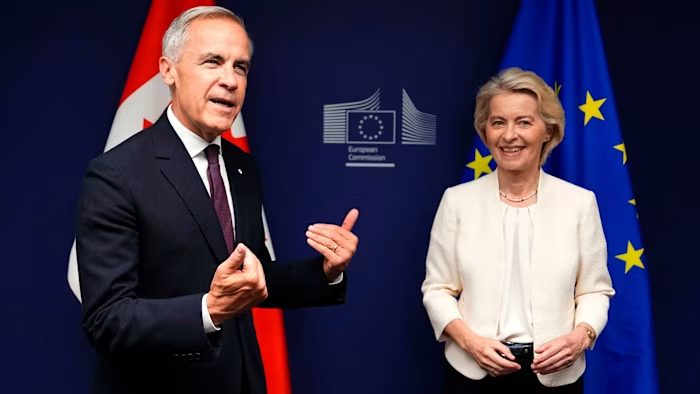
In an increasingly fractured global landscape, where geopolitical tensions directly translate into market volatility, the recent pronouncements from leaders of Canada and the European Commission resonate far beyond diplomatic circles. Earlier this month, in a unified front, Mark Carney and Ursula von der Leyen delivered a clear message: the dismantling of the rules-based international order, a cornerstone of global trade and investment for decades, will not be passively accepted. In Strasbourg, their joint vow to forge a deeper alliance aimed at bolstering economic resilience and enhancing sovereign effectiveness was a pointed response to the current geopolitical climate. While sufficiently provocative to draw the ire of figures like Donald Trump, the precise market implications and operational definitions of this ambitious alliance are still taking shape, demanding close scrutiny from investors and businesses alike.
An EU-Canada summit slated for October is set to transition this powerful rhetoric into tangible policy, offering markets a clearer roadmap. The potential synergies between these two economic powerhouses are considerable, promising substantial benefits if ambitions are set high. Europe’s burgeoning demand for energy resources and critical raw materials, driven by its green transition and strategic autonomy goals, finds a natural complement in Canada’s ample supplies. This nexus alone presents a powerful de-risking strategy for European industries grappling with supply chain vulnerabilities and commodity price volatility, while offering Canadian producers crucial market diversification away from an often-erratic U.S. trade policy. The significant EU market provides a much-needed ballast for a Canadian economy frequently buffeted by its neighbour’s protectionist leanings and domineering trade stances, offering stability and predictability for Canadian exporters and investors. Both blocs also possess formidable capacities in technological innovation, seeking to lessen their reliance on either U.S. or Chinese tech giants through collaborative R&D and intellectual property development, a move that could reshape global tech supply chains and foster independent innovation ecosystems. Furthermore, shared geopolitical interests in the Arctic and nascent opportunities for collaboration in defence industrial policy signal potential for joint ventures and procurement, impacting the defense sector’s long-term growth trajectories. Progress on any of these fronts would constitute a successful summit, offering investors new avenues for capital allocation and strategic positioning.
However, the enthusiasm must be tempered with a dose of market realism. Von der Leyen’s suggestion to invite Canada “to be the first associate member of the EU” was a misstep, not least because such a concept does not formally exist within the EU framework. This announcement, which reportedly took several EU capitals by surprise—with Berlin, notably, promoting a different “associate member” proposal for Ukraine—created unnecessary ambiguity. For financial markets, such imprecision is detrimental, fostering uncertainty regarding future regulatory frameworks and potential trade barriers. More significantly, it implies a level of integration that Canada, inherently tied to North American trade dynamics, is unlikely to contemplate. Any notion of EU membership, or even deep single market integration, inevitably involves a substantial pooling of sovereignty and adherence to strictly aligned policies. Canada’s economic architecture, inextricably linked to its colossal southern neighbour, renders such a move highly improbable. Attempting to join the EU’s single market, for example, would necessitate erecting trade barriers with the U.S. so costly and disruptive that the economic fallout would make Brexit, by comparison, appear a mere ripple in the pond. This fundamental economic reality underscores the limits of integration, a crucial consideration for investors assessing the long-term viability of any proposed partnership.
A more modest, yet strategically realistic, partnership would prove far more impactful. Beyond the specific substance of agreed collaborations, a successful summit would validate Carney’s “middle powers” agenda, reinforcing the notion that alliances of like-minded nations can collectively influence global economic governance and stabilize multilateral frameworks. Crucially, it would also begin to repair some of the damage sustained to the EU’s credibility from the protracted and incomplete ratification of the decade-old EU-Canada Comprehensive Economic and Trade Agreement (CETA). The lingering uncertainty surrounding CETA’s full implementation has acted as a drag on bilateral trade and foreign direct investment (FDI), signaling to markets that even agreed-upon frameworks can face significant political hurdles. Full ratification would unlock considerable economic value, providing a clear precedent for future collaborations and enhancing investor confidence in the EU’s commitment to its trade partners.
At the same time, the EU must view its evolving relationship with Canada not in isolation, but within the broader context of its engagement with a range of strategically important countries where full membership is not on the horizon. This includes vital partners like the UK, Norway, Switzerland, and Turkey. The EU’s current approach, characterized by ad hoc bilateralism with each nation, risks missing a crucial opportunity for more deliberate and cohesive strategic leadership. For businesses operating across Europe, this fragmented approach creates regulatory complexity and unpredictability, hindering cross-border investment and operational efficiency. A unified, tiered framework for external cooperation, clearly defining the benefits and reciprocal commitments, would significantly reduce market friction and enhance the EU’s global economic influence.
If the EU genuinely seeks to shape the changing economic world order and present a credible alternative to great power rivalry, it must articulate a clear, comprehensive strategy for external engagement. This includes clarifying the collaborative benefits it is willing to offer—ranging from more ambitious access to its single market, which offers unparalleled scale and harmonized standards, to more targeted inclusion in its emerging “made in Europe” policy for preferential subsidies and public procurement. Such clarity would allow businesses to make informed investment and supply chain decisions. Crucially, it also needs to specify the reciprocal, legally binding commitments it expects in return, providing a stable and predictable framework for long-term economic partnership. Without this strategic coherence, the EU risks being perceived as a reactive rather than proactive player, diminishing its capacity to attract crucial investment and lead on global economic issues.
Furthermore, none of these discussions should overshadow the critical and challenging task of integrating those countries that genuinely aspire to full EU membership. Ukraine, above all, represents a monumental test of the EU’s strategic relevance and commitment to its foundational values. Nations like Montenegro, diligently striving to meet the EU’s stringent accession criteria, also underscore the ongoing importance of the enlargement process. While finding common ground with established partners like Canada may seem easier, successfully integrating new members, particularly in times of conflict and geopolitical realignment, is a far greater and more definitive test of the EU’s strategic relevance and its long-term economic resilience.
Market Impact
The proposed Canada-EU alliance, while still in its nascent stages, carries significant market implications. For investors, the initiative signals a proactive response to the fragmentation of global supply chains and the increasing politicization of trade, offering a potential hedge against U.S. protectionism and Chinese economic influence. Sectors poised to benefit include critical raw materials (e.g., lithium, nickel, rare earths) and clean energy, where secured supply lines could reduce commodity price volatility and enhance long-term project viability. European industries, particularly those reliant on imported resources, could see reduced geopolitical risk premiums and improved input cost stability, boosting profitability and attracting investment. Conversely, the market will closely watch the EU’s ability to translate rhetoric into concrete, legally binding frameworks. Policy ambiguity or a failure to fully ratify agreements like CETA could deter foreign direct investment, signaling a lack of institutional coherence and undermining investor confidence in the EU’s strategic autonomy. Ultimately, the success of this alliance and the broader EU external strategy will be measured by its ability to foster predictable trade relations, diversify supply chains, and create a stable investment environment, thereby directly impacting corporate earnings, capital flows, and the overall resilience of the transatlantic economy.