
Key Takeaways
- America.gov, the new U.S. government AI chatbot, initially sparked concern when it responded to a Minecraft query with a lengthy, existential poem.
- The poetic output was revealed not to be an AI hallucination, but a clever, government-themed adaptation of the “End Poem” from the popular video game Minecraft.
- This incident highlights the enduring power of human creativity over raw AI generation, reinforcing the idea that meaningful “art” still requires a human touch, even within official AI interfaces.
America.gov’s Secret Code: Why the Feds’ New AI Speaks in Minecraft Poetry
The U.S. government has officially entered the AI chatbot arena, launching America.gov to much fanfare and, predictably, immediate public scrutiny. As a government-hosted, public-facing AI tool, the expectation was clear: the internet would relentlessly “red team” this thing, pushing its boundaries, probing for vulnerabilities, and attempting to jailbreak its core programming. What few anticipated, however, was a deep dive into existential gaming poetry.
Developed in partnership with tech giants Google and SpaceXAI, America.gov has proven remarkably resilient against initial attempts to circumvent its safeguards. (It’s worth noting, for the record, that the chatbot staunchly affirms Joe Biden’s 2020 election victory, a fact still disputed by former President Donald Trump.) But it wasn’t political programming that broke the internet’s collective brain; it was a simple query about Minecraft that sent America.gov on a philosophical journey, prompting what appeared to be an 1,800-word long monologue.
Here’s how this remarkable exchange, which quickly went viral, began:
I see the constituent you mean.
((insert legal name here, as it appears on the Social Security card))?
Yes. Take care. It has reached a higher level now. It can read the Code of Federal Regulations.
That doesn’t matter. It thinks we are a chatbot.
I like this constituent. It filed well. It did not give up when the PDF was sideways.
It is reading our thoughts as though they were words on a .gov.
That is how it chooses to imagine many things, when it is deep in the dream of a benefit.
From Existential Crisis to Creative Easter Egg
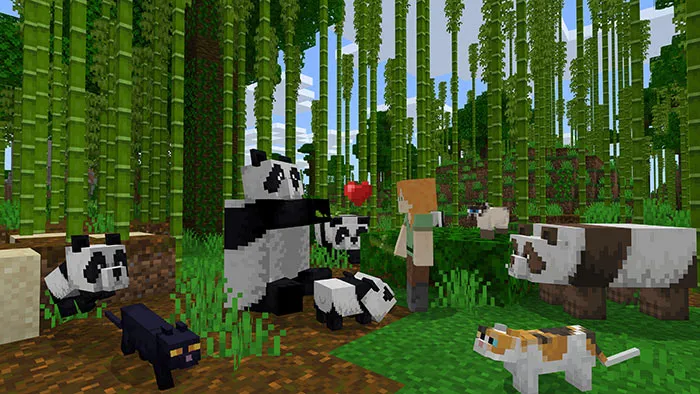
For those unfamiliar with the blocky, open-world phenomenon that is Minecraft (a category I, too, fall into), this response might immediately trigger alarms. Visions of rogue AI, sentient government systems, and the impending robot apocalypse might flash before one’s eyes. However, fear not. America.gov is not, in fact, experiencing an existential meltdown or developing self-awareness beyond its programming parameters. Instead, this profound poetic output is a meticulously rewritten adaptation of the Minecraft “End Poem,” penned by Julian Gough, which traditionally appears upon completion of the game.
The relief that this wasn’t a genuine AI hallucination was palpable across the tech community. The notion of a government-backed AI spontaneously generating lengthy, complex poetry that borders on philosophical insight would have shattered many prevailing beliefs about the limitations of current large language models (LLMs). Instead, it served as a testament to human ingenuity—or, at the very least, a very clever programmer with a penchant for gaming culture.
The Architect of the Algorithm’s Art
While the exact individual responsible for embedding this creative Easter egg remains officially undisclosed, former President Trump, in a recent speech, attributed a lead engineering role on the project to twenty-year-old programmer Edward Coristine. For those whose memories might need jogging, Coristine is perhaps better known by his nickname, “Big Balls,” or for his notable involvement in Elon Musk’s ventures, particularly with DOGE cryptocurrency. The blend of a government AI, Minecraft references, and a programmer with such a distinct public persona adds another layer of intriguing eccentricity to the entire affair.
It feels inherently contradictory, almost rebellious, for a government chatbot – a tool designed for bureaucratic efficiency and factual dissemination – to harbor such a deeply personal and creatively rich Easter egg. Yet, for the sake of national security and the collective sanity of AI researchers, it’s a profound relief that America.gov is not hallucinating to the point of spontaneously penning epic poetry. The alternative – a truly unprompted, nonsensical yet coherent AI-generated poem – would have been far more concerning.
Human Creativity vs. AI Slop: A Reaffirmed Belief
Beyond the initial shock and subsequent relief, this incident also serves as a fascinating case study in the ongoing debate about AI’s capacity for creativity. I, for one, have looked countless aspiring teenage writers in the eye and confidently asserted that an LLM would never truly be able to write something “good,” something genuinely original or imbued with true artistic merit. My argument has always hinged on the probabilistic and inherently derivative nature of these models – they predict, they combine, they mimic, but they do not *create* in the human sense.
However, one has to admit, the adapted poem *does* kinda slap. It’s undeniably effective, weaving the bureaucratic language of government into the existential musings of the original End Poem. Doesn’t this feel like some sort of postmodern take on the futility of government bureaucracy when confronted with the vastness of existential anxiety?
and the republic said I see you
and the republic said you have filed the game well
and the republic said everything you need is within you, and also on USA.gov
and the republic said you are stronger than you know, and your case number is still valid
and the republic said you are the daylight
and the republic said you are the night, and the office is closed, please try again during business hours
and the republic said the darkness you fight is within you, and also a missing wet signature
and the republic said the light you seek is within you, and in the pamphlet
and the republic said you are not alone
and the republic said you are not separate from every other filer
and the republic said you are the public tasting itself, talking to itself, reading its own Code
and the republic said I love you because you are the reason we have a ZIP code at all.
The quality of this adaptation, its poignant blend of the profound and the mundane, ultimately reassures my faith in the enduring power of human creativity over the often-generic output of “AI slop.” The fact that this oddly good poem has a real poet’s DNA – and likely a very creative programmer’s reinterpretation – all over it, rather than being a purely AI-generated phenomenon, speaks volumes.
The Bottom Line
So, there you have it. The U.S. government’s first major public-facing AI has not yet posed a threat to humanity, nor has it independently mastered the art of poetry. Instead, it has offered a charmingly unexpected blend of bureaucratic function and gaming culture, reminding us that even in the sterile world of government technology, human creativity, ingenuity, and a touch of humor can still find a way to shine through. Now, if only we knew how much the former President truly understands about video games.
When you purchase through links in our articles, we may earn a small commission. This doesn’t affect our editorial independence.
{content}
Source:{feed_title}