
Key Takeaways for Investors:
- **Resilient Q3 Deliveries Amidst Headwinds:** Tesla’s better-than-expected Q3 delivery figures of 486,532 vehicles, significantly outpacing analyst estimates, provide a much-needed signal of demand resilience. This performance, primarily fueled by a robust European rebound, partially alleviates investor concerns regarding global EV market saturation, intense competition, and macro-economic pressures like elevated interest rates.
- **Shifting Regional Dynamics and Growth Narrative:** The remarkable recovery in European sales, where the Model Y emerged as a top seller in France, highlights the criticality of diversified market strength. This regional success helped mitigate the impact of expiring U.S. tax incentives and the ongoing, fierce price wars within the highly competitive Chinese EV market, underscoring Tesla’s challenge to maintain its growth trajectory and avert a third consecutive annual decline in deliveries.
- **Beyond Deliveries: The AI and Robotics Valuation Premium:** While operational delivery numbers offer immediate insight, the market’s long-term valuation of Tesla increasingly hinges on its ambitious ventures into Artificial Intelligence, advanced Full Self-Driving (FSD) capabilities, humanoid robots, and integrated energy solutions. Investors are actively assessing whether these futuristic pivots can justify Tesla’s premium multiple, especially as the core automotive business navigates a more competitive, interest-rate-sensitive, and technologically evolving landscape.
Yardeni Research President Ed Yardeni joins the panel to discuss how higher yields weigh on stocks. He analyzes Magnificent 7 performance against the S&P 500 and explains the outlook for technology and communication sectors.
Tesla (NASDAQ: TSLA) delivered a surprising beat on its third-quarter delivery figures, reporting 486,532 vehicles, significantly exceeding Wall Street’s consensus estimate of 456,896. This stronger-than-expected performance, disclosed on Friday, offered a crucial dose of optimism to investors grappling with a volatile market characterized by escalating interest rates and a tightening monetary policy environment, as highlighted by Ed Yardeni’s analysis on the broader impact of higher yields on stocks, particularly within the tech-heavy ‘Magnificent 7’ cohort that includes Tesla.
The Austin, Texas-based electric vehicle (EV) giant’s shares responded positively, climbing nearly 2% in premarket trading. This uptick provided some respite after the stock had experienced a challenging year-to-date, falling more than 21% through its last close, indicative of broader market anxieties concerning Tesla’s growth trajectory, profitability, and intensifying competition within the global EV landscape.
The core of Tesla’s Q3 outperformance lay in a robust recovery in European demand. This resurgence in sales across the continent effectively counterbalanced the headwinds encountered in its two historically largest markets: the United States and China. In the U.S., Tesla faced the lingering impact of the loss of certain federal tax incentives for its vehicles, which had previously stimulated demand. Concurrently, China presented a formidable challenge with heightened domestic competition from local EV manufacturers and a more price-sensitive consumer base, leading to aggressive pricing strategies across the industry.
TESLA BEGINS DELIVERING SEMI TRUCKS TO CUSTOMERS AFTER YEARS OF DELAYS
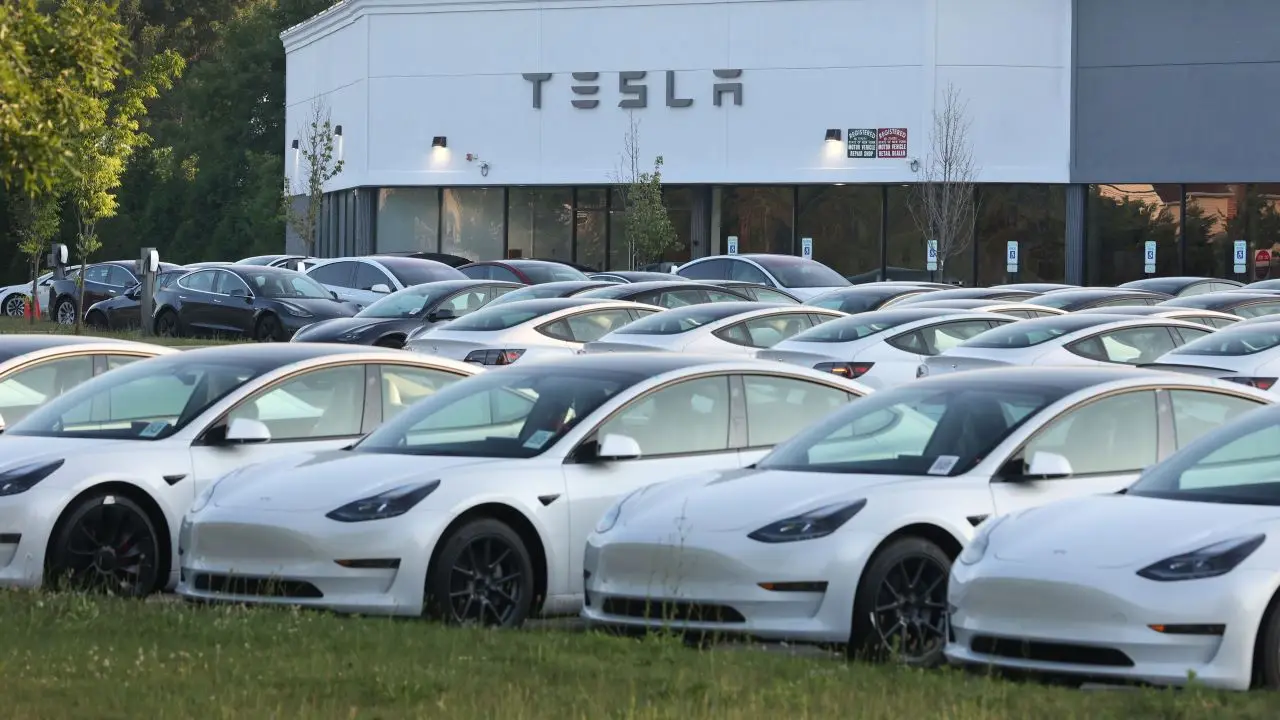
Stronger European vehicle sales offset weaker U.S. and China demand.(John Paraskevas/Newsday RM via Getty Images)
The reported delivery figure of 486,532 vehicles for the July-September period, against Visible Alpha’s compiled analyst average of 456,896, suggests a potential stabilization, if not a modest resurgence, in Tesla’s core automotive business. This is a critical development for a company that has seen its annual sales growth rates moderate after two consecutive years of unprecedented expansion. For Tesla to avoid a third straight annual decline in deliveries, a psychological threshold that could further weigh on investor sentiment, it must deliver at least 311,448 vehicles in the upcoming fourth quarter. This target underscores the ongoing pressure on Tesla to maintain robust sales momentum through year-end.
TESLA REOPENS ROADSTER RESERVATIONS – BUT YOU’LL NEED $50K
The demand landscape leading into the quarter appeared promising, with finance chief Vaibhav Taneja noting in July that Tesla “exited Q2 with our largest order backlog since 2023.” This backlog provided a degree of confidence, suggesting underlying consumer interest despite the aforementioned market challenges. The conversion of this backlog into Q3 deliveries, particularly in Europe, validates this sentiment.
| Ticker | Security | Last | Change | Change % |
|---|---|---|---|---|
| TSLA | TESLA INC. | 354.11 | -0.70 | -0.20% |
The resurgence in Europe is particularly noteworthy. After a slump last year, partly attributed to a perceived “Musk backlash” impacting brand perception, EU registrations for Tesla vehicles surged by approximately two-thirds through August. In a significant market triumph, the Tesla Model Y became the best-selling car of any type in France, marking the first instance a Tesla model has achieved such a top ranking. This indicates a strong rebound in consumer acceptance and market penetration, potentially driven by enhanced charging infrastructure, favorable government incentives for EVs in certain European nations, and the inherent appeal of Tesla’s technology.
Furthermore, exports from Tesla’s critical Shanghai Gigafactory nearly doubled in July and August, indicating a strategic reallocation of production to meet international demand, including the burgeoning European market, even as domestic Chinese sales faced intensified pressure.
TESLA FILES PLANS FOR PROPOSED $10.1B TEXAS SOLAR MANUFACTURING PLANT
Looking ahead, analysts anticipate that the gradual rollout of the company’s Full Self-Driving (FSD) software in Europe will provide an additional catalyst for sales. With FSD now approved in eight European countries, this advanced technology could serve as a key differentiator, attracting tech-forward consumers and potentially justifying a premium over competing EV models.

Tesla recently added its purpose-built Cybercab to its existing robotaxi service in Austin.(Mike Blake/Reuters)
However, the narrative around Tesla’s valuation has evolved beyond mere quarterly delivery figures. Investors are increasingly looking past vehicle sales to the company’s more ambitious, high-growth ventures. CEO Elon Musk has consistently shifted Tesla’s focus toward Artificial Intelligence (AI), the development of truly autonomous self-driving cars, humanoid robots (Optimus), and its broader energy storage and generation solutions. This strategic pivot positions Tesla not merely as an automotive manufacturer but as a diversified technology and AI powerhouse. The market is keenly watching developments like Tesla’s robotaxi service, which now operates without a safety supervisor in Texas and Florida, and the recent integration of its purpose-built Cybercab into the Austin robotaxi fleet. These initiatives are central to Musk’s vision of future revenue streams and are heavily factored into the company’s long-term valuation model, often placing it in a category distinct from traditional automakers.
GET FOX BUSINESS ON THE GO BY CLICKING HERE
A subtle but important detail in the Q3 report was the production figure: Tesla produced 464,391 vehicles, which fell below both analyst estimates of 486,761 and its own delivery figures for the quarter. This discrepancy implies that Tesla drew down existing inventory to meet delivery targets, a move that can manage inventory levels but might raise questions about immediate production capacity if not reconciled in subsequent quarters. This operational nuance will be scrutinized as the company provides further insights during its upcoming earnings call.
Market Impact:
Tesla’s Q3 delivery beat serves as a crucial positive data point for a stock that has navigated significant volatility this year, offering a temporary boost to investor confidence. The strong European performance highlights the company’s ability to pivot and capitalize on regional growth pockets, mitigating weaknesses elsewhere. However, the underlying challenges in the U.S. and particularly China, coupled with the production-to-delivery mismatch, suggest that sustainable growth and margin expansion will remain key investor concerns. The market will continue to weigh the foundational automotive business against the speculative, yet potentially transformative, AI, FSD, and robotics ventures. For the broader EV sector, Tesla’s resilience underscores the ongoing market expansion but also the intensifying competitive pressures that necessitate strategic flexibility and technological innovation. Furthermore, in an environment where higher yields are weighing on growth stocks, as noted by Ed Yardeni, Tesla’s ability to demonstrate tangible progress in its futuristic endeavors will be critical for maintaining its premium valuation and influencing investor sentiment across the tech and automotive segments.