
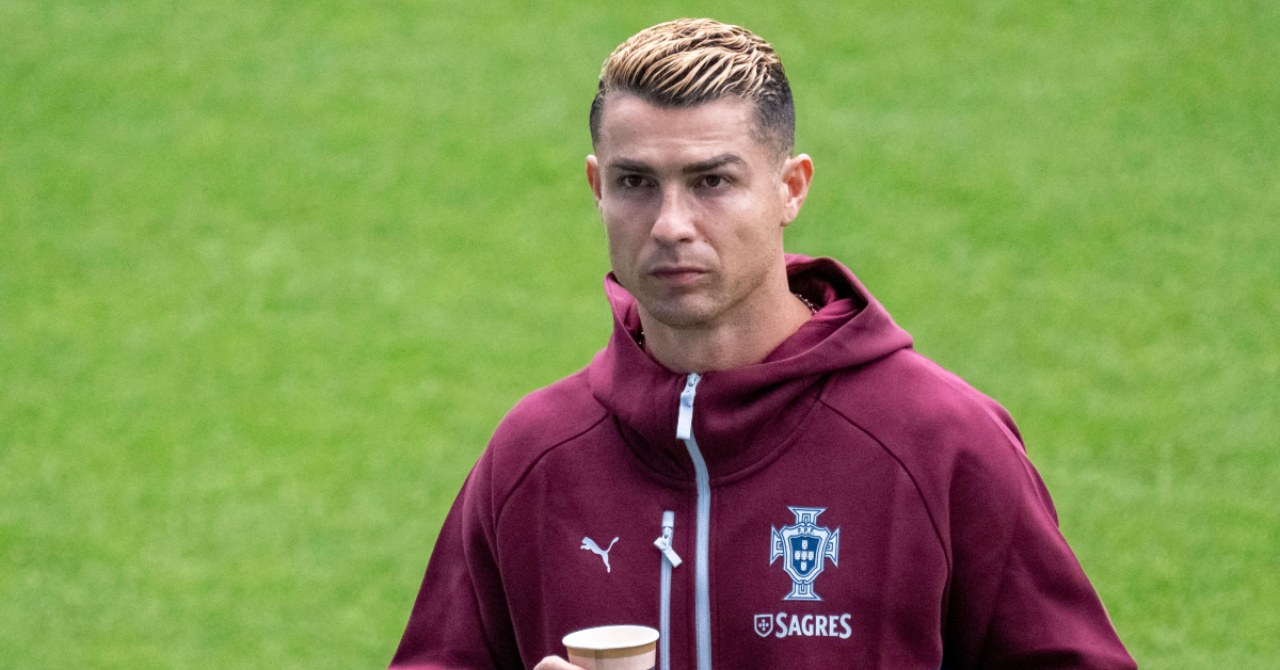
The air around the Portuguese national team is thick with tension, a palpable unease that even the recent Nations League victory over Norway can’t entirely dispel. At the heart of this storm, two titans clash: legendary forward Cristiano Ronaldo and the unyielding head coach, Jorge Jesus. FPF president Pedro Proença, caught in the eye of this hurricane, desperately attempts to navigate the tempest, expressing confidence that this “misunderstanding” will soon be resolved and hoping for Ronaldo’s return in November. But is it merely a misunderstanding, or a seismic shift in the power dynamics of a footballing nation?
The saga erupted with startling force prior to last week’s crucial Nations League clash against Denmark. The catalyst? Coach Jesus’s audacious decision to leave Ronaldo on the bench for the preceding game against Norway. For a player who has redefined the very concept of footballing longevity and impact, being an unused substitute was an unprecedented indignity. The fallout was swift and dramatic: Ronaldo, the talismanic captain, walked out on the squad, reportedly flying back from Copenhagen in his private jet just hours before the Denmark fixture. He was, predictably, not considered for the return leg against Norway in Porto, a match Portugal ultimately clinched 2-1, with a new hero, Gonçalo Ramos, stepping into the void left by the absent icon.
As Ronaldo prepares to rejoin his club side Al-Nassr this Friday, the football world watches with bated breath, wondering if a resolution can indeed be forged before the November international break. Proença, speaking to RTP, painted a picture of internal dynamics, asserting, “The FPF is not a house without rules but these dynamics happen within a working group. There is a very strong relationship between Jorge Jesus and Cristiano Ronaldo. If that were not the case, maybe Ronaldo would have already retired from the national team. Everything that will happen in the next few days are moments of tranquility, conversation, discussion and what we want is that in November he can be with our squad again.” His words, while reassuring, hint at the deep-seated complexities and the delicate tightrope he must walk.

Ronaldo is Our Legend – Proença’s Diplomatic Dance
Proença’s position is unenviable. He must uphold the authority of the coach while simultaneously honouring the unparalleled legacy of the national team’s greatest ever player. It’s a masterclass in diplomatic balancing. “Ronaldo is the best player of all time,” Proença affirmed, leaving no room for doubt regarding the striker’s historical significance. “He has given more than two decades to Portuguese football. Cristiano Ronaldo is the greatest symbol of Portugueseness. He is in the national team for his own sporting merit and this is absolutely unquestionable. He will always be part of this squad whenever he is technically capable. Cristiano knows that this is the feeling.”
The FPF president’s narrative is clear: this is a temporary hiccup, a familial dispute. “On the specific subject, let me say that we are facing a misunderstanding that has to be resolved internally. He’s part of the squad, he’s our legend. He was the captain for the first of these four games. The coach says he counts on him.” Proença’s words are a clear plea for unity, a recognition of Ronaldo’s enduring emotional connection to the team and its fans. “Cristiano Ronaldo is a Portuguese legend, an absolutely extraordinary player who could have ended his career after the World Cup but did not want to do it because of the love he has for his national team. I am a witness of this relationship that Cristiano has with the Portuguese people, with our team. Therefore, now that these four games are over, we will all have time and tranquility to sit down and solve a misunderstanding. Ronaldo is part of our heritage and will be here whenever the coach wants him to be.” The sentiment is strong, but the final clause – “whenever the coach wants him to be” – subtly underlines where the ultimate power now lies.

Jesus – The Unapologetic Strategist
While Proença preaches reconciliation, Jorge Jesus stands firm, a bastion of tactical conviction. He welcomed the idea of Ronaldo’s return but drew a definitive line in the sand: no apology would be forthcoming. “I don’t apologise to anyone,” he declared, his words echoing through the press room like a gauntlet thrown. “The problem that started all of this was that the player was warming up. I made the decision [not to bring him on]. What do I have to apologise for?” This unyielding stance is a bold assertion of his authority, a clear message that no player, regardless of stature, is above the team’s tactical requirements or the coach’s decisions.
Jesus elaborated on his principles, emphasizing the professional detachment required of a coach. “I don’t know what Cris will decide. I’ve already said what I have to say, but I’ll add, for me, at first it was never a situation. It was something I thought was normal as a coach. There are principles as a coach that are non-negotiable.” His analysis of Ronaldo’s reaction is equally telling, acknowledging his legend status but framing the incident as a player-created drama. “It was something he created himself, and maybe well because he’s a legend, this whole problem of coming on, warming up, not coming on… How many warmed up today and didn’t come on? Will there be any problem? No. With Cris it’s different, he’s a legend. But is it a problem? It’s not a problem for me. If Cris wants to and is playing for Al-Nassr he will be called up. But it’s Cris who will decide.” The message is clear: the ball is in Ronaldo’s court, but on Jesus’s terms.
Game Highlights: Life Without the King
The two Nations League fixtures offered a stark glimpse into a potential future for Portugal without its most luminous star, showcasing both the challenges and unexpected opportunities that arise in his absence.
Denmark vs. Portugal
In Copenhagen, Portugal faced a resilient Danish side eager to exploit any perceived disunity. Ronaldo’s last-minute departure undoubtedly cast a long shadow, affecting team morale. The game itself was a cagey affair, ending in a frustrating 0-0 draw. Portugal dominated possession but lacked the clinical edge and unpredictable brilliance that Ronaldo often provides. João Félix and Rafael Leão showed flashes of individual skill, but the collective struggled to break down Denmark’s organized defense. It was a performance that highlighted the void, leaving many to wonder if Portugal truly could thrive without their goal-scoring machine.
Portugal vs. Norway (Porto)
The return leg in Porto was a different story, imbued with a desire for redemption and a chance to prove the team’s depth. Norway, buoyed by the draw in Denmark, started strong. Portugal fell behind early in the first half to a stunning long-range strike. However, the team showed character, levelling just before the break through a powerful header from Rúben Dias. The second half saw a more fluid and determined Portuguese side. The decisive moment arrived in the 79th minute when Gonçalo Ramos, stepping into Ronaldo’s shoes, latched onto a Bernardo Silva through-ball and coolly slotted home the winner, sparking jubilant celebrations. Ramos’s decisive goal, scored with an authority that belied his relative inexperience, served as a powerful statement: the national team is evolving, and new heroes are ready to emerge, even in the colossal shadow of a legend.
Portugal’s next games are during the November international break when they host Denmark before taking on Wales in Cardiff. These fixtures will be critical in shaping the squad’s dynamics and potentially determining Ronaldo’s immediate future with the national team.
Prediction: A Cautious Reconciliation, But a Shifting Landscape
The “misunderstanding” between Ronaldo and Jesus is less about a single incident and more about a clash of eras and egos. Proença’s efforts will likely yield a temporary peace, with Ronaldo making a return in November. However, it will be a different Ronaldo, and a different Portugal. Jesus has successfully asserted his authority, and the emergence of players like Gonçalo Ramos means Ronaldo’s starting spot is no longer sacrosanct. He will be part of the squad, but his role will be more rotational, more tactical, and less central to the entire system. This incident marks a pivotal moment: the beginning of the post-Ronaldo era for Portugal, even with Ronaldo still in the team. The legend will conclude his international career with a diminished, albeit still significant, role, adapting to a team that has learned to win without him.