

Key Takeaways
- Political Optimism vs. Fiscal Reality:SSA Commissioner Frank Bisignano’s assurance of Social Security’s longevity for another 90 years contrasts sharply with official trustee projections of the main trust fund’s insolvency by 2032, highlighting the political tightrope walk on critical entitlement programs.
- Looming Benefit Cuts & Economic Impact:Without legislative intervention, Social Security beneficiaries face automatic benefit reductions of 22-28% as early as late 2032. This prospective cut poses a significant threat to millions of American households, potentially dampening consumer spending and impacting retirement planning across the economy.
- Market Uncertainty Amidst Demographic Strain:The ongoing lack of concrete, bipartisan solutions to address Social Security’s demographic imbalances (declining worker-to-retiree ratio) creates fiscal uncertainty. This ambiguity influences investor sentiment, government bond yields, and long-term economic growth forecasts.
Michael A. Peterson, CEO of the Peter G. Peterson Foundation, discusses the fiscal challenges facing the U.S. and why policymakers need to pursue solutions.
In a striking declaration that seeks to reassure an anxious public and, by extension, the financial markets, Social Security Administration Commissioner Frank Bisignano stated Monday that the entitlement program is poised to endure for another 90 years, despite official warnings that a key trust fund is on a collision course with insolvency. Bisignano’s comments, made during a CNBC “Squawk Box” interview, come ahead of this week’s announcement of the 2027 cost-of-living adjustment (COLA) for Social Security benefits, a routine adjustment now scrutinized more closely amidst persistent inflation and the program’s long-term fiscal health.
As one of the trustees of Social Security’s trust funds, Bisignano’s optimistic outlook aims to temper fears surrounding the program’s future, a concern that consistently registers as a top issue for voters and investors alike. “This is a long journey. It’s 90 years old, and it’ll be around for another 90 years. The president has promised to protect and preserve and that’s what we’re doing,” Bisignano affirmed, echoing a familiar political mantra. This sentiment, while politically expedient, often meets with skepticism from financial analysts who prioritize concrete legislative action over broad assurances.
“We have a trust fund, so they have trustees, which I am one of. We have a president who is committed to this and lives by ‘protect and preserve’ and made it a mandate to me,” he added. However, Bisignano quickly pivoted to operational improvements rather than systemic reforms, noting, “Ultimately, it will be the White House and Congress and the trustees. But the job, when you have 30 million records that are wrong, is fix the place.” He explained that the SSA has already corrected about 10% of erroneous records, a vital administrative task but one that does not directly address the fundamental demographic and financial imbalances driving the solvency crisis.
When pressed on potential reforms to shore up Social Security’s finances, such as raising the full retirement age or adjusting the payroll tax cap, Bisignano acknowledged that there “will always be questions” but conspicuously sidestepped a discussion on changes to benefits or the taxes that finance them. This reluctance to delve into policy specifics underscores the political sensitivity of Social Security reform, which has historically proven to be a third rail for lawmakers, leaving markets in a state of perpetual uncertainty regarding the eventual legislative path.
SOCIAL SECURITY RECIPIENTS MAY GET BIGGER BENEFIT BOOST IN 2027
Social Security Administration Commissioner Frank Bisignano predicted the entitlement program will be around for another 90 years despite financial challenges.(Mandel Ngan/AFP via Getty Images)
Social Security, established in 1935 and operational since 1937, has been a cornerstone of American retirement security. Yet, over the ensuing decades, it has come under escalating financial pressure due to profound demographic shifts in the U.S. population. The latest report from the program’s own trustees starkly projects that Social Security’s main Old-Age and Survivors Insurance (OASI) trust fund will be depleted in 2032. This is not merely an accounting issue; it’s a critical financial inflection point that would, by law, trigger automatic benefit cuts for millions of beneficiaries.
Once Social Security’s trust fund becomes insolvent, the program is statutorily required to cut benefits to match incoming payroll tax revenue. Based on the trustees’ estimate, this would mean Social Security could only pay 78% of scheduled benefits in late 2032, an estimated benefit reduction of 22%. Such a cut would be devastating for many retirees who rely on Social Security for a substantial portion of their income, potentially leading to a significant contraction in consumer spending among an already vulnerable demographic. For the markets, this translates to reduced demand, particularly in sectors catering to seniors, and increased pressure on personal savings rates.
SOCIAL SECURITY’S MAIN TRUST FUND FACES DEPLETION IN 2032, TRIGGERING BENEFIT CUTS

Social Security’s main trust fund is projected to reach insolvency in 2032, which would trigger automatic benefit cuts.(Getty Images/stock)
Estimates of the exact size of the benefit cut vary, adding another layer of uncertainty. The nonpartisan Congressional Budget Office (CBO) has projected benefits could be cut by an average of 28% per year from 2033 to 2036. The CBO’s analysis also highlighted that the precise method for implementing these cuts isn’t explicitly outlined in federal law, meaning various approaches could have wide-ranging implications for the broader economy and the federal budget, further complicating market assessments of future fiscal stability. The Committee for a Responsible Federal Budget (CRFB), another nonpartisan think tank, previously estimated a 24% benefit reduction, which would translate to a staggering $18,400 cut to annual benefits for a typical couple aged 60 retiring at the time of insolvency.
These projections underscore the grim reality confronting Social Security’s finances, which have deteriorated precipitously in recent decades. The primary culprit is the declining ratio of workers contributing to the program relative to the number of retirees drawing benefits. SSA data illustrates this demographic cliff: the ratio of covered workers to Social Security beneficiaries plummeted from 41.9 in 1945 to 16.5 in 1950, then to 5.1 in 1960, four in 1965, and crucially, dipped below three for the first time in 2010. This trend is driven by lower birth rates, increased life expectancy, and the retirement of the large Baby Boomer generation, creating an unsustainable “pay-as-you-go” system without significant adjustments.
ONE TYPE OF SOCIAL SECURITY ADJUSTMENT COULD CUT THE 75-YEAR SHORTFALL IN HALF
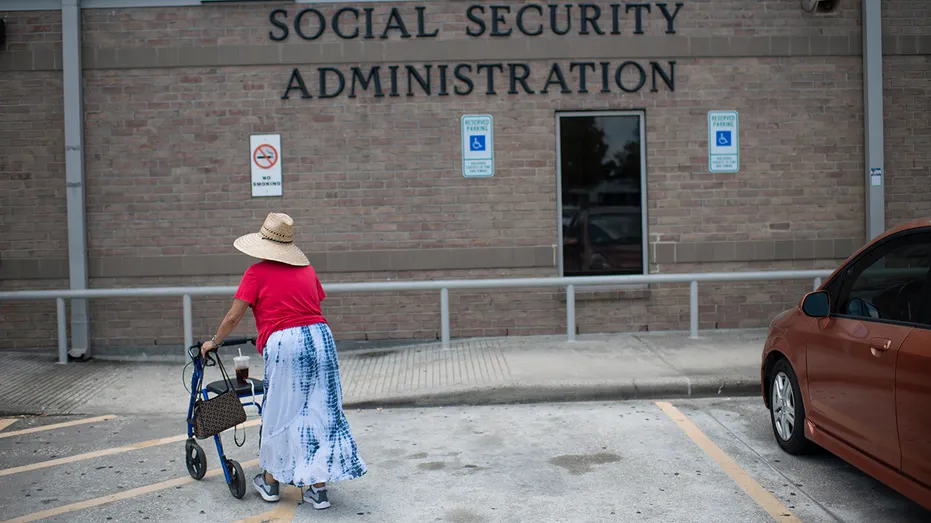
Social Security’s finances have been strained by the growing number of retirees relative to workers paying into the program.(Mark Felix/The Washington Post)
The aging U.S. population has also contributed significantly to an uptick in federal spending on Social Security, which stands as the largest government program. Spending on Social Security alone is projected to increase by 5% in the federal government’s fiscal year 2026, further exacerbating the nation’s broader fiscal challenges, as highlighted by organizations like the Peter G. Peterson Foundation. This escalating expenditure, alongside rising interest rates on the national debt, places immense pressure on federal budgets and could crowd out other essential government investments, affecting long-term economic productivity and competitiveness.
The lack of a bipartisan consensus on reforms—whether through raising the full retirement age, increasing the payroll tax rate or the cap on taxable earnings, or adjusting the COLA formula—leaves the financial markets to price in an ever-growing degree of uncertainty. Investors often view this political paralysis as a significant fiscal risk, potentially impacting the demand for U.S. Treasury bonds and, by extension, the government’s borrowing costs. Until policymakers move beyond rhetoric and towards actionable solutions, the shadow of Social Security’s impending insolvency will continue to cast a pall over America’s long-term financial outlook.
CLICK HERE TO DOWNLOAD THE FOX NEWS APP
Market Impact
The persistent uncertainty surrounding Social Security’s solvency and the lack of a clear legislative path to reform pose significant implications for financial markets. Equity markets, particularly sectors sensitive to consumer spending and retirement income (e.g., consumer discretionary, healthcare, financial services), could face headwinds from prospective benefit cuts, which would reduce purchasing power for millions of retirees. Furthermore, the prospect of future tax hikes to shore up the system could impact corporate earnings and individual disposable income, dampening overall economic growth projections. The fixed-income market is also acutely sensitive; increased government borrowing to avoid benefit cuts would add to the national debt, potentially pushing up Treasury yields and raising the cost of capital across the economy. Conversely, if benefits are indeed cut, it could alleviate some pressure on future government spending, but at the cost of immediate economic slowdown. Real estate markets, particularly those catering to retirees, could see demand fluctuations. Overall, the political inaction on Social Security injects a chronic element of fiscal risk into market valuations, influencing long-term investment strategies and contributing to broader investor caution regarding the U.S. government’s fiscal stability.