
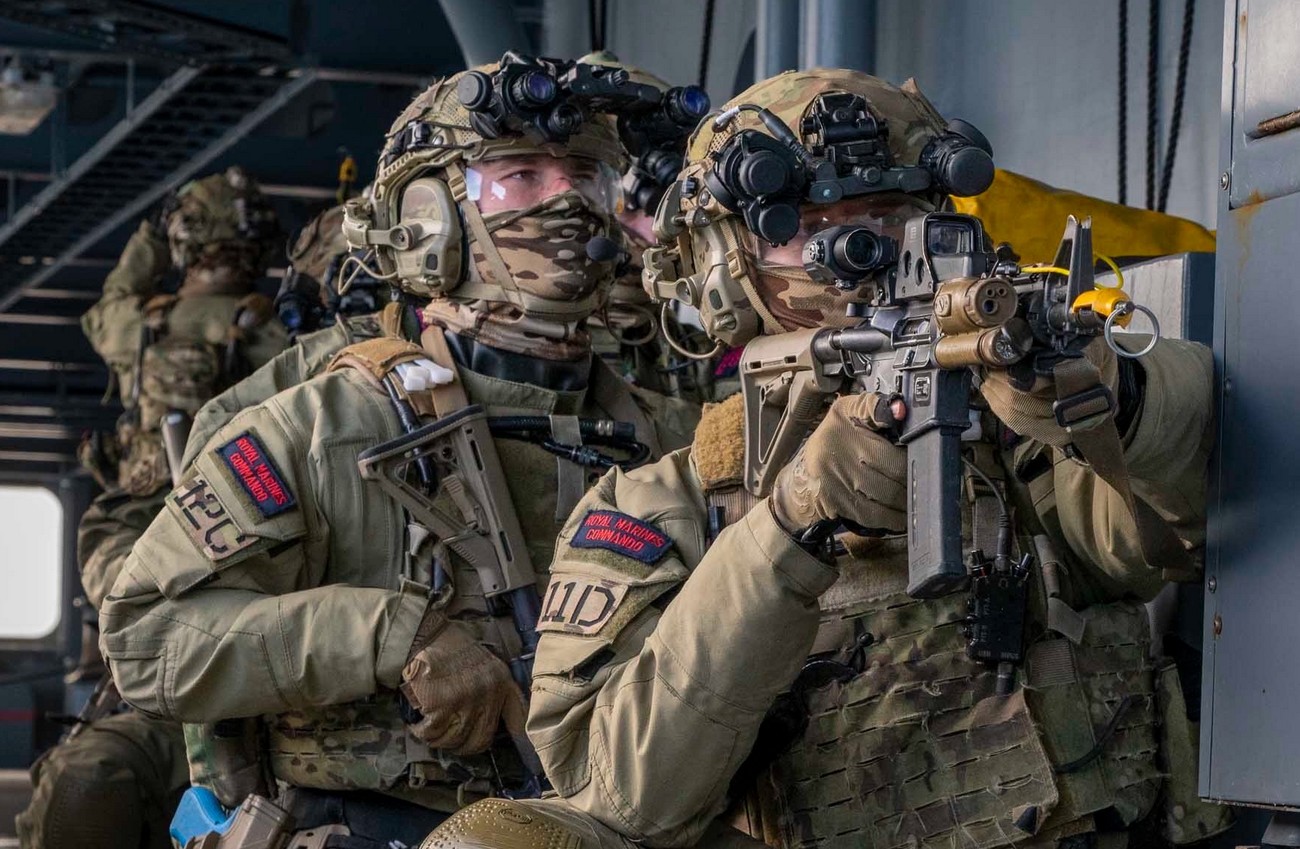
Royal Marines Conduct Complex Boarding Operation on German Warship During Major NATO Exercise
In a demonstration of advanced maritime interdiction capabilities and allied interoperability, Royal Marines executed a multi-faceted boarding operation on the German support ship FGS Berlin. The exercise, part of the broader Exercise Strike Warrior, involved personnel descending by fast-rope from a Merlin helicopter while a separate team ascended the vessel’s hull from a rigid inflatable boat (RIB).
Defence Operations, a United Kingdom Ministry of Defence channel, reported on the event, stating the commandos were “making an entrance the commando way” and “sharpening their skills alongside NATO allies.” The post emphasized the collaborative nature of the training, concluding: “Training together to defend together.” This phrase underscores NATO’s fundamental principle of collective defense, where member states enhance their military capabilities through joint exercises to deter potential adversaries and respond cohesively to security challenges.
⚓ Making an entrance the commando way@RoyalMarines boarded German warship FGS Berlin by air and sea during Exercise Strike Warrior, sharpening their skills alongside @NATO allies.
🛡️Training together to defend together.#ExStrikeWarrior #SW26pic.twitter.com/F2D1ya5Mhf
— Defence Operations 🇬🇧 (@DefenceOps) October 21, 2026
The FGS Berlin holds a significant role as the lead ship of the German Navy’s Berlin-class replenishment vessels, designed to provide logistical support to naval task groups. At the time of the exercise, it served as the flagship of Standing NATO Maritime Group One (SNMG1), one of NATO’s permanent multinational naval forces, which maintains a continuous presence in northern European waters and is currently operating under French command. The selection of a key logistical asset and a NATO flagship for such an exercise highlights the importance of testing operational procedures on diverse vessel types and within an allied command structure.
The boarding itself was conducted by personnel from K Company, 42 Commando, a specialized unit within the Royal Marines known for its expertise in maritime interdiction operations (MIO). MIOs involve intercepting vessels at sea to enforce international law, prevent illegal activities such as piracy or smuggling, or to secure ships in conflict zones. The execution of the boarding demonstrated two distinct tactical approaches:
- One team utilized caving ladders to climb the ship’s side from a rigid inflatable boat. This method, while physically demanding and challenging in adverse weather conditions, offers a degree of stealth, preserving the element of surprise during an initial approach.
- A second team rapidly descended onto the deck via fast-roping from a Merlin helicopter, specifically an aircraft from 824 Naval Air Squadron. This technique provides rapid deployment and is often quicker, though it typically generates more noise, potentially compromising surprise. The use of both methods simultaneously allows for the assessment of tactical flexibility and responsiveness under varying operational parameters.
Upon gaining control of the deck, the commando teams systematically cleared the ship compartment by compartment. This procedure, critical in securing a vessel, involved personnel carrying short-barrelled L119A1 rifles, prioritizing the neutralization or control of key areas such as the bridge and control rooms. A simulated casualty drill was also integrated into the exercise, allowing both commando and Royal Navy medical personnel to practice the complex and physically demanding process of evacuating a wounded individual from the confines of a ship’s interior, an essential skill for real-world combat or humanitarian operations.
Exercise Strike Warrior, which took place from September 28 to October 9, represented a substantial multinational military undertaking. It involved more than two thousand personnel, eight warships, and nineteen aircraft, operating across a wide geographical area encompassing Cape Wrath, the Western Isles, the North-West Approaches, Galloway, the Borders, and the North Sea. The Royal Navy characterized this exercise as the largest test of the United Kingdom Commando Force in fifteen years, marking the first occasion since the war in Afghanistan that all of its specialist elements—ranging from amphibious assault capabilities to arctic warfare and maritime interdiction—have trained together concurrently. This signifies a renewed emphasis on high-intensity, multi-domain operations.
The overarching objective of Exercise Strike Warrior was to rehearse allied crisis-response operations in the strategically vital High North and North Atlantic regions. These areas have seen increasing geopolitical attention due to evolving security dynamics, including heightened Russian naval activity and the growing importance of Arctic shipping routes. Beyond the United Kingdom, the exercise drew in forces from the Netherlands, Canada, Germany, Norway, and the United States. Notable participating vessels included the Portuguese frigate NRP Dom Francisco de Almeida, the Dutch frigate HNLMS Van Amstel, and the Royal Canadian Navy frigate HMCS St John’s, showcasing the broad allied commitment to collective security.
Another key component of the exercise involved soldiers of 148 (Meiktila) Commando Forward Observation Battery. These specialized personnel were transported to the Scottish coast aboard the German submarine U36, a Type 212A boat known for its advanced stealth capabilities. After going ashore near Cape Wrath, they proceeded to direct simulated naval gunfire from the Portuguese, Dutch, and Canadian warships onto designated targets. This aspect of the training honed the critical skill of coordinating joint fire support, an essential element in amphibious landings and coastal defense scenarios.
This publication previously reported on the arrival of NATO warships in Glasgow prior to the commencement of Strike Warrior and the deployment of Merlin helicopters to Scotland to provide protection for the submarine force involved in the exercise, underscoring the comprehensive nature of the preparations for this significant multinational training event.
Why This Matters
The Royal Marines’ boarding operation on the FGS Berlin during Exercise Strike Warrior is more than a routine drill; it carries significant implications for international security and military readiness:
- Enhanced NATO Interoperability:The seamless coordination between British commandos, a German support ship, and multinational forces underscores NATO’s commitment to collective defense. Regular joint exercises like Strike Warrior are crucial for ensuring that allied militaries can operate effectively together, sharing tactics, techniques, and procedures, which is vital for any future crisis or conflict response.
- Readiness for Maritime Interdiction Operations (MIOs):The specific focus on MIOs demonstrates the Royal Marines’ sustained capability to address a range of threats at sea, from counter-piracy and counter-terrorism to enforcing embargoes and securing maritime trade routes. These skills are increasingly important in a world where maritime security is frequently challenged.
- Strategic Focus on the High North and North Atlantic:The geographical scope of Exercise Strike Warrior highlights the growing strategic importance of the High North and North Atlantic. These regions are critical for maintaining sea lines of communication, protecting national interests, and responding to increased military activity by potential adversaries. Training in these challenging environments prepares forces for operations in diverse and often harsh conditions.
- Reinvigoration of UK Commando Force:The Royal Navy’s description of this as the “largest test of the United Kingdom Commando Force in fifteen years” and the first time all specialist elements have trained together since Afghanistan signals a strategic shift. It suggests a renewed focus on high-intensity, multi-domain operations and a return to training for peer-to-peer conflict scenarios, moving beyond the counter-insurgency operations that dominated recent decades.
- Demonstration of Deterrence:Large-scale, complex multinational exercises like Strike Warrior serve as a powerful signal of NATO’s unity, strength, and resolve. By showcasing advanced capabilities and a commitment to collective defense, these exercises contribute to deterrence, discouraging potential aggressors and reassuring allied nations of mutual support.
- Adaptability and Technological Integration:The integration of various platforms—helicopters, rigid inflatable boats, warships, and submarines—demonstrates the adaptability and technological sophistication of modern military forces. The ability to coordinate air, surface, and sub-surface assets for complex operations is crucial for success in contemporary warfare.
In essence, this exercise is a tangible demonstration of NATO’s commitment to maintaining a robust and adaptable defense posture, ready to respond to the evolving challenges of global security.