
Welcome back toTechCrunch Mobility, your hub for the future of transportation and now, more than ever, the role AI is playing in it. To get this in your inbox, sign up here for free — just click TechCrunch Mobility!
Key Takeaways
- Cyan Signals for AVs:U.S. federal regulators propose new lighting standards, including optional cyan lights, to uniformly signal when autonomous vehicles are operating without human monitoring, aiming to balance public safety with AV adoption.
- GM’s AI Transformation:General Motors is undergoing a profound technological overhaul, integrating advanced AI into its vehicle architecture, software, and development processes to deliver next-gen automated driving features and a custom AI assistant by 2028.
- AI Fuels Mobility M&A:The deal landscape in mobility is vibrant with AI at its core, from Rivian acquiring a 3D simulation startup to global robotaxi partnerships and autonomous aviation firms securing massive funding, underscoring AI’s critical role across diverse transportation sectors.
The gears of the future mobility industry are grinding forward, driven by an accelerating blend of regulatory efforts, ambitious corporate overhauls, and strategic investments in artificial intelligence. From new proposals to literally light up autonomous vehicles (AVs) for public identification, to a legacy automaker’s sweeping embrace of AI, and a flurry of M&A activity pushing the boundaries of simulation and autonomous flight, the sector is buzzing with transformative change. This edition of TechCrunch Mobility delves into these pivotal developments, exploring how AI is not just a feature, but the foundational layer for the next era of transportation.
The Regulatory Frontier: Illuminating Autonomous Futures
TheNational Highway Traffic Safety Administration (NHTSA)continues its meticulous work to integrate autonomous vehicle technology safely into daily life. This week, the agency unveiled a significant proposal addressing the critical need for clear public identification of AVs, particularly when they are operating without a human occupant actively monitoring the road. The core of this initiative? A strong suggestion to adopt cyan (blue-green) colored lights as a universal signal.
While not a direct mandate, NHTSA’s proposal for these steadily illuminated cyan lights – visible from the front, rear, and sides of an AV – represents a concerted effort to establish a uniform signaling system. This standardization is crucial for public understanding and trust, allowing pedestrians, cyclists, and human drivers to instantly recognize when a vehicle is under autonomous control. Such clarity can mitigate confusion, enhance safety, and ultimately smooth the path for broader AV adoption.
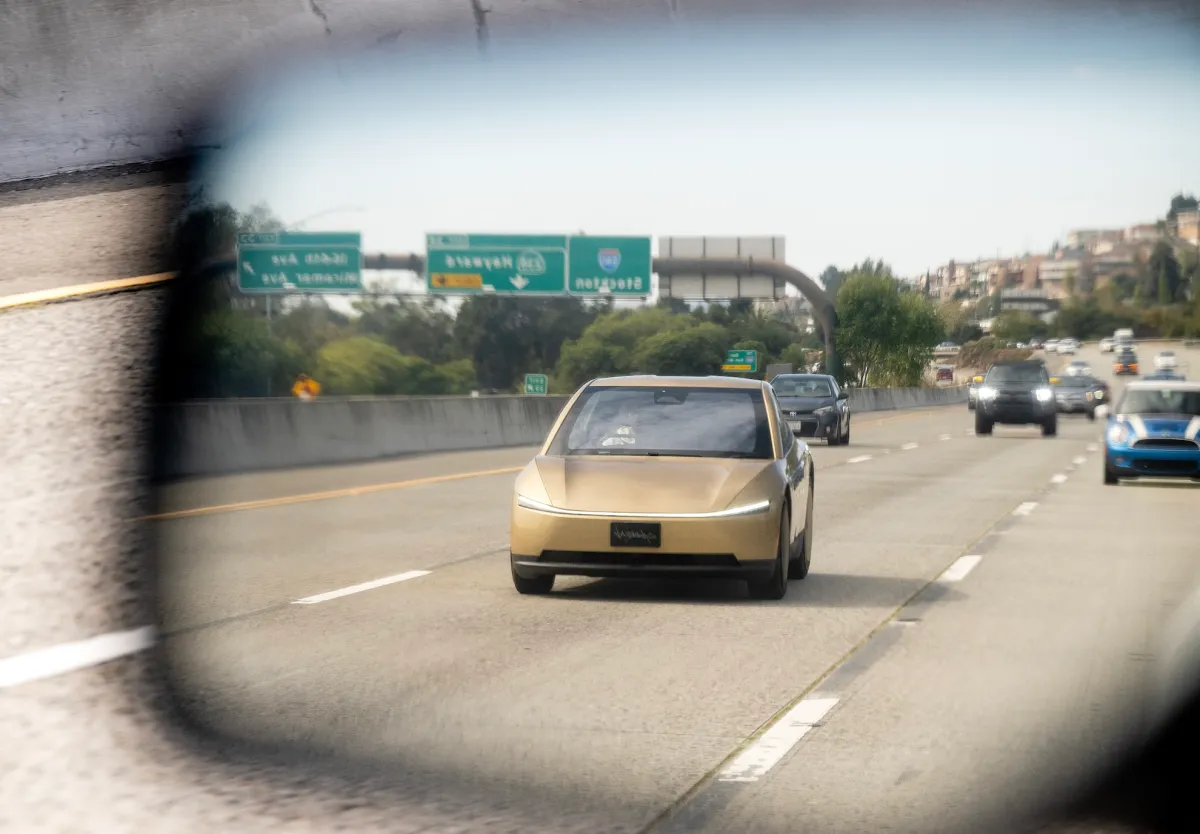
Beyond the distinctive lighting, the proposal also establishes detailed equipment specifications, including mounting locations and activation protocols. Critically, it aims to modernize regulatory frameworks by removing requirements for manually operated controls like turn signals, high beams, and hazard lights in AVs that are designed for full autonomy. This move acknowledges the fundamental shift in vehicle design that fully autonomous platforms, such as the Tesla Cybercab and Zoox robotaxi, represent – vehicles that intentionally lack traditional human interfaces like steering wheels and pedals. According to NHTSA administrator Jonathan Morrison, this latest proposal is a vital component of a larger strategy to update federal motor vehicle safety standards (FMVSS), ensuring they keep pace with innovation while upholding the highest safety benchmarks for the evolving transportation landscape.
Big Auto’s AI Play: GM’s Ambitious Overhaul
As regulators navigate the complexities of autonomous technology, legacy automakers are charging ahead with their own transformational strategies.General Motors (GM)recently showcased its comprehensive vision for the future at its annual GM Forward event, signaling a profound shift centered squarely on artificial intelligence. Building on last year’s AI-centric announcements, GM provided concrete details and timelines for an overhaul that promises to redefine its vehicles.
At the heart of GM’s strategy is a radical reinvention of its vehicles’ electrical and computational architecture. This deep-seated change is designed to enable faster, more sophisticated software deployment, significantly more capable automated driving features, and the integration of a custom, conversational AI assistant. This new AI assistant is poised to revolutionize GM’s long-standing OnStar service, transforming it from a mere telematics system into an intuitive, interactive in-vehicle experience that learns and adapts to user preferences. The first vehicle to showcase this technological leap will be the 2028 Cadillac Escalade IQ, setting a new benchmark for luxury and technology integration.
Crucially, GM also announced plans to roll out an advanced autonomous highway driving feature by 2028. This system will allow drivers to experience true hands-off, eyes-off driving on compatible highways, eliminating the need for constant human supervision. This level of autonomy represents a significant step beyond current advanced driver-assistance systems (ADAS) and underscores GM’s commitment to leading in the autonomous driving space. Internally, GM is leveraging enterprise AI across its entire operations, aiming to slash its traditional four- to five-year development timelines by half. This aggressive timeline and comprehensive approach signal that GM is not merely reacting to competitors like Tesla but is preparing for a much larger, more integrated fight for dominance in the future of mobility, leveraging its scale and resources to become a true software-defined vehicle company.
The AI-Powered Deal Landscape: Simulation, Services, and Skies
The strategic importance of AI in mobility is not only evident in regulatory proposals and corporate strategies but also in a dynamic mergers and acquisitions (M&A) landscape. Startups at the forefront of AI innovation are increasingly becoming targets for established players, eager to integrate cutting-edge capabilities into their future offerings. This trend is shaping everything from vehicle development to ride-hailing and even autonomous aviation.
Simulation & Reality: Rivian’s Third Dimension Acquisition
A prime example of this trend isRivian’srecent acquisition ofThird Dimension, a UK-based startup specializing in using AI to transform images and videos into hyper-realistic 3D virtual worlds. For an autonomous vehicle developer like Rivian, this acquisition is all about simulation—a critical tool for accelerating the development and testing of self-driving systems. Rivian’s head of autonomy, James Philbin, emphasized the need to close the “sim-to-real gap,” referring to the persistent challenge of ensuring that data and experiences from simulated environments accurately reflect the complexities of the physical world. While simulation has been a cornerstone of AV development since the early days, the technology continues to evolve rapidly. Startups like Third Dimension, with their advanced AI capabilities, are now essential for creating the rich, accurate virtual environments needed to train and validate increasingly sophisticated autonomous driving algorithms. The terms of the deal were not disclosed, but insights into Third Dimension’s $7 million seed round and a team of approximately 15 engineers suggest a strategic, focused acquisition designed to bring specialized expertise in-house.
Global Robotaxi Expansion: inDrive, Pony.ai, and Nvidia
Beyond internal development, partnerships are also key to scaling AI-driven mobility solutions. Ride-hailing companyinDrive, known for its unique model allowing passengers and drivers to negotiate fares, is forging a significant alliance with Chinese autonomous driving firm Pony.ai and AI chip giant Nvidia. This collaboration aims to begin testing robotaxis in Kazakhstan by 2027, with the companies signing a memorandum of understanding to explore integrating Pony.ai’s autonomous vehicles into inDrive’s platform. This partnership highlights the global ambition of robotaxi services and the crucial role of AI hardware and software expertise in bringing these services to diverse international markets.
Beyond Roads: Autonomous Aviation’s Rise (Reliable Robotics)
The impact of AI extends far beyond ground transportation, reaching into the skies.Reliable Robotics, a pioneering startup focused on commercializing autonomous flying technology for existing aircraft, recently secured a substantial $115 million in a Series D extension round. This funding, comprising $90 million in equity led by Nimble Partners and $25 million in debt from Silicon Valley Bank, brings their total Series D funding to an impressive $275 million and pushes the company’s valuation past the $1 billion mark. Reliable Robotics’ success underscores the growing investor confidence in autonomous aviation, particularly for cargo and logistics, where the application of AI for enhanced safety and efficiency promises to revolutionize air transport.
Bottom Line
The confluence of regulatory advancements, aggressive corporate AI strategies, and a dynamic investment landscape paints a clear picture: AI is no longer a peripheral technology but the central nervous system of future mobility. From ensuring public trust through standardized AV signals, to fundamentally redesigning vehicles from the ground up, and enabling everything from hyper-realistic simulations to autonomous flight, AI is accelerating the pace of innovation across every facet of transportation. As these developments unfold, the journey towards a safer, more efficient, and truly autonomous future continues to gain unstoppable momentum, redefining how we move and interact with the world around us.
Key Takeaways:
1. **Autonomous Vehicles Face Complex Headwinds:** While companies like Waymo and Rivian push for expansion and innovation in autonomous driving, the sector is grappling with organized opposition groups whose origins are often opaque, highlighting ongoing societal and economic tensions.
2. **Musk’s Empire Eyes Consolidation Amidst Shifting Fortunes:** Elon Musk’s Tesla and SpaceX are exploring a potential merger, a move that could consolidate his vision for an AI and robotics-centric future, even as Tesla grapples with flat revenues and falling profits, contrasting sharply with SpaceX’s booming AI-driven business.
3. **In-Vehicle Intelligence Reaches New Personal Depths:** Google’s Gemini integration in vehicles signals a future where car cabins offer highly personalized, context-aware AI assistants, raising both the bar for user experience and new considerations for data privacy and digital integration.
The tech world never stands still. From the intricate politics of autonomous vehicle deployment to the ambitious visions of industry titans, this past week delivered a potent mix of innovation, strategic maneuvers, and persistent challenges. We’re witnessing a landscape where cutting-edge technology intersects with public perception, economic realities, and the relentless pursuit of future possibilities.
The Autonomous Frontier: Pushing Boundaries and Facing Backlash
The journey towards widespread autonomous vehicle (AV) adoption is undeniably complex, marked by both technological leaps and significant societal friction. While some companies are aggressively expanding their reach, others are confronting resistance that stems from a variety of sources, some more transparent than others.
Robotaxi Resistance: Unmasking the Opponents
A recent report from the Washington Post shed light on a new group actively campaigning against robotaxis, whose origins remain shrouded in mystery. This development closely mirrors earlier investigations into similar anti-AV organizations. Earlier this summer, our reporting delved into the “Coalition for Accountability and Road Safety,” an entity that was not only canvassing voters but also orchestrating a social media presence designed to amplify concerns about autonomous vehicles. What surfaced from that investigation was quite telling: the organization was found to be registered to an employee of a New York lobbying firm. This firm, in turn, has a track record of being retained by several prominent labor unions and, notably, the New York Black Car Operators’ Injury Compensation Fund. The implications of these connections are significant, suggesting that the opposition to robotaxis may not always be purely grassroots. Instead, it can be driven by established economic interests concerned about the disruptive potential of autonomous technology to traditional industries and job markets. This opacity creates a challenge for public discourse, as the motivations behind the campaigns can influence how their arguments are perceived and debated. The ongoing tug-of-war between innovation and incumbent interests remains a critical theme in the deployment of self-driving cars, making transparency from all sides paramount for informed public discussion.
Waymo’s Global Ascent: From Vegas to Madrid
In stark contrast to the localized resistance, autonomous driving giant Waymo continues its relentless march towards broader deployment, demonstrating a strategy of both deeper penetration within existing markets and ambitious international expansion. The company recently announced plans to launch a robotaxi service in Spain, with Madrid slated as its inaugural city by 2027. This move signals a significant step in Waymo’s global strategy, venturing beyond its established North American strongholds and into a new regulatory and cultural landscape. International expansion presents unique challenges, from navigating diverse regulatory frameworks and local traffic customs to building public trust in new territories. However, the potential rewards of tapping into major European cities are immense, offering vast new markets for autonomous ride-hailing. Closer to home, Waymo has also strategically expanded its services to include shuttling customers to and from the bustling Harry Reid International Airport in Las Vegas. Airport routes are often considered a “sweet spot” for early AV deployment due to their structured environments, predictable high demand, and the clear utility they offer to travelers. This twin strategy—global ambition paired with practical, high-value local expansion—underscores Waymo’s commitment to scaling its operations and cementing its leadership in the autonomous mobility sector.
Rivian’s Autonomous Vision: Beyond the Wheel
Meanwhile, electric vehicle manufacturer Rivian is also looking to autonomy, not just as an enhancement to existing models, but as a fundamental enabler for entirely new vehicle concepts. CEORJ Scaringerecently articulated a compelling vision for how advanced autonomy will allow his company to engineer “radically different kinds of vehicles” than the acclaimed R1T electric pickup truck and R1S SUV, or even the upcoming R2 SUVs. This perspective hints at a future where the traditional design constraints imposed by human drivers are removed, opening up possibilities for modular interiors, specialized mobile workspaces, or even purely utilitarian autonomous platforms designed for specific delivery or service applications. While details remain speculative, this forward-looking statement aligns with a broader industry trend where autonomy is seen as a catalyst for transformative vehicle architectures and novel user experiences. All eyes are now on what this could mean for the much-anticipated “R4,” which could potentially embody this innovative design philosophy, pushing Rivian beyond its current adventure-focused portfolio into new segments defined by autonomous functionality.
Power Shifts & Financial Currents: Tesla, SpaceX, and GM
The financial landscape of the tech and automotive sectors remains a dynamic arena, characterized by both strategic consolidation attempts and evolving manufacturing priorities. The week saw significant developments from Elon Musk’s formidable empire and a key manufacturing adjustment from a Detroit stalwart.
The Muskian Vision: Tesla, SpaceX, and the Merger Enigma
The tech world buzzed this week following the third-quarter earnings reports from bothTeslaandSpaceX, particularly due to comments by their shared CEO, Elon Musk. Musk’s remarks have accelerated speculation about a potential merger between the two behemoths, confirming that the boards of each company have now formed special committees to formally review such a proposal. The strategic rationale for such a merger could be multifaceted: pooling capital for ambitious projects, streamlining R&D efforts across AI and robotics, and creating a truly integrated vision for Musk’s future-focused enterprises. However, the financial health of the two companies presented a study in contrasts. SpaceX’s “AI business” is reportedly booming, generating a substantial $7.5 billion in revenue and now comprising an impressive 52% of the company’s total income – a figure that likely encompasses its rapidly expanding Starlink satellite internet service and potentially internal AI applications for rocket operations. Tesla, on the other hand, experienced a period of stagnation, with its revenue across various segments remaining flat while operational expenses surged. The upshot was a significant 43% year-over-year drop in profits, reflecting intense competition and ongoing investments. Despite these financial headwinds, Musk’s focus remains steadfastly on Tesla’s AI and robotics future. The company announced it has commenced production of its Optimus humanoid robot, signaling a deeper commitment to AI beyond self-driving cars. Furthermore, Tesla reported rosy FSD (Full Self-Driving) subscription growth, even as the “unsupervised version” of the software faced a delay, now anticipated for Q2 next year. Perhaps most ambitiously, Musk reiterated plans to begin selling its Cybercab to customers by the end of the year, echoing senior reporter Sean O’Kane’s insightful observation:Teslais indeed “prepping for a Cybercab onslaught.” This relentless pursuit of AI and robotics, even in the face of current financial pressures, underscores Musk’s long-term vision for Tesla as a leader in these transformative technologies.
GM’s Manufacturing Reconfiguration: A Lease, Not a Strategy
Elsewhere in the automotive sphere, General Motors announced the impending closure of a manufacturing plant located south of Detroit. This facility has been crucial for assembling battery packs for Cadillac’s premium electric vehicle, the Celestiq, as well as producing both electric drive units (EDUs) and battery packs for the plug-in hybrid Chevrolet Corvette E-Ray. While such closures often spark concerns about a company’s broader strategic direction, aGMspokesperson clarified that the decision is not linked to the company’s overarching electric vehicle strategy. Instead, the closure is attributed to the lease on the site nearing its expiration. This explanation, if accurate, suggests a more logistical rather than strategic pivot. However, it still highlights the dynamic nature of EV manufacturing and supply chain management. Companies are constantly optimizing their production footprints, seeking efficiencies, and adapting to evolving technological requirements and market demands. While this specific closure may be lease-driven, the broader context of GM’s multi-billion dollar investment in new EV battery plants and dedicated EV production facilities across North America shows a clear, unwavering commitment to its electric future, with strategic decisions often involving consolidation and modernization of its manufacturing base.
Intelligence Onboard: Google’s Gemini in the Driver’s Seat
The interior of our vehicles is rapidly transforming into an extension of our digital lives, and Google is at the forefront of this evolution with its latest advancements in in-car AI.
Googleis poised to significantly upgrade its Gemini platform within vehicles, introducing a sophisticated “personal intelligence” feature. This enhancement is designed to seamlessly draw upon a wealth of information from a user’s interconnected Google services, including Gmail, Google Calendar, YouTube, Maps, and Google Search history, among others. The goal is to create an in-car assistant that moves beyond simple voice commands to truly understand your preferences, daily activities, and past experiences. Imagine your car anticipating your next destination based on your calendar, suggesting a restaurant you’ve previously searched for, or adjusting media playback based on your YouTube history – all without explicit input. This deep level of personalization promises an unprecedentedly intuitive and proactive user experience, making the vehicle feel more like a truly intelligent co-pilot. However, such extensive data integration also brings forth important considerations regarding data privacy and user control. Google will need to clearly articulate how this personal intelligence feature manages and protects sensitive user information, providing transparent options for privacy settings to ensure user trust as our cars become increasingly integrated into our digital ecosystems. This marks a significant step towards creating truly smart, personalized car cabins that adapt to individual needs and habits.
Community & Connection: Join the Conversation
As the tech world continues its rapid pace, opportunities for connection and collaboration remain vital. Fresh off the energy of TechCrunch Disrupt, I’m already looking ahead to another invaluable event on the calendar.
I am currently preparing for the Founder Summit, a focused one-day event in Boston specifically tailored for, as the name suggests, founders. Taking place on November 4th, this summit is an exceptional opportunity for startup founders, aspiring entrepreneurs, and investors alike. Attendees can anticipate a packed agenda featuring advice-driven talks from seasoned VCs and serial founders, alongside ample chances for valuable networking. And yes, I will be there! I encourage all TechCrunch Mobility readers to come say hello and engage in the discussions. To facilitate your attendance, I’m pleased to offer a 30% discount on tickets. Simply click thislinkand use the codemobility30at checkout. It’s an excellent chance to gain insights, build connections, and help shape the future of innovation.
When you purchase through links in our articles, we may earn a small commission. This doesn’t affect our editorial independence.
Image Credits:Bryce Durbin
Bottom Line
The tech sector continues its exhilarating, albeit sometimes turbulent, trajectory. From the complex, often politically charged, rollout of autonomous vehicles to the bold, AI-driven strategies of industry giants like Tesla and Google, the narrative is one of relentless innovation tempered by real-world challenges. Whether it’s the quiet reorganization of manufacturing by established players or the audacious merger talks between visionaries, the underlying current remains clear: technology is not just advancing, it’s redefining industries, reshaping our daily experiences, and constantly pushing the boundaries of what’s possible, demanding both keen observation and adaptive strategies from all involved.
Source:{feed_title}