
**Key Takeaways:**
1. **Prolonged Political Gridlock Ahead:** Israel’s inconclusive parliamentary election signals continued political fragmentation and likely prolonged negotiations, maintaining a cloud of uncertainty over economic policy and investor confidence.
2. **Heightened Geopolitical and Social Risks:** The strong showing of Arab parties underscores deep internal divisions exacerbated by the Gaza conflict and right-wing policies, raising concerns about social stability, security spending, and potential impacts on foreign direct investment.
3. **Shekel Volatility and Credit Rating Scrutiny:** Persistent political instability, coupled with regional tensions, is expected to keep the Israeli Shekel volatile and could invite further scrutiny from credit rating agencies, potentially impacting borrowing costs and capital flows.
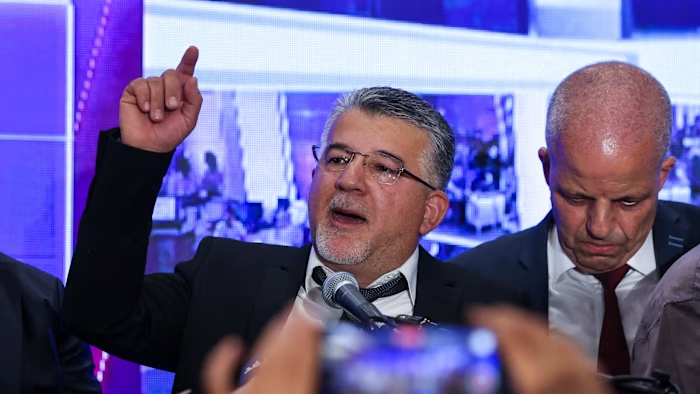
As the dust settled on Israel’s parliamentary election, the financial markets braced for yet another period of uncertainty, a familiar refrain in the nation’s often tumultuous political landscape. Yousef Jabareen, head of the country’s largest Arab grouping, the Joint List, issued a blunt message to the Jewish opposition parties that have spent the past four years waiting to dethrone the divisive prime minister, Benjamin Netanyahu.
“We are ready and prepared to pave the way for the ousting of the Netanyahu government,” the Joint List leader wrote on X as exit polls suggested Arab parties would hold a record number of seats in Israel’s new parliament. This declaration, while a political overture, immediately signaled to investors that the path to a stable governing coalition would be anything but straightforward, potentially prolonging policy paralysis.
“[But] change comes through Jewish-Arab partnership — a genuine and egalitarian partnership. Nothing less, and nothing more.”
Whether or not the Jewish opposition, centred around the centrist Yashar party led by former general Gadi Eisenkot, accepts Jabareen’s offer will be one of the crucial questions as Israel’s rival political blocs scramble to plot a path to power after what a partial vote count suggests was an inconclusive election. For market participants, an inconclusive election often translates into delayed budget approvals, stalled infrastructure projects, and a general hesitation in foreign direct investment, all of which weigh on economic growth prospects.
With 85 per cent of votes tallied on Wednesday afternoon, both Netanyahu’s far-right coalition, which was on course to win 53 seats, and the Jewish opposition, which was on course to win 48, were set to fall well short of the 61 needed for a majority in Israel’s 120-seat Knesset. This arithmetic points to a deeply fragmented parliament, a scenario historically associated with political volatility and a lack of decisive economic leadership. The Shekel, Israel’s currency, often reacts negatively to such political stalemates, reflecting investor concern over a prolonged period without a clear policy direction.
But Israel’s Arab parties were on course for their best result ever. Powered by a surge in turnout among Israel’s Palestinian citizens, who make up a fifth of the country’s population, the Joint List was on course to win 12 seats, while Mansour Abbas’s Islamist Ra’am party was on course to win seven. This unprecedented electoral success, while a significant social development, adds a complex layer to coalition negotiations. The inclusion of Arab parties, or the difficulty in forming a government without them, introduces new variables into the political calculus that could affect national security spending, social welfare programs, and international relations – all of which have direct market implications.
Although their final tally could yet drop as the last votes are counted, the two Arab groups have a good chance of topping the 15 seats won by Arab parties in 2020, the previous record.
“Turnout was somewhere between 70 and 80 per cent in Arab localities and in many was over 80 per cent,” said Nimer Sultany, a professor of law and chair of the Centre for Palestine Studies at Soas in London. “This is quite unprecedented.”
The surge has been driven by a sense among Israel’s Palestinian minority that another four years of Netanyahu’s government, widely regarded as the most rightwing in Israeli history, would pose an existential threat to their communities. From a market perspective, a government perceived as highly polarizing or discriminatory can deter foreign investment, particularly from entities with strong ESG (Environmental, Social, Governance) mandates, and can lead to internal social unrest that disrupts economic activity.
While Arab Israelis have long been treated as second-class citizens, members of the community say that the discrimination has intensified dramatically since Netanyahu’s coalition took office in 2022, and particularly since Hamas’s October 7 2023 attack on Israel triggered the war in Gaza. This internal social friction, compounded by external geopolitical conflicts, creates a risk premium for Israeli assets. Far-right members of Netanyahu’s coalition have floated even more extreme anti-Arab measures if they are re-elected, with Bezalel Smotrich, the ultranationalist finance minister, announcing a plan to “Judaise” Arab-majority parts of Israel if he is part of the next government. Such policies are not only socially divisive but carry the potential for international condemnation, impacting Israel’s trade relations and diplomatic standing, further influencing investor sentiment.
“We have to change this government. If we don’t stop it, it will be a disaster,” said Wahby Issa, who works in an electronics shop in Kafr Qasim, an Arab town in central Israel. “The government is encouraging racism among normal people. So now the people are more racist because of the government’s behaviour.” This sentiment of deep societal discord is a red flag for long-term economic stability, signaling potential disruptions to labor markets and consumer confidence.

But the biggest concern for many Palestinian citizens of Israel is the surge in killings by crime gangs in Arab communities that has taken place since Netanyahu took office in 2022 and installed Itamar Ben-Gvir, an ultranationalist previously convicted of incitement to racism, as national security minister. Critics have accused him of intentionally neglecting crime in the Arab community, where the vast majority of murders go unsolved. This breakdown in internal security, if perceived as systemic, directly impacts domestic business operations, local investment, and insurance costs, creating an additional economic burden on the state and its citizens.
“There is a sense of existential fear among Palestinian citizens of Israel, particularly due to the generalised feeling of a lack of security and the huge increase in organised crime,” said Sultany. “And there was a sense of the need to act to mitigate this.”
But whether the Arab parties’ bumper haul of seats will translate into political power remains uncertain. Despite Jabareen’s offer, Joint List officials have made clear they would support the Jewish opposition parties from outside, rather than joining them in a coalition. Abbas’s Ra’am has gone further, making clear it would be open to joining a coalition, and taking various steps — such as adding a Jewish MP to its list — to boost its chances of working with the Jewish parties. The complexity of these negotiations suggests a protracted period of political horse-trading, potentially delaying the formation of a stable government and the implementation of any coherent economic agenda.
But they have faced a relentless delegitimisation campaign from Netanyahu and his allies. Netanyahu claimed after polls closed on Tuesday that co-operating with them would “endanger Israel”. Eisenkot’s bloc is also split on the idea. Yair Golan, head of the leftwing Democrats, has long argued that the Jewish opposition should go into coalition with the Arab parties, and reiterated that position forcefully on Wednesday.
“Anyone who tries to erase the votes of Arab citizens is surrendering to Netanyahu and giving up on Israel,” he wrote on X.
“The change bloc has an Israeli majority: 65 to 55 . . . We have a majority. We have a responsibility. And we have an opportunity to form a change government in partnership with Arab citizens of Israel.” A “change government” offering greater social cohesion could, in theory, unlock new economic potential by addressing long-standing inequalities and fostering a more inclusive society, but the political hurdles remain immense.
But other key figures in Eisenkot’s bloc, such as the hawkish former defence minister Avigdor Lieberman and former prime minister Naftali Bennett, have said their parties would not join a government dependent on Arab parties.
Eisenkot has also been reluctant, setting conditions for working with Arab groups that analysts say would be hard for them to meet.

It is an issue on which Lieberman and Bennett have changed their stance in the past. In 2021, they both joined a shortlived government that included Abbas and briefly ousted Netanyahu, despite having previously said they would not. It was the only time an Arab party has joined an Israeli government. While that government, briefly, offered a period of relative calm and stability that was generally well-received by markets, the current political climate is far more charged.
But five years on, both the politics and numbers are less favourable, analysts said. Surveys suggest that most Jewish Israelis do not want an Arab party in government. And the lower-than-expected number of seats won by the Jewish opposition parties means they would need the support of not just Ra’am but also the Joint List to be able to form a government — a scenario many analysts see as a bridge too far for the rightwing members of Eisenkot’s bloc.
“They won’t reach 61 with Ra’am,” said Dahlia Scheindlin, a pollster and political analyst. “Never say never, but it’s hard to see them taking such a political risk when it wouldn’t give them what they really need, which is a majority.” This numerical and ideological impasse suggests that Israel’s political future is likely to remain unsettled, with the possibility of another election looming large, further exacerbating the uncertainty for investors and businesses alike.
**Market Impact:**
The protracted political gridlock following Israel’s inconclusive election is set to maintain a significant degree of volatility in financial markets. The Israeli Shekel (ILS) is likely to remain under pressure, reflecting investor concerns over policy paralysis and the increased political risk premium. Government bond yields could see upward pressure as uncertainty dampens demand and concerns about fiscal stability persist, especially given the ongoing high defense spending related to the Gaza conflict. Equity markets, particularly those sensitive to domestic policy and stability, may experience headwinds. Foreign direct investment (FDI) could slow, as international investors typically shy away from environments marked by political instability and deep social divisions. Furthermore, the potential for continued internal unrest and the elevated geopolitical risk in the region, amplified by the difficulty in forming a stable government, could lead credit rating agencies to re-evaluate Israel’s outlook, potentially impacting its sovereign credit rating and future borrowing costs.