
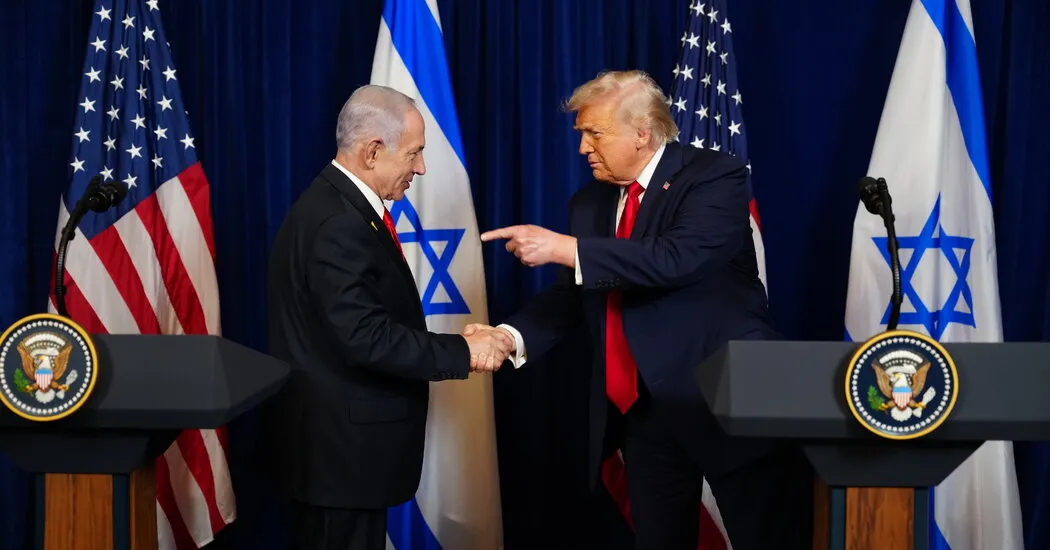
President Trump Announces End to Bulk of U.S. Aid to Israel by Year-End
Former President Donald Trump stated on Tuesday that the significant portion of American financial assistance to Israel would cease by the end of the year, an arrangement he attributed to an agreement reached months prior with Prime Minister Benjamin Netanyahu. Speaking in a morning interview with Fox News host Brian Kilmeade as polls opened on the East Coast for Election Day, Mr. Trump characterized the announcement primarily as a political maneuver to neutralize a “bad talking point” frequently used by the left wing of the Democratic Party.
“We were giving them 4 billion,” Mr. Trump said, referring to the aid. “We are. But it gets cut off at the end of the year.” He elaborated that instead of direct aid, a different agreement would see the United States continue to sell weaponry to Israel, with Israel expected to pay for these acquisitions, potentially through technology swaps or direct cash payments. This shift would mark a significant departure from decades of established U.S. foreign policy toward one of its closest allies in the Middle East.
Prime Minister Netanyahu has alluded in recent months to a desire to move away from reliance on U.S. aid, though he has not previously specified a timeline for such a transition. Mr. Trump’s comments suggested an acknowledgment that securing new aid packages through the U.S. Congress, particularly in the current political climate and potentially after the ongoing election, would be exceptionally challenging. Notably, Mr. Trump’s statement did not directly reference the ongoing conflict in Gaza or the discernible erosion of support for Israel in the United States since the October 7, 2023, terrorist attacks and the subsequent military operations.
Mr. Trump explicitly linked the decision to domestic political considerations. “They don’t need it,” he stated regarding the American aid, adding, “and because why should we suffer the slings from lunatics like an El-Sayed when they don’t need it?” This was a direct reference to Dr. Abdul El-Sayed, a Democratic candidate for a Michigan Senate seat who has been openly critical of Israel’s actions. Mr. Trump reiterated that discontinuing aid was a strategic move to eliminate a “bad talking point” for his political opponents, while simultaneously affirming, “Israel’s our No. 1,” but also a “thriving country.”
From Israel’s perspective, Prime Minister Netanyahu’s government may also have motivations for reassessing the aid arrangement. Congressional control over aid to Israel has increasingly become a tool for U.S. lawmakers seeking to influence Israeli government policies and actions. A shift toward procuring American armaments through traditional military sales or comprehensive trade and technology agreements could potentially reduce the frequency and intensity of congressional debates and oversight, although it would not eliminate them entirely. Such a change could afford Israel greater autonomy in its defense planning and procurement processes.
The timing of Mr. Trump’s declaration was particularly noteworthy, coinciding with the opening of polling stations across the United States. This announcement, made by a former Republican president, challenged a bipartisan foreign policy bedrock that has supported Israel for decades. As of the time of reporting, Prime Minister Netanyahu’s office had not issued an immediate comment on Mr. Trump’s statement. The issue is anticipated to be a significant factor as Mr. Netanyahu navigates the complex process of forming a new government in Israel, following an inconclusive election held just last week.
U.S. foreign assistance to Israel has historically been substantial, primarily delivered through the Foreign Military Financing (FMF) program, which allows Israel to purchase U.S. military equipment and services. A Memorandum of Understanding (MOU) signed in 2016 committed the U.S. to providing Israel with $38 billion in military aid over a decade, averaging $3.8 billion annually, from fiscal years 2019 to 2028. This aid is often seen as a cornerstone of the U.S.-Israel strategic alliance, aimed at maintaining Israel’s qualitative military edge in a volatile region. The transition from aid to outright sales would fundamentally alter this long-standing financial and strategic relationship.
The implications of such a policy shift extend beyond financial considerations, touching upon diplomatic influence, regional security dynamics, and domestic political landscapes in both countries. For the United States, it would signify a reassessment of its role as a primary financial patron for key allies. For Israel, it would necessitate a re-evaluation of its defense budget and procurement strategies, potentially fostering greater self-reliance but also introducing new financial pressures. The political motivations articulated by Mr. Trump underscore the increasing politicization of U.S. foreign aid, particularly in the context of evolving American public sentiment regarding Israel.
Why This Matters
The announcement that the bulk of U.S. aid to Israel could be cut off by the end of the year represents a potentially monumental shift in American foreign policy, with far-reaching implications for both the United States and Israel, as well as the broader Middle East. This development matters for several critical reasons:
Fundamental Reconfiguration of U.S.-Israel Relations:For decades, U.S. military aid, totaling billions annually, has been a cornerstone of the strategic partnership between the two nations, ensuring Israel’s qualitative military edge and reinforcing American diplomatic influence in the region. Shifting from aid to military sales fundamentally alters this dynamic, potentially reducing U.S. leverage and obligating Israel to fully finance its defense acquisitions, which could impact its defense capabilities and budget planning.
Shifting U.S. Foreign Policy Paradigm:This decision, if implemented, would mark a significant departure from a bipartisan consensus that has underpinned U.S. support for Israel since its inception. It signals a potential move towards a more transactional approach to alliances, where financial assistance is replaced by commercial transactions. Such a precedent could influence U.S. relations with other allied nations that currently receive substantial American aid.
Impact on Israeli Security and Economy:While Mr. Trump asserted Israel “doesn’t need” the aid, the financial assistance has historically been crucial for Israel’s military modernization and readiness. Having to pay full price for advanced U.S. weaponry could place significant strain on the Israeli defense budget, potentially affecting its long-term strategic planning and military posture in a volatile neighborhood. It also speaks to Israel’s drive for greater sovereignty over its defense decisions, free from congressional conditions.
Domestic Political Ramifications in the U.S.:The announcement was explicitly framed by Mr. Trump as a political move to disarm critics on the left wing of the Democratic Party. This highlights the growing partisan divide on Israel in American politics, particularly amidst the ongoing conflict in Gaza. The debate over aid to Israel is likely to intensify, becoming a key issue in future elections and potentially reshaping party platforms and electoral strategies.
Regional Stability and Geopolitical Dynamics:The U.S.-Israel alliance is a critical factor in the Middle East’s geopolitical landscape. A perceived weakening of this alliance, or a change in the nature of U.S. support, could embolden adversaries, alter regional power balances, and influence the calculus of other regional actors. It could also have ripple effects on ongoing diplomatic efforts and security cooperation in the region.
Evolving Congressional Influence:One stated reason for Netanyahu’s desire to move away from aid is to reduce congressional oversight and leverage over Israeli policies. While shifting to sales may indeed reduce some forms of direct conditionalities tied to aid, Congress retains significant power over arms sales and foreign policy. The nature of congressional engagement would evolve, but oversight would not disappear, potentially transforming the battleground for U.S. influence over Israeli actions.
In essence, this proposed policy change extends beyond mere financial transactions; it touches upon the foundational principles of U.S. alliances, the strategic autonomy of key partners, and the intricate interplay of domestic and international politics. Its execution would reshape a decades-old relationship and send a powerful message about the future direction of American foreign policy.