
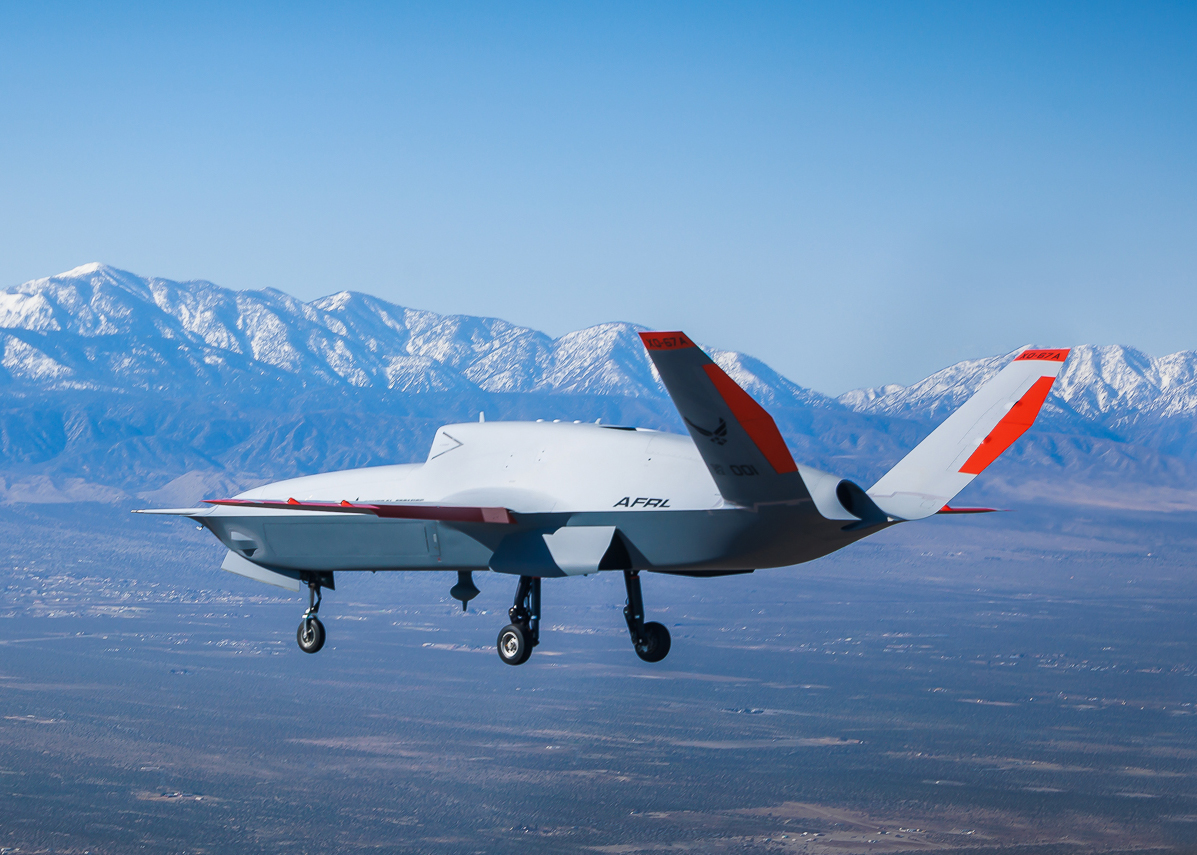
General Atomics, a prominent defense contractor, is significantly expanding its portfolio of semi-autonomous drone technologies beyond its initial Collaborative Combat Aircraft (CCA) designs. The company has unveiled ambitious plans for a family of uncrewed aerial systems, including a large flying-wing aircraft designed for both reconnaissance and strike missions, alongside specialized variants for naval operations and pilot training.
Simultaneously, the U.S. Air Force Research Laboratory (AFRL) is actively testing these advanced autonomous capabilities. The AFRL recently conducted a flight test of General Atomics’ XQ-67A, a prototype for a CCA, as part of a new program focused on integrating mission systems for autonomous reconnaissance aircraft.
General Atomics’ Expanding Drone Family
C. Mark Brinkley, a spokesman for General Atomics, outlined the company’s vision for future uncrewed aircraft. He confirmed that General Atomics is developing an uncrewed flying-wing design known as “NextGen.” Brinkley emphasized that NextGen is distinct from a CCA, describing it as a “much larger…fully armed, fully outfitted, [intelligence, surveillance and reconnaissance]/strike wing” aircraft.
NextGen is projected to feature a hybrid-electric propulsion system, enabling it to fly for over 60 hours without requiring refueling. Its operational flexibility is intended to include remote piloting, full autonomy, or semi-autonomous control. Brinkley positioned NextGen as a “high-end capability,” with its development intended to inform and contribute to another, smaller flying-wing drone known as Gambit 4.
The Gambit concept, first introduced in 2022, represents a modular approach to drone design. This series is envisioned as a family of airframes that can share a common “chassis,” incorporating a standardized engine, landing gear, and processing units. The FQ-42 CCA, one of the Air Force’s initial CCA designs, is part of this Gambit series. Gambit 4, the future flying-wing concept informed by NextGen, is expected to be more cost-effective than NextGen but will offer shorter endurance and less advanced stealth capabilities.
Brinkley highlighted General Atomics’ extensive investment in research and development. “I don’t think people realize how deep GA-ASI’s bandwidth is, or how much we dedicate to R&D,” he stated. “NextGen is coming, and the work we’re doing on that flying wing program will funnel into Gambit 4 so that when customers are ready for this, we’re not starting from scratch here either.”
In May 2025, General Atomics was awarded a $99.3 million contract by AFRL for a program named GHOST (General Atomics Off-Board Sensing and Targeter). This contract is for the development of a long-endurance, autonomous flying-wing aircraft capable of reconnaissance and strike missions, described with characteristics similar to NextGen, including references to a hybrid-electric propulsion system. Brinkley declined to comment on any direct relationship between the GHOST program and the NextGen project.
Diverse Gambit Variants and Capabilities
Beyond the flying-wing concepts, General Atomics is developing other specialized variants within its Gambit series. Gambit 6 is planned as a ground strike variant of the FQ-42. General Atomics intends to conduct a live-fire demonstration with a Gambit 6 aircraft using a ground attack munition in early 2027. Brinkley noted that the FQ-42’s internal weapons bay is crucial for maintaining stealth and survivability, an advantage Gambit 6 would inherit. He suggested that nations considering the CCA concept for air-to-ground missions would be potential customers for Gambit 6, benefiting from shared expertise across the Gambit family.
Another concept, Gambit 5, is being developed to meet the unique requirements of naval operations. This variant would be optimized for use on ships, requiring specific landing gear, compatibility with catapult launch and arresting gear systems, and enhanced resistance to the corrosive, salt-heavy marine environment.
General Atomics is also working on Gambit 3, a “red air trainer” drone designed to act as an adversary for pilot training. This concept is considered vital for preparing future pilots to engage with enemy CCA-type drones. “Eventually, manned aircraft will need to fight against these autonomous jets and train like they fight,” Brinkley explained, suggesting that Gambit 3 could be adapted from other Gambit designs by removing certain fighter components to enhance overall value for training purposes.
AFRL Tests Autonomous Mission Systems
The U.S. Air Force Research Laboratory (AFRL) recently conducted a significant flight test of General Atomics’ XQ-67A, the company’s first Gambit drone, at the Nevada Test and Training Range. The flight, which took place under a program called “Demon APE” (Demonstration of ACP Performance and Effectiveness), showcased how semi-autonomous aircraft could function in future combat scenarios.
While specific details of the flight were not immediately provided by AFRL, the laboratory confirmed that the XQ-67A demonstrated its ability to integrate advanced mission systems designed to “work collaboratively in demanding combat environments.” These systems encompass advanced sensors, mission computers, and power and thermal management hardware.
A key aspect of the demonstration was the integration of beyond line-of-sight datalinks and “live, virtual and constructive simulations.” This capability is critical for operating uncrewed platforms across geographically dispersed theaters, enabling continuous communication and data exchange. Trenton White, an aerospace engineer in AFRL’s air warfare directorate, stated that the flight “proved that AFRL’s autonomous architectures, aligned with autonomy and agile mission suite government reference architectures, can reliably process and relay combat-relevant data in real-world scenarios.”
The Demon APE program specifically aims to enhance battlespace awareness by connecting autonomous reconnaissance drones with manned aircraft, such as fighters and bombers, to augment their lethality. Colonel Matthew Caspers, Department of the Air Force deputy technology executive officer for air, emphasized the speed of this collaboration: “By pairing AFRL’s rapid prototyping with ACC’s operational test units, the Air Force is shortening the timeline between concept and warfighter capability.” Brinkley also praised AFRL’s partnership with General Atomics on the XQ-67, acknowledging the lab’s “vision for this as a new warfighting concept for the future.”
Why This Matters
The rapid advancements in autonomous drone technology, particularly those being spearheaded by General Atomics and tested by the U.S. Air Force Research Laboratory, signify a profound shift in military strategy and air warfare. These developments move beyond simply adding drones to existing forces; they represent a fundamental rethinking of how airpower is generated, projected, and executed.
Firstly, the emphasis on Collaborative Combat Aircraft (CCAs) like the FQ-42 and XQ-67A underscores a future where manned fighter jets will operate alongside a network of semi-autonomous drones. These CCAs are envisioned to act as loyal wingmen, carrying additional sensors, weapons, or electronic warfare systems, thereby expanding the capabilities and survivability of manned platforms without exposing human pilots to unnecessary risk in highly contested environments. This concept could significantly increase the combat mass and operational flexibility of air forces globally.
Secondly, General Atomics’ “NextGen” and “Gambit” series represent a modular, scalable, and adaptable approach to defense technology. The ability to quickly reconfigure drone airframes for various missions—from high-end reconnaissance and strike (NextGen) to ground attack (Gambit 6), naval operations (Gambit 5), or adversary training (Gambit 3)—demonstrates an agile development philosophy crucial for staying ahead in a rapidly evolving threat landscape. The hybrid-electric propulsion systems also point towards greater endurance and potentially reduced logistical footprints, offering strategic advantages in global operations.
Thirdly, the AFRL’s “Demon APE” program highlights the critical importance of integrating advanced mission systems, artificial intelligence, and robust data links for autonomous operations. The successful demonstration of processing and relaying combat-relevant data in real-world scenarios is vital for establishing trust in autonomous decision-making and ensuring seamless collaboration between human and machine. This integration is not just about technology; it’s about developing the operational doctrines and command structures that can effectively leverage these new capabilities.
Finally, these developments have broad strategic implications. They suggest a potential paradigm shift in defense spending, industrial priorities, and international relations. Nations that successfully adopt and integrate these autonomous systems could gain significant military advantages, while those that lag may find themselves at a disadvantage. The potential for these technologies to be exported to allied nations also raises questions about interoperability and the global proliferation of advanced autonomous weapons systems, sparking ongoing discussions about the ethics and control of AI in warfare. In essence, these programs are laying the groundwork for the next generation of airpower, with profound consequences for global security and military strategy.