
Robert Wolf, a former economic advisor to Obama, and Steve Cortes, a former Trump campaign advisor, discuss the midterm election’s impact on Wall Street.
Key Takeaways for Investors:
- Unified Democratic Control & Policy Uncertainty:The projected Democratic sweep of both chambers of Congress introduces significant legislative uncertainty, leading to an immediate market recalibration as investors weigh potential shifts in fiscal policy, corporate taxation, and regulatory oversight across various sectors.
- Sectoral Realignments on the Horizon:High-growth sectors, particularly Big Tech and Artificial Intelligence, face heightened regulatory scrutiny and potential antitrust actions. Conversely, industries aligned with Democratic priorities such as clean energy, infrastructure, and certain healthcare segments may anticipate legislative tailwinds.
- Fiscal Policy & Inflationary Dynamics:The prospect of increased government spending under unified Democratic control, coupled with potentially higher corporate taxes, could fuel ongoing inflation concerns while simultaneously impacting corporate profitability, influencing Federal Reserve policy decisions and fostering volatility in the bond markets.
U.S. stock futures plunged dramatically in pre-market trading as exit polls and projections signaled a decisive victory for Democrats in the midterm elections, with the Fox News Decision Desk projecting the party will seize control of both the House of Representatives and the U.S. Senate. This outcome, a “blue wave” that surpassed many market expectations for a divided government, triggered an immediate repricing of assets as investors braced for a significant shift in Washington’s legislative agenda.
S&P 500 futures, a key barometer for the broader market, tumbled 1.3%, reflecting widespread apprehension. The technology-heavy Nasdaq-100 futures experienced an even steeper decline, dropping 2.2%, indicative of particular investor concern over potential regulatory shifts impacting growth companies. Futures tied to the Dow Jones Industrial Average, representing established industrial giants, slid a notable 0.8%.
The Fox News Decision Desk confirmed the decisive shift, projecting Democrats will gain control of the House of Representatives and secure a majority in the U.S. Senate following crucial victories in competitive congressional races across the country. This unified control marks a departure from recent political landscapes, setting the stage for potentially sweeping policy changes.
WHAT THE MIDTERM ELECTIONS COULD MEAN FOR MARKETS, DEBT
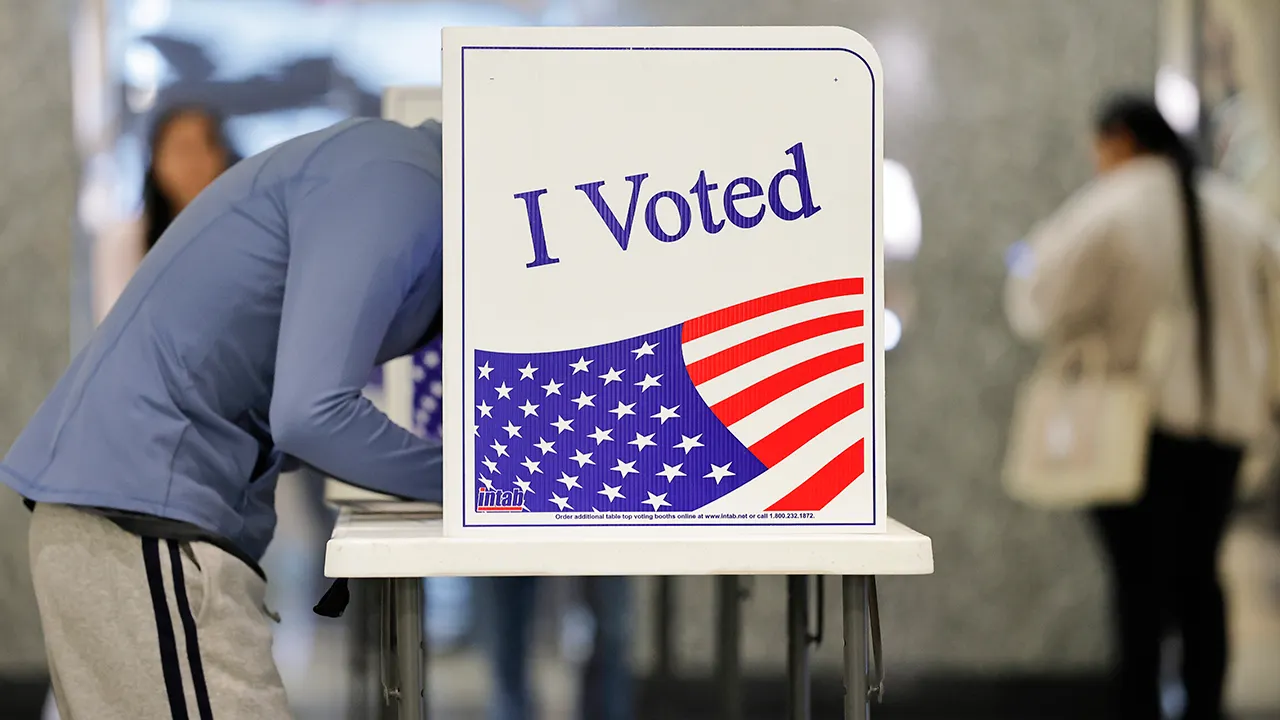
A voter marks their ballot in the Kern County Elections Office on Nov. 3, 2026, in Bakersfield, Calif. (Mario Tama/Getty Images)
The conclusive election results injected a potent dose of uncertainty onto Wall Street, compelling investors to swiftly reassess the profound implications of a unified Democratic government on a wide array of economic and corporate fronts. Key areas of focus include the trajectory of corporate and individual taxes, the scope and direction of government spending initiatives, and the regulatory landscape for critical sectors such as artificial intelligence, Big Tech, defense, healthcare, banking, and the nascent cryptocurrency market. The market’s immediate negative reaction underscores a preference for legislative gridlock, which often translates to policy stability and predictability, over the potential for aggressive policy shifts inherent in single-party rule.
“Markets appear to be pricing in the possibility of a stronger-than-expected Democratic showing, which could reduce expectations for further fiscal stimulus without corresponding tax increases or increased regulatory burdens,” Charu Chanana, chief investment strategist at Saxo in Singapore, told Reuters. This perspective highlights the complex interplay between potential government spending and its funding mechanisms, with investors wary of policies that could compress corporate earnings or stifle innovation through increased oversight.
Historically, significant shifts in congressional control following midterm elections have not consistently derailed long-term stock market performance. In fact, the S&P 500 has demonstrated resilience, rising through year-end in five of the eight midterm cycles since 1930 when the president’s party lost the House, according to Ned Davis Research. This historical pattern suggests that initial knee-jerk reactions often stabilize, and markets tend to adapt to new political realities. However, the current projection of unified control, rather than a split Congress, presents a different dynamic, implying a greater potential for legislative action that could directly impact corporate balance sheets and sector-specific outlooks.
LARRY KUDLOW: THE SOCIALIST DEMOCRATS WILL SPEND PLENTY IF THEY WIN, BUT PRESIDENT TRUMP WILL VETO ALL OF IT

Voters cast their ballots on Election Day at the Cross Insurance Center polling location on Nov. 3, 2026, in Bangor, Maine. (Joe Raedle/Getty Images)
Prediction markets, often a more agile indicator of real-time sentiment, had increasingly signaled a high probability of Democratic control of both chambers as election results began to firm up, with an astounding $1.48 billion wagered on the midterm elections. This substantial betting volume underscores the intense investor focus and the growing conviction towards a “blue wave” scenario, reflecting an informed consensus that predated official projections.
Chanana elaborated on specific concerns, noting that investors are particularly apprehensive that a Democratic-controlled Congress could usher in an era of heightened regulatory scrutiny for artificial intelligence and Big Tech firms. This comes at a critical juncture where investors are already grappling with questions surrounding lofty valuations and the sustainability of rising AI-related spending. Potential legislative actions could include more aggressive antitrust enforcement, stricter data privacy regulations, and proposals for higher taxes on digital advertising or multinational tech profits, directly impacting the profitability and growth trajectories of these dominant companies. This explains the disproportionate drop in Nasdaq futures.
“However, lower Treasury yields could eventually provide some relief, so the initial selloff may not necessarily be sustained,” she added. The benchmark 10-year Treasury yield, a key indicator for borrowing costs and future economic expectations, fell a notable 6 basis points to 4.906%. This decline suggests a flight to safety, an expectation of slower economic growth under new policy, or reduced inflation expectations if potential increased spending is perceived to be offset by tax increases or slower overall economic activity. Lower yields can eventually provide a cushion for equity valuations, particularly for growth stocks, by reducing the discount rate applied to future earnings.
The U.S. dollar also experienced a noticeable weakening in the immediate aftermath of the election results. The euro and British pound both gained ground against the dollar, while the dollar index, which measures the greenback against a basket of major currencies, fell 0.32%. This depreciation signals reduced investor confidence in the near-term U.S. economic outlook under the new political leadership, or a broader “risk-off” sentiment pushing capital towards perceived safer havens or other developed markets.
AFFORDABILITY TAKES CENTER STAGE AS AMERICANS CAST THEIR BALLOTS IN HIGH-STAKES MIDTERMS

Kalshi billboards displaying U.S. Senate midterm election odds in Times Square in New York Nov. 2, 2026. (Angelina Katsanis/Bloomberg via Getty Images)
The market reaction was not confined to U.S. borders, underscoring the interconnectedness of global financial systems. Markets overseas also moved lower in sympathy, reflecting concerns about potential ripple effects from U.S. policy shifts on global trade, investment, and economic stability. Japan’s Nikkei fell a sharp 3%, South Korea’s KOSPI dropped 1.6%, and a broad index of Asia-Pacific stocks outside Japan declined 0.5%. These global movements highlight the pervasive nature of U.S. political decisions and their capacity to influence international investor sentiment and capital flows.
CLICK HERE TO GET FOX BUSINESS ON THE GO
Market Impact:
The projected unified Democratic control of Congress ushers in a period of heightened policy uncertainty and potential volatility, but also targeted opportunities. While an immediate market sell-off reflects anxieties over higher corporate taxes, increased regulation, and potentially inflationary spending, investors will now pivot to scrutinize specific legislative proposals. Sectors like clean energy, healthcare infrastructure, and specific social programs could see tailwinds, while Big Tech, traditional energy, and financials may face headwinds from antitrust enforcement, environmental regulations, and consumer protection initiatives. The Federal Reserve’s monetary policy path will also be influenced by the new fiscal landscape, potentially leading to a re-evaluation of interest rate expectations. Ultimately, market performance will hinge on the specifics of the legislative agenda and the ability of the new Congress to navigate economic challenges without severely dampening corporate profitability or exacerbating existing inflationary pressures.
FOX Business’ Eric Revell and Reuters contributed to this report.