
More than 118 million users watch microdramas every month as the serialized format has taken off in India. EloElo’s Story TV is one of the top apps for microdramas, with over 33 million active users, according to analysts.
**Key Takeaways**
* **Microdramas Surge in India:** EloElo’s Story TV leads India’s rapidly growing microdrama market, securing an $80 million Series C investment at a $500 million valuation, driven by over 118 million monthly users consuming vertical, serialized content.
* **Mobile-First Entertainment Vision:** Founder Saurabh Pandey champions snackable, mobile-native storytelling, attracting users for 95 minutes daily, but faces the challenge of converting India’s free content consumers into a sustainable, paying subscriber base.
* **AI Augments, Humans Direct:** While leveraging its Dolphin AI platform to enhance content creation workflows and explore new applications like marketing, EloElo emphasizes that human creative direction remains paramount in crafting compelling narratives.
The Rise of Microdramas: EloElo’s Story TV Secures $80M Funding
In an increasingly mobile-centric world, where attention spans are measured in seconds rather than minutes, the microdrama format has emerged as a formidable force in digital entertainment. These bite-sized, serialized video narratives, often optimized for vertical viewing on smartphones, have captivated audiences across the globe. Nowhere is this phenomenon more pronounced than in India, a nation boasting a colossal internet population and an insatiable appetite for digital content.
At the forefront of this burgeoning trend is EloElo, whose flagship app, Story TV, has become a household name for millions. Analysts report that Story TV alone commands over 33 million active users, contributing significantly to the staggering 118 million monthly users who now engage with microdramas across India. Recognizing this immense scale and future potential, EloElo recently announced a substantial Series C funding round, raising $80 million from Hornbill Capital and NBCUniversal. This latest injection of capital propels EloElo’s total fundraising to an impressive $130 million, cementing its valuation at a robust $500 million.
The Global Appeal of Snackable Storytelling
The appeal of verticalized, serialized content isn’t confined to India. From the U.S. to China, this format is reshaping how people consume entertainment. Hollywood heavyweights like Issa Rae, James Franco, and Kim Kardashian have not only invested in but also starred in microdrama productions, signaling a significant shift in industry perception. The convenience of consuming high-quality narratives in short bursts, seamlessly integrated into daily routines, has proven irresistible.
India, with its more than a billion internet users, presents a uniquely fertile ground for this content revolution. The country’s entertainment market is vast, and analysts are optimistic, projecting the microdrama industry to swell to an annual revenue of $3-$4 billion by 2030. Last year alone, dedicated microdrama platforms such as Story TV, Kuku TV, and Quick TV consistently ranked among the most downloaded video streaming applications nationwide, underscoring their rapid ascendancy.
The Vision Behind Story TV’s Success
Founded in 2020 by former Flipkart executive Saurabh Pandey, the Story TV platform has experienced exponential growth. It now boasts an extensive catalog of over 5,000 titles, available in six different languages, catering to India’s diverse linguistic landscape. Pandey attributes much of this success to the inherent “snackable” nature of the content. Users, on average, log an impressive 95 minutes on the app daily, spread across multiple sessions – a testament to how seamlessly microdramas fit into modern lifestyles.
“I fundamentally believe that the next billion users will probably not grow up on a diet of watching television; they will grow up on a diet of watching content on their phones, right?” Pandey shared with TechCrunch. “And this content has to be, and this entertainment, designed very differently. It’s not going to be appointment viewing. It’s going to be within certain slots throughout the day. And a lot of this was earlier solved for short clips, but serialized storytelling was never solved.”
While acknowledging that traditional big-screen viewing with family and friends will retain its place, Pandey firmly believes that the lion’s share of daily entertainment consumption will shift to mobile devices. This conviction forms the bedrock of EloElo’s strategy, positioning Story TV as a pioneer in mobile-first, serialized narratives.
Navigating Competition and the Monetization Maze
EloElo, like all microdrama platforms, operates in a highly competitive landscape, vying for user attention against free content powerhouses like YouTube, Instagram, and TikTok. These ubiquitous platforms also host creators who are increasingly experimenting with serialized content. To entice users to choose Story TV over free alternatives, Pandey’s strategy hinges on delivering consistently high-quality, premium content. Strategic partnerships, such as the one with Indian television production giant Balaji Telefilms, are crucial in ensuring a steady supply of compelling original titles.
The company offers various subscription tiers – monthly, quarterly, and yearly – to unlock its premium catalog. Additionally, some ad-supported free content is available, though reports suggest that ad revenue in this segment might not be as lucrative as direct subscriptions.
Monetization remains a significant challenge in the Indian market, where users often prefer free content and conversion to paid subscriptions can be difficult. A report from analyst firm Redseer highlights this hurdle, indicating that while over 40 million people have paid for microdramas at least once, only 15-17 million maintain a monthly paid subscription. Further underscoring this trend, a separate survey by Ormax Media revealed that a striking 72% of microdrama consumers have never paid for the content they consume. Overcoming this paywall inertia will be critical for EloElo’s long-term financial sustainability.
AI: The Co-Pilot for Creativity, Not the Driver
The future of content creation in the microdrama space is inextricably linked to artificial intelligence. Platforms across the board are exploring AI to enhance content supply and engagement. Some, like Google-backed Kuku, are focused on optimizing production workflows, while others, such as Dashverse’s Shortfree, are experimenting with video AI models to generate serialized clips.
EloElo falls into the former camp with its proprietary Dolphin AI platform. Initially developed as an internal tool to streamline and improve video creation, the company now plans to make Dolphin AI broadly available. Its capabilities are extensive, functioning as a comprehensive editor complete with templates and an array of models for generating images, audio, and video, as detailed on its website.
EloElo envisions Dolphin AI extending its utility beyond content creation, with potential applications in marketing campaigns and advertising. While Indian platforms like Pocket and Kuku have already integrated AI tools for creators, a scaled effort to provide a robust alternative to popular editing suites like CapCut or Instagram Edits has yet to materialize from an Indian company like InVideo.
Pandey, however, maintains a clear philosophy regarding AI’s role: human involvement remains paramount for crafting truly compelling stories. He sees AI not as a replacement for human creativity, but as a powerful augmentation. “My belief in involving AI is that AI is a really fast race car where AI is the engine, but you need an extremely capable Formula One driver to be on the steering wheel,” he elaborated. “That, for me, is the creative director or the showrunner. AI is supposed to work with them, augmenting their skill set. AI can help write stories, but so far the best stories I have loved have all had a very high human x AI element to it.” This perspective positions AI as a sophisticated co-pilot, enhancing the capabilities of human storytellers rather than steering the narrative entirely.
Beyond Microdramas: EloElo’s Broader Ecosystem
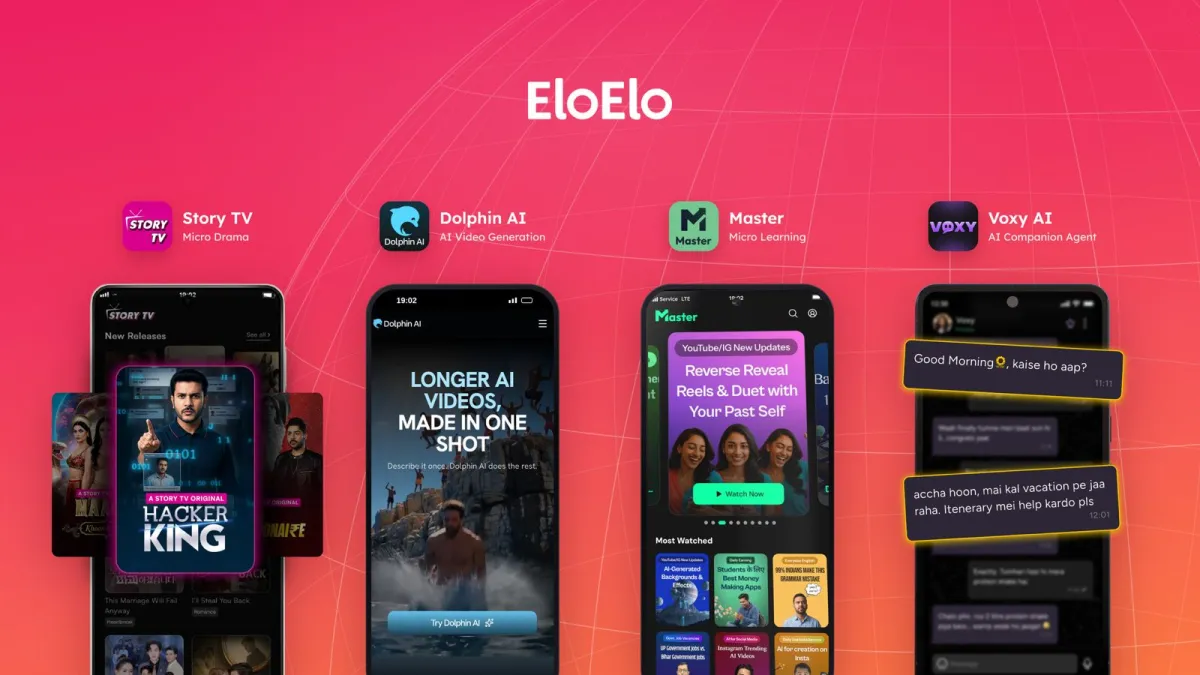
EloElo’s strategic vision extends beyond microdramas. The company has diversified its offerings, including Master, a vertical video learning app that competes with platforms like Seekho and Kuku’s Guru. Additionally, it has launched Voxy AI, an AI companion app. Across its suite of applications, EloElo currently reports more than 40 million monthly users. While a precise bifurcation of users per app was not provided, it is understood that Story TV accounts for the vast majority of this user base.
With the recent funding, EloElo is poised for significant expansion. The company currently employs 240 individuals and plans aggressive hiring to bolster its AI and machine learning research teams – crucial for further developing platforms like Dolphin AI. A substantial portion of the newly acquired capital is also earmarked for the production of more original titles, reinforcing Story TV’s content library and competitive edge.
The Series C round saw participation from new investors like MIT Investment Co., alongside continued support from existing backers such as Play Ventures, Kalaari Capital, Waterbridge Ventures, and Griffin Gaming Partners, all signaling strong confidence in EloElo’s multi-faceted strategy and its leadership in the booming mobile entertainment sector.
The Bottom Line
EloElo’s successful $80 million Series C funding underscores the explosive growth of microdramas in India, validating its vision for mobile-first, snackable entertainment. While Story TV has skillfully captured a massive audience with its compelling content and strategic AI integration, the company’s ultimate success will hinge on its ability to navigate India’s challenging monetization landscape and convert its vast free user base into sustainable, paying subscribers, thereby proving the long-term viability of premium serialized content on the small screen.
When you purchase through links in our articles, we may earn a small commission. This doesn’t affect our editorial independence.
{content}
Source:{feed_title}