
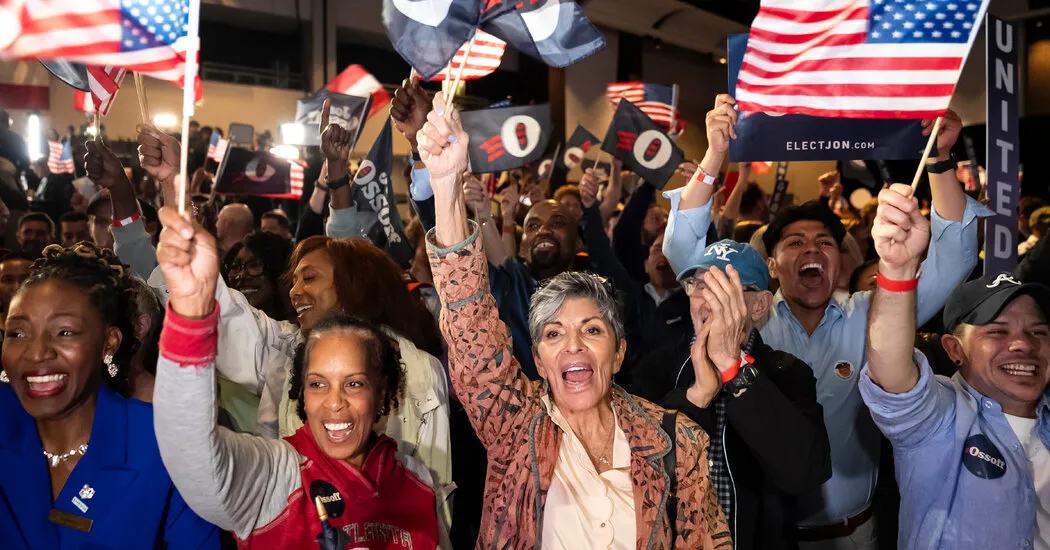
Congressional Landscape Transforms as Democrats Secure Legislative Control
Following a sweeping electoral victory that delivered control of both the House of Representatives and the Senate to the Democratic Party, the legislative branch in Washington is poised for a significant transformation. This shift in power presents an opportunity for Congress to potentially reassert its constitutional role as a co-equal branch of government, particularly in its capacity to serve as a check on the executive, after a period characterized by unified Republican control and legislative alignment with the presidency.
Since President Trump’s election in 2024, alongside Republican majorities in both chambers of Congress, the Republican-led legislative branch largely prioritized the advancement of the President’s agenda. This period saw the executive branch exercise considerable latitude in areas such as federal spending, trade policy, and the application of war powers, with critics arguing that congressional oversight was diminished during this time.
With the Democratic Party now poised to assume firm control of both the House and Senate, the legislative branch is expected to pursue a more assertive stance, particularly regarding budgetary authority and executive oversight. Democratic leaders have articulated a clear intent to scrutinize the President and his administration more rigorously. Representative Hakeem Jeffries, projected to become the next Speaker of the House, stated, “We are going to bring accountability to those who have visited unprecedented corruption on this country.” He further declared on Wednesday in Washington, as the full extent of the Democratic victories became apparent, that “The days of the House of Representatives functioning like a wholly owned subsidiary of the Trump administration are over.” Similarly, Senator Chuck Schumer of New York, the Democratic leader, pledged to usher in a new era, asserting, “The days of Trump’s supplicant Senate are over.”
Despite these stated intentions and the breadth of their electoral success, the incoming Democratic majority may face limitations in its capacity to constrain the President. President Trump has previously demonstrated a willingness to challenge established congressional powers and traditional norms governing executive-legislative relations. Prior to the elections, Mr. Trump had indicated to Fox News his intention to act as “Mr. Veto” should Democrats gain control. However, following the election results, he adopted a more conciliatory stance, expressing an openness to negotiate legislative agreements. This shift echoes earlier periods of his presidency when he presented himself as open to bipartisan deal-making on major issues. Nevertheless, political partisanship has intensified significantly in recent years. Empowered by their electoral mandate, Democrats are expected to pursue legislative compromises predominantly on their own terms.
A significant point of contention is anticipated to be the executive branch’s response to congressional oversight. The administration is expected to mount substantial resistance to demands for information and testimony from its officials, potentially leading to intense clashes and hindering collaborative legislative efforts. During the previous two years, administration officials were often perceived as dismissive or confrontational when interacting with minority Democrats on committees chaired by Republicans. Beginning in January, Democrats will assume control of these committees, gaining subpoena power to initiate investigations into various aspects of the administration’s operations and personnel. Furthermore, in the Senate, Democrats will possess the authority to delay or outright block the confirmation of President Trump’s judicial and executive branch nominees.
Some leading Democrats have expressed hope that the election results, widely seen as a rejection of the President’s party, might encourage a segment of Republicans to diverge from the White House’s agenda and potentially support efforts to reverse certain administration policies. However, Senator John Thune of South Dakota, the current Republican Majority Leader, adopted a confrontational tone as election results solidified. He stated that Republicans would resist what he termed “fringe” Democratic positions from becoming mainstream policy. Despite their electoral gains, Democrats do not hold the 60 votes required to overcome a legislative filibuster in the Senate, thereby preserving a degree of leverage for the Republican minority. Senator Thune affirmed, “Senate Republicans will not stand idly by as the far-left, socialist wing of the Democrat Party attempts to unwind everything we’ve done.” He added, “Thankfully, we still have President Trump in the White House, and we’ll work with him to stop the worst impulses of Democrat extremism.”
Democrats have indicated their strategy includes presenting Republicans with opportunities to demonstrate responsiveness to voter concerns by initiating votes on proposals such as reversing reductions to healthcare and social safety net programs, particularly those affecting rural constituencies where Republican support waned. Senator Schumer articulated this approach: “We are going to challenge them. We are going to put some easy things on the floor and see if they vote for them.” Internally, the Democratic Party faces its own set of challenges. The party encompasses a spectrum of ideological viewpoints, which could complicate efforts to achieve internal consensus on key legislative priorities, potentially hindering their ability to deliver on campaign promises for swift policy changes, even amidst President Trump’s expressed willingness for negotiation.
Disputes over federal spending are anticipated to be a particularly contentious area. Democrats are committed to reasserting congressional authority over appropriations, following instances where the previous Republican majority utilized a special reconciliation process to fund specific administration initiatives, such as an immigration crackdown, leading to a prolonged shutdown of the Department of Homeland Security after Democratic opposition. Furthermore, the administration has faced criticism for allegedly refusing to spend certain funds allocated by Congress, reallocating other monies towards administration priorities without explicit legislative approval, and employing its “rescission” authority in ways that some lawmakers from both parties contend circumvent established budgetary laws. Democrats aim to restore traditional congressional spending prerogatives and may seek bipartisan support from members of the House and Senate Appropriations Committees who reportedly expressed concerns about the President’s fiscal decisions.
The perceived degree of congressional deference to the executive branch was a recurrent theme in the recent election campaign. Democratic candidates frequently criticized incumbent Republicans for what they characterized as insufficient resistance to the President’s actions, which they argued negatively impacted their constituents. For example, Adam Hamilton, the Democrat who defeated Republican Senator Roger Marshall in Kansas, stated on MS NOW that Marshall “in essence is a ‘yes man’ to the president,” adding, “Instead of fighting for the people of Kansas, he comes back as though he’s a spokesperson for the White House.” As the new legislative session approaches, the Democratic leadership, including Representative Jeffries, has framed the election outcome as the beginning of a “great American comeback.” This sentiment extends to the potential for Congress itself to experience a revitalization of its institutional role and authority.
Why This Matters
The outcome of this election, leading to a divided government with Democrats controlling Congress and a Republican in the White House, carries profound implications for the governance of the United States and its democratic institutions.
Checks and Balances:Fundamentally, this shift represents a potential restoration of the constitutional system of checks and balances. For the past two years, with unified Republican control, the legislative branch was often perceived as aligning closely with the executive’s agenda. A Democratic-led Congress is now positioned to scrutinize presidential actions, policies, and appointments more rigorously, potentially limiting the executive’s unilateral authority in areas such as spending, foreign policy, and regulatory enforcement. This reassertion of congressional power is crucial for maintaining the separation of powers envisioned by the U.S. Constitution, safeguarding against potential overreach by any single branch of government.
Policy Landscape:The change in congressional control will significantly alter the legislative agenda and the prospects for major policy initiatives. President Trump’s remaining policy goals will likely face substantial opposition, with Democrats poised to block or modify proposals they deem contrary to their platform. Conversely, Democratic legislative priorities, such as reforms in healthcare, environmental policy, or social spending, will now be advanced through Congress. However, the President’s veto power and the Republican minority’s ability to filibuster in the Senate mean that significant bipartisan compromise will be necessary for most legislation to become law, potentially leading to legislative gridlock or a focus on areas of narrow agreement.
Government Oversight and Accountability:A primary focus for the new Democratic majority will be enhanced oversight of the executive branch. This includes investigations into various administration activities, demanding transparency, and holding officials accountable through hearings and subpoena power. This function is vital for government transparency, ensuring adherence to the rule of law, and rebuilding public trust in institutions. The intensity of these investigations could, however, generate significant political friction, potentially hindering cooperation on other matters.
Judicial and Executive Nominations:The Senate’s new Democratic majority will have a decisive impact on presidential nominations. While the President can still propose candidates for federal judgeships and executive branch positions, Senate Democrats can now block or delay confirmation, ensuring that future appointments align more closely with their ideological preferences or at least undergo more rigorous scrutiny. This will shape the composition of the federal judiciary and the leadership of government agencies for years to come.
Impact on Public Trust and Global Standing:How effectively these newly empowered branches navigate their redefined relationship will be closely watched both domestically and internationally. A functioning system, even with robust disagreements, can demonstrate the resilience of democratic institutions. Conversely, prolonged legislative paralysis or intense inter-branch conflict could further erode public confidence in government’s ability to address pressing national challenges. Globally, a stable and constitutionally balanced U.S. government projects reliability and strengthens its diplomatic standing, whereas internal discord can be perceived as weakness. This election therefore marks not just a shift in political control, but a critical juncture for the vitality of American democracy.