
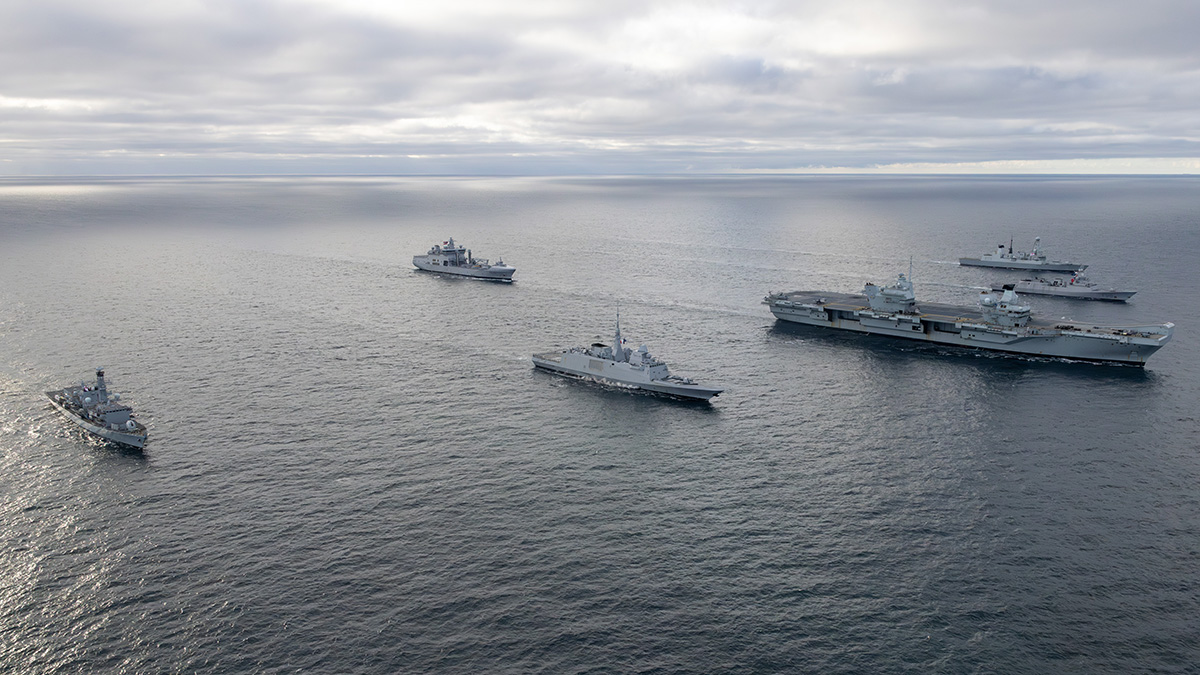
HMS Prince of Wales Leads Multinational Carrier Task Group in NATO Exercise Neptune Strike 26-4
The United Kingdom’s aircraft carrier, HMS Prince of Wales, has recently led a multinational carrier task group comprised of British, French, and Norwegian warships in a close formation exercise, designated Neptune Strike 26-4. This deployment signifies the UK Carrier Strike Group’s operational integration under NATO command, according to an official statement from the Ministry of Defence.
A photograph released on November 3, credited to AS1 Liam Ramsden, depicted the carrier at the core of the naval formation. Flanking the HMS Prince of Wales were the British Type 23 frigate HMS St Albans and a French frigate on one side, while the Norwegian frigate HNoMS Fridtjof Nansen and the British Type 45 destroyer HMS Dauntless sailed on the other. The Norwegian logistics support vessel HNoMS Maud was positioned astern. The Ministry of Defence characterized Neptune Strike 26 as “a multi-domain commitment to collective defence and deterrence,” underscoring its strategic importance in maintaining security across various operational domains.
The carrier task group commenced its deployment from Portsmouth on October 18, marking the second phase of Operation Firecrest. HMS Prince of Wales was accompanied by HMS Dauntless and carried a comprehensive air group. This air component included F-35B Lightning II stealth jets, Merlin Mk4 and Mk2 helicopters, Wildcat helicopters, and Malloy drones, showcasing advanced naval aviation capabilities. More than 1,200 British service personnel are engaged in this deployment, operating alongside allied forces from nations including Norway, Denmark, and Germany. The Royal Navy announced prior to the group’s departure that it would host significant international gatherings, including the Atlantic Future Forum and the International Sea Power Conference, both scheduled to take place in Oslo, Norway.
Louise Sandher-Jones, the Minister for the Armed Forces, emphasized the strategic significance of the deployment at the time of its commencement. She stated, “The deployment of the HMS Prince of Wales and her air wing to the High North and the North Atlantic, operating under NATO leadership, is a clear demonstration of the UK’s commitment to the Alliance and contribution to the enduring security and stability of the North Atlantic.” Commodore Richard Hewitt, Commander of the UK Carrier Strike Group, also commented on the mission, stating, “I am pleased to return to the Arctic and North Atlantic as we build on the successes of the first phase of Op Firecrest. Led by the UK Flagship HMS Prince of Wales, the Strike Group will bring together a range of assets and capabilities, while taking every opportunity to train, operate and integrate with our NATO Allies and Partners.”
Shortly after sailing, F-35B aircraft operating from the carrier participated in Exercise Global Thunder, the US Strategic Command’s annual nuclear command and control exercise. During this, they escorted a US Air Force B-52 strategic bomber over the High North, flying in conjunction with Norwegian F-35A jets. Subsequent activities included the carrier’s F-35 jets conducting a live land strike exercise in collaboration with the Norwegian Army, while a Wildcat helicopter from HMS Dauntless carried out a maritime strike exercise alongside Norwegian forces. Concurrently, Britain’s other aircraft carrier, HMS Queen Elizabeth, has been engaged in separate training exercises with Royal Air Force Chinook heavy lift helicopters off the coast of Gibraltar, illustrating the breadth of the Royal Navy’s operational readiness and commitment.
The initial phase of Operation Firecrest concluded in July when HMS Prince of Wales returned to Portsmouth. During that period, the carrier group undertook NATO’s Air Policing mission over Iceland and the Arctic. It also led the first iteration of Neptune Strike to extend into the High North and North Atlantic, with F-35Bs from 809 Naval Air Squadron conducting sorties that extended as far as Poland, demonstrating significant reach and operational flexibility and reinforcing NATO’s presence across its eastern flank.
Why This Matters
The deployment of the HMS Prince of Wales Carrier Strike Group, operating under NATO command during Exercise Neptune Strike 26-4, holds significant geopolitical implications. It serves as a potent demonstration of NATO’s collective defence capabilities and its commitment to deterring aggression in the strategically vital High North and North Atlantic regions. The presence of a multinational task force, comprising assets from the UK, France, and Norway, underscores the robust unity and interoperability among allied nations, sending a clear message to potential adversaries about the alliance’s readiness and resolve to protect its collective interests.
The High North and Arctic are increasingly contested zones, vital for shipping lanes, energy resources, and geopolitical influence. Russia has significantly increased its military presence and activities in this area, raising concerns about regional stability. NATO’s exercises in this region, particularly those involving advanced capabilities like carrier strike groups, are crucial for projecting power, maintaining freedom of navigation, and safeguarding the economic and security interests of member states. The ability to operate effectively in challenging Arctic conditions is a critical aspect of modern naval warfare and deterrence strategy.
This deployment highlights the United Kingdom’s ongoing commitment to its role as a leading maritime power and a pivotal contributor to NATO’s security architecture. The HMS Prince of Wales, as one of the Royal Navy’s two Queen Elizabeth-class aircraft carriers, represents a substantial investment in advanced naval capability. Its ability to embark a diverse air group, including F-35B stealth fighters and various helicopters and drones, provides a flexible and powerful instrument for power projection, crisis response, and diplomatic engagement on a global scale, enhancing the UK’s influence and capacity to respond to international challenges.
Exercises like Neptune Strike are indispensable for enhancing interoperability among NATO allies. The simultaneous operation of different national warships, air assets, and personnel under a unified command structure allows for the refinement of tactics, communication protocols, and logistical coordination. This ensures that in the event of a real-world contingency, allied forces can integrate seamlessly and respond effectively, maximizing their collective strength. The live strike exercises conducted with Norwegian forces further demonstrate the practical application of this interoperability, building trust and effectiveness between partner nations.
The inclusion of fifth-generation F-35B jets, advanced helicopters, and unmanned aerial vehicles (UAVs) like Malloy drones within the carrier’s air group showcases the cutting-edge technological capabilities being integrated into modern naval operations. This multi-domain approach allows for enhanced situational awareness, precision strike capabilities, and resilience against evolving threats, ensuring NATO maintains a technological edge and remains prepared for the complexities of contemporary warfare.
Beyond military exercises, the carrier’s role in hosting the Atlantic Future Forum and the International Sea Power Conference in Oslo underscores the broader diplomatic and economic dimensions of its deployment. These events provide platforms for dialogue on maritime security, technological innovation, and geopolitical challenges, reinforcing international partnerships and shaping future defence strategies. The security and stability fostered by such military presence indirectly support economic activities, including vital trade routes and resource exploration in the region, making these deployments crucial for both military readiness and broader international relations.