
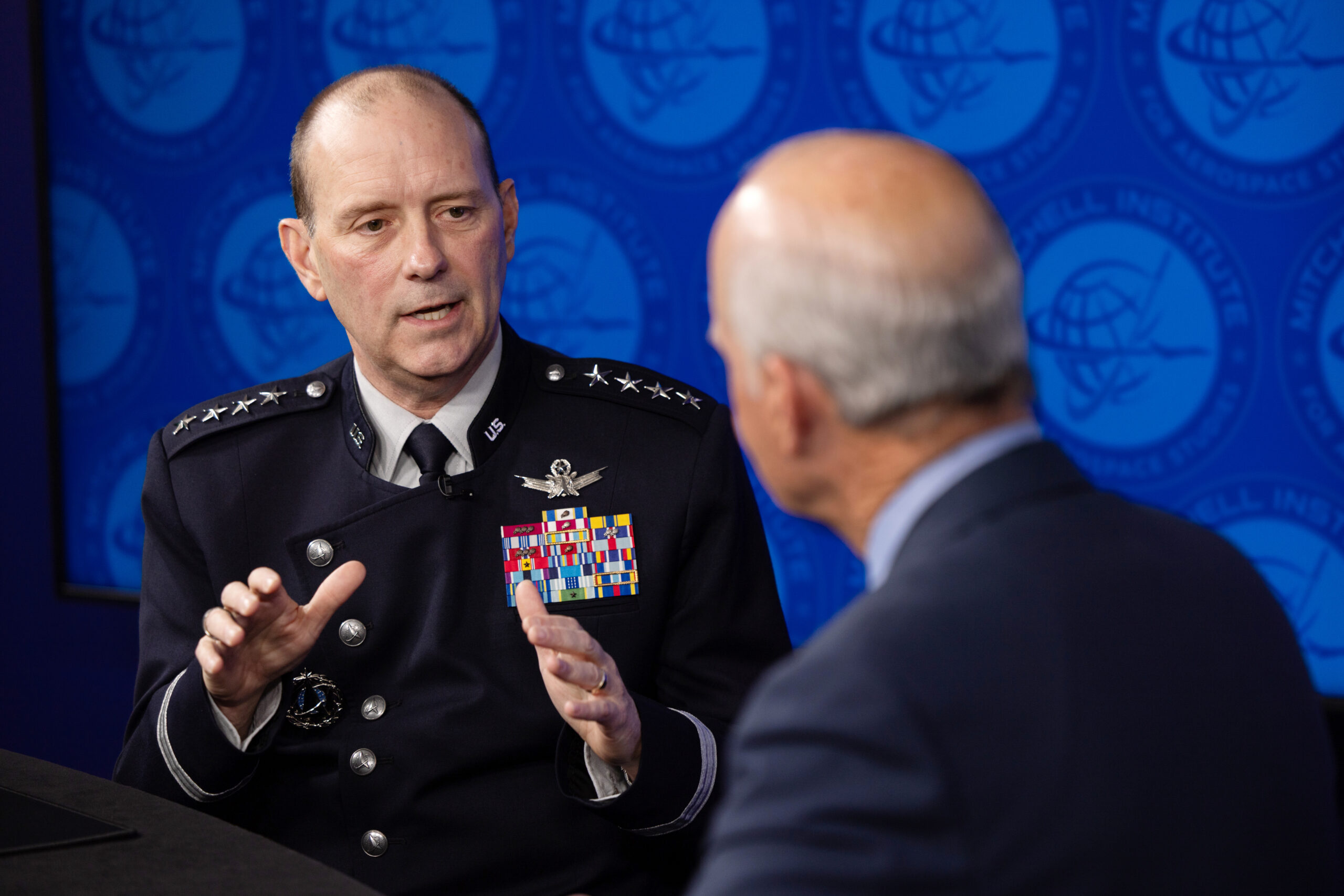
The United States Space Force is planning a significant expansion of its personnel and capabilities over the coming years, aiming to enhance its support for U.S. combatant commands globally. This strategic growth initiative was outlined by Chief of Space Operations Gen. Douglas Schiess, who indicated a substantial increase in both military and civilian personnel.
Speaking at an event hosted by the Air & Space Forces Association’s Mitchell Institute for Aerospace Studies on November 4, Gen. Schiess announced, “We’re going to add 2,800 Guardians and 2,000 civilians in fiscal 2027 if the budget comes through. A lot of that will go into our components.” Guardians are the military members of the Space Force, a branch established in 2019 to organize, train, and equip space forces to protect U.S. and allied interests in space.
These components are specialized units integrated within the broader structure of the U.S. military’s combatant commands. The Space Force currently maintains components within all seven geographic combatant commands (e.g., U.S. Central Command, U.S. European Command, U.S. Indo-Pacific Command) and, most recently, within U.S. Special Operations Command, which formally activated its Space Force element on November 2. While there are no immediate plans announced for establishing similar elements within the remaining functional commands—U.S. Cyber Command, U.S. Strategic Command, and U.S. Transportation Command—a Space Force spokesperson confirmed to Air & Space Forces Magazine that the service intends to create components within each eventually, though a definitive timeline has not yet been established.
The primary role of these Space Force components is to provide “space effects” to commanders operating in the field. This can involve a range of capabilities, from satellite communications and precision navigation to intelligence, surveillance, and reconnaissance (ISR), as well as missile warning and electronic warfare operations. These effects can be delivered from remote operations centers or through forward-deployed personnel directly supporting forces on the ground.
Gen. Schiess underscored the real-world operational relevance of these components by citing Operation Epic Fury, during which Space Forces Central deployed Guardians to the Middle East. Some of these deployed personnel reportedly came under enemy fire or sustained injuries while operating critical electronic warfare and missile defense systems. This example highlights the increasingly direct and hazardous involvement of space personnel in conventional military operations, moving beyond purely remote or strategic roles.
To adequately support combatant commands, both within their designated areas of responsibility and from their home stations, Gen. Schiess emphasized the necessity of growing the size of these Space Force components. While specific details on the exact growth for each element were not provided, he indicated that the service would prioritize the larger commands and those with the most pressing need for space-enabled capabilities.
Gen. Schiess himself previously led the Space Force’s component under U.S. Space Command from late 2023 to 2025, which is currently its largest element. He anticipates that components attached to U.S. Central Command (CENTCOM), U.S. European Command (European Command), U.S. Northern Command (Northern Command), U.S. Africa Command (Africa Command), and U.S. Indo-Pacific Command (Pacific Command)—all of which are led by one-star generals—will be prioritized for future growth. “We’ve got to grow those to the proper size,” he stated, acknowledging that the initial establishment of some components was done “on the cheap a little bit to get them out there.” He added, “We’ve still got some that we’ve got to bring on, but we’ve also got to get them the capabilities.”
While Gen. Schiess did not specify the precise number of personnel to be added to each component, he estimated that if he had unlimited resources, he would add “several hundred people” to these specialized units. Integrating Guardians into joint force and allied operations on a larger scale has been a top priority for Gen. Schiess since he assumed leadership of the Space Force in September. This strategic integration requires not only increased funding to recruit and train military and civilian personnel but also the resources to equip them with advanced systems for downrange operations.
The Space Force has requested a substantial $71 billion to commence funding this growth in fiscal year 2027, a figure more than double its request for fiscal year 2026. However, the path forward for this budget request is fraught with challenges. Approximately $12 billion of this proposed funding was part of a larger $350 billion reconciliation package, which faces significant political hurdles and is considered unlikely to be approved, particularly with a projected shift in congressional control. Furthermore, the timeline for the passage of regular appropriations for the defense budget remains uncertain.
Gen. Schiess acknowledged these budgetary difficulties, noting that the Space Force is currently operating under a continuing resolution (CR). A CR effectively freezes funding at fiscal year 2026 levels and prevents the service from initiating new programs or significant expansions, severely limiting its ability to implement its long-term strategy. “We have a great plan,” he said, “But as the CR continues, then it becomes more difficult.” This ongoing financial uncertainty poses a direct threat to the Space Force’s ambitious plans for expansion and enhanced operational integration.
Why This Matters
The planned expansion of the U.S. Space Force carries significant implications for global security, military strategy, and technological development. In an era of increasing geopolitical competition, space has emerged as a critical domain, fundamental to virtually all modern military operations, economic activities, and daily life. From guiding precision munitions and enabling global communications to providing crucial intelligence and early warning of missile launches, space assets are indispensable. Therefore, the Space Force’s growth signals a recognition of this evolving strategic landscape and an intent to solidify U.S. leadership and security in space.
This initiative underscores a shift from viewing space as merely a support function to considering it an operational warfighting domain. By integrating Guardians directly into geographic and special operations commands, the U.S. military aims to ensure that space capabilities are not just available but are seamlessly woven into the planning and execution of joint force operations. This enhanced interoperability can provide commanders with a decisive edge, allowing for more adaptive responses to threats and more effective deployment of resources across all domains—land, air, sea, and cyber.
The emphasis on forward deployment and direct support, as evidenced by incidents like Operation Epic Fury, also highlights the increasing human element and risk associated with space operations. It means that personnel operating highly advanced space systems may find themselves directly in harm’s way, challenging the traditional perception of space warfare as a purely remote endeavor. This necessitates not only more personnel but also specialized training and equipment to ensure their effectiveness and safety in contested environments.
Financially, the Space Force’s ambitious budget request, more than double the previous year, reflects the high cost of maintaining and advancing space capabilities. The political challenges in securing this funding, particularly amidst broader budgetary reconciliation debates and continuing resolutions, underscore the difficult choices facing policymakers. The ability to fund this expansion will directly impact the pace at which the Space Force can mature and fulfill its mission, potentially affecting national security readiness and technological superiority in space. The outcome of these budgetary battles will be a key indicator of the nation’s commitment to prioritizing space as a critical domain for future defense.