
UK First Sea Lord Underscores Norway’s Critical Role in North Atlantic Security Against Russian Border
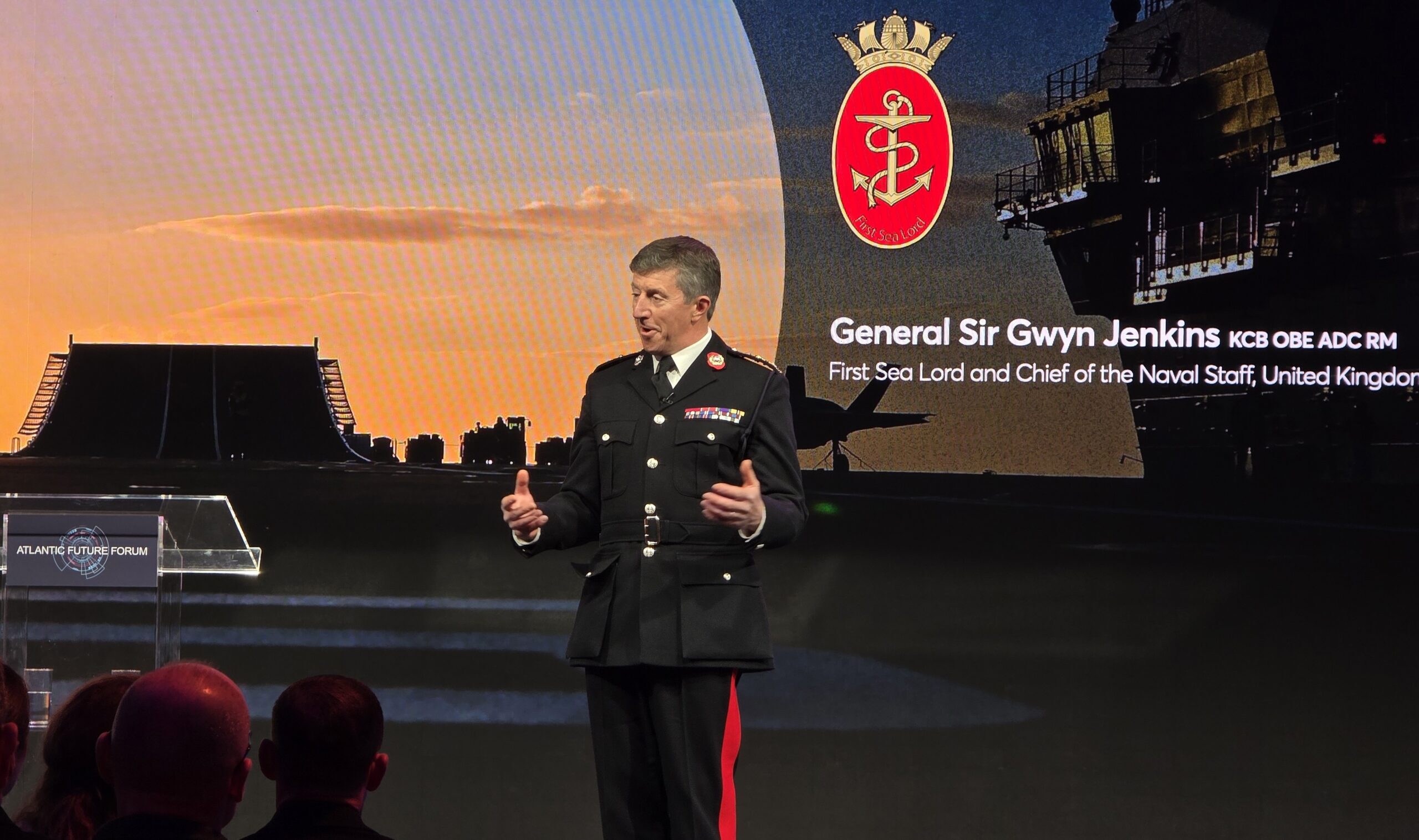
Oslo, Norway– General Sir Gwyn Jenkins, the United Kingdom’s First Sea Lord and professional head of the Royal Navy, has articulated a stark assessment of Britain’s northern maritime boundary, stating that the UK shares an “open border with Russia” across the North Atlantic, and identifying Norway as the United Kingdom’s primary line of defence in this strategically vital region. The remarks were made during the Atlantic Future Forum in Oslo, an event dedicated to discussions on maritime security and geopolitical challenges.
Addressing delegates aboard HMS Prince of Wales, one of the Royal Navy’s state-of-the-art aircraft carriers, General Jenkins underscored the geographical and strategic importance of Norway. “Norway does protect our northern flank. Norway is on the border with Russia, and Norway guards the entrance to the Euro-Atlantic area,” he stated, emphasizing Norway’s unique position. He continued, “The UK has an open border with Russia, and it is to our north, and it is through the Atlantic, and Norway is our first line of defense. We depend on Norway not just for our prosperity and energy, but for our security as well.”
General Jenkins’ comments highlight the vast expanse of the North Atlantic and the strategic proximity of Norway to Russia’s Kola Peninsula, a region hosting critical Russian naval bases, including those of its Northern Fleet. His assertion of an “open border” serves to emphasize the shared maritime domain and the potential for a direct confrontation or strategic competition in the high seas, far from conventional land borders. This perspective re-frames the traditional understanding of national borders, extending it to the vital maritime arteries that connect continents and enable global trade and security.
The First Sea Lord also drew upon his personal experience, noting his extensive history of training alongside Norwegian forces in the High North since 1992. This long-standing cooperation underscores a deep-rooted and practical partnership between the two NATO allies. He confirmed that Royal Marines Commandos are currently engaged in joint training exercises with their Norwegian counterparts in Norway, reinforcing the ongoing commitment to interoperability and readiness in challenging Arctic and sub-Arctic environments. Such training typically involves cold weather survival, amphibious operations, and specialized warfare tactics designed for extreme conditions.
General Jenkins, who played a pivotal role as the lead British negotiator for the Lunna House agreement, informed attendees that the preceding day’s International Sea Power Conference had focused on developing practical solutions to emerging threats, particularly those found in the “grey zone,” and on leveraging technological advancements to counter these challenges. “Today, you all get to take this to the next level,” he encouraged, signaling a push for deeper strategic engagement and implementation of innovative defence strategies.
The Lunna House agreement, announced jointly by Britain and Norway last December, signifies a significant deepening of naval cooperation between the two nations. Central to the agreement is enhanced collaboration on naval operations, notably concerning the Type 26 frigates. Both the Royal Navy and the Royal Norwegian Navy are set to operate these advanced anti-submarine warfare vessels, which are designed to protect fleets and deter adversaries in complex maritime environments. The agreement further establishes a framework for a more persistent presence of Royal Marines in northern Norway, enhancing the UK’s ability to operate and project power in the Arctic region. The agreement draws its name from Lunna House in Shetland, a historically significant location that served as a base for the wartime Special Operations Executive’s clandestine operations into occupied Norway during World War II, symbolizing a continuity of Anglo-Norwegian strategic alliance.
In a related development, the Royal Navy announced on Tuesday a substantial investment of £100 million aimed at transforming the UK Commando Force into a specialized warfighting formation with a primary focus on operations in the High North. This significant financial commitment reflects a strategic reorientation, ensuring that British elite forces are equipped and trained to excel in Arctic warfare, including cold weather survival, reconnaissance, and offensive operations in extreme conditions. This investment is part of a broader UK defence strategy to enhance its capabilities in an increasingly contested Arctic region, which holds significant geopolitical importance due to its strategic waterways and natural resources.
Why This Matters
General Sir Gwyn Jenkins’ candid remarks at the Atlantic Future Forum illuminate several critical aspects of contemporary European security and defence policy. Firstly, his assertion of an “open border with Russia” through the Atlantic underscores the strategic reality of maritime power projection and the pervasive reach of potential adversaries in an era where geographical distance is less of a barrier. This highlights the vital importance of the North Atlantic for trade, energy security, and military movements, making its safeguarding a paramount concern for NATO and its member states.
Secondly, the explicit designation of Norway as Britain’s “first line of defence” is a powerful testament to the indispensable role of alliances and geographical positioning. Norway’s long coastline, its direct border with Russia, and its control over the northern entry points to the Euro-Atlantic area are crucial for monitoring and potentially interdicting Russian naval activities emanating from the Kola Peninsula. This statement reinforces the core principle of collective defence within NATO, where the security of one ally is inextricably linked to the security of all.
Thirdly, the emphasis on Norway’s importance for UK “prosperity and energy” connects defence strategy directly to economic stability. As a major energy producer and a guardian of critical shipping lanes, Norway’s security directly impacts the UK’s energy supply and broader economic well-being. This perspective broadens the scope of national security, integrating economic resilience with military readiness.
The Lunna House agreement and the £100 million investment in the UK Commando Force for High North operations signify a concrete and practical response to these strategic realities. By deepening bilateral naval cooperation, standardizing equipment like the Type 26 frigates, and maintaining a persistent presence of Royal Marines in Norway, both nations are actively enhancing their interoperability and deterrence capabilities in a strategically vital and increasingly contested region. This forward-leaning posture is crucial for deterring potential aggression and maintaining stability in the Arctic and North Atlantic, areas that are becoming focal points for global power competition due.
Finally, the focus on “grey zone” threats and technological solutions at the International Sea Power Conference acknowledges the evolving nature of modern warfare. These sub-threshold aggressions, which include cyberattacks, disinformation campaigns, and maritime harassment, pose complex challenges that require sophisticated, multi-domain responses. The commitment to addressing these threats through practical solutions and advanced technology is essential for ensuring comprehensive security in an environment where traditional warfare boundaries are increasingly blurred. Ultimately, these developments reflect a sharpened focus by the UK and Norway on bolstering their collective defence posture against a complex array of threats in a critical geopolitical theatre.