
New York is gearing up to enforce one of the country’s most significant AI safety laws. The state opened a registration portal Tuesday, with which large frontier AI developers like Anthropic and OpenAI will be required to register by January 1, 2027.
Key Takeaways
- New York’s groundbreaking RAISE Act mandates comprehensive safety frameworks, incident reporting, and transparency from large “frontier” AI developers by January 2027.
- The state has established a new oversight body, DIGIT, and an independent research center to rigorously evaluate AI systems and ensure compliance, aiming to create a national model for regulation.
- Beyond frontier models, New York has also implemented laws for AI companion bots and youth-focused chatbots, demonstrating a multi-faceted approach to public AI safety, mirroring similar legislative efforts in other states.
New York is making a definitive statement in the rapidly evolving world of artificial intelligence: unchecked innovation will not be tolerated. The state has officially opened a registration portal for its landmark AI safety legislation, the Responsible AI Innovation, Safety, and Evaluation (RAISE) Act, signaling a serious commitment to regulating the cutting edge of AI development. This move places New York at the forefront of a growing national push to balance technological advancement with public protection, setting a precedent that could ripple across the industry.
As of Tuesday, large “frontier” AI developers, including industry giants like Anthropic and OpenAI, now have a clear directive: register with the state by January 1, 2027. This isn’t just about logging names; it’s the first step in a comprehensive regulatory framework designed to introduce accountability into a sector often characterized by its rapid, sometimes opaque, progress.
New York’s Bold Stance: The RAISE Act Unpacked
The RAISE Act, New York’s ambitious safety and transparency bill, is set to become fully effective at the dawn of 2027. It targets companies generating over $500 million in annual revenue, classifying them as “large frontier developers” – those whose AI systems are most likely to have widespread impact and, potentially, pose significant risks. The mandates of the RAISE Act are clear and substantial:
- Safety Frameworks:Companies must publish detailed safety frameworks on their websites, outlining their strategies and protocols for identifying, mitigating, and managing risks associated with their advanced AI models. This moves beyond mere promises, demanding documented, public-facing commitments to safety.
- Critical Incident Reporting:In a crucial step towards transparency and rapid response, developers will be required to report critical safety incidents within a tight 72-hour window. This ensures that serious malfunctions, unintended behaviors, or security breaches are promptly disclosed, allowing for quicker assessment and potential intervention.
- Public Model Transparency Reports:To foster trust and understanding, the act mandates the issuance of public reports detailing the capabilities, limitations, and potential impacts of their AI models. This aims to demystify complex AI systems for regulators and the public alike, promoting informed public discourse.
Strict Deadlines and Hefty Penalties
Enforcing these regulations falls to the newly established Office of Digital Innovation, Governance, Integrity, and Trust (DIGIT). This dedicated state body will be the primary implementer of the RAISE Act, tasked with overseeing compliance from large frontier AI labs. The financial penalties for non-compliance are designed to be a significant deterrent: up to $1 million for a single violation, escalating to $3 million for subsequent infractions. Furthermore, the state retains the right to bring enforcement actions against companies that fail to register with the new portal, underscoring the seriousness of the state’s intent, even if the specifics of these actions remain undisclosed for now.
Governor Hochul’s Vision for Responsible AI
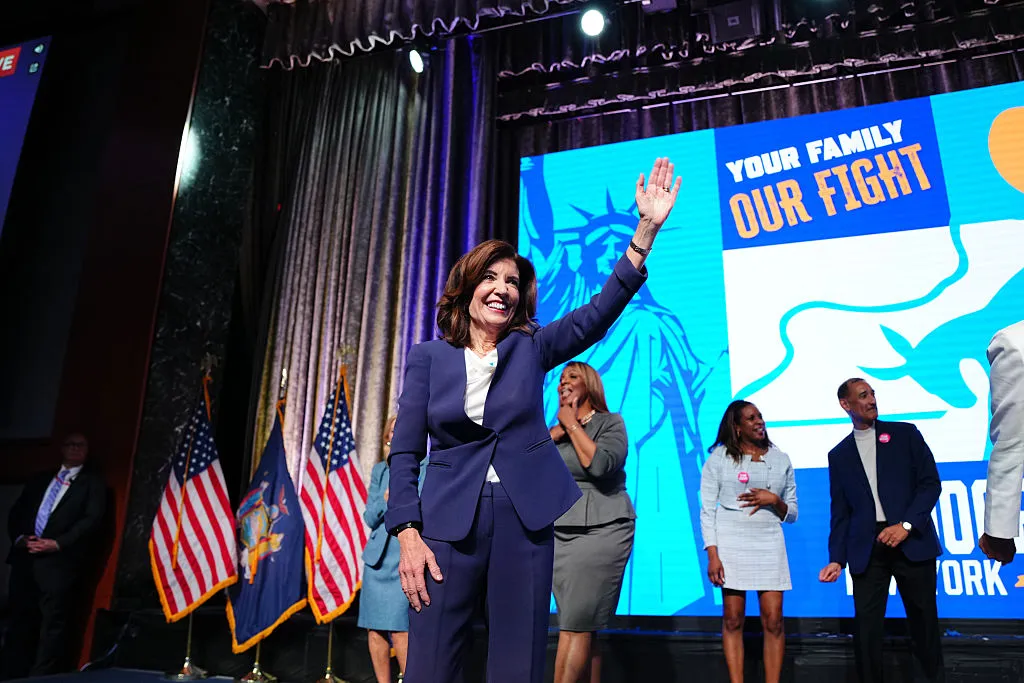
Governor Kathy Hochul has been a vocal proponent of this proactive approach, framing it as a necessary counter-narrative to the prevailing tech industry ethos. “Tech moguls tell us that their vision for AI is inevitable,” Governor Hochul stated during a recent press briefing. “They tell us get on board or get left behind… That any collateral damage is worth it as long as we win the race to the AI cliff.” Her words reflect a growing public and governmental skepticism towards a purely innovation-driven philosophy that sometimes overlooks societal consequences. Hochul’s vision is explicit: prioritizing communities over corporations and people over powerful technology.
Reinforcing Oversight: DIGIT and the Binghamton Center
To bolster New York’s regulatory infrastructure, Governor Hochul also unveiled the New York Center for AI Responsibility and Research, strategically based at the State University of New York’s Binghamton University. This center is envisioned as a critical independent entity, responsible for objectively evaluating the safety, security, and operational integrity of advanced AI systems. Its collaboration with DIGIT will be crucial, providing expert analysis to inform the review of companies’ submitted safety frameworks. First announced in January with a substantial $55 million in donations and capital, the center represents a significant investment in creating a robust ecosystem for AI governance. This dual approach of a governmental oversight body and an independent academic research center is central to Hochul’s ambition to build “a national model for smart, sensible AI regulation.”
A Broader Regulatory Landscape: Beyond Frontier AI
The RAISE Act, while significant, is not New York’s sole foray into AI regulation. The state has demonstrated a comprehensive strategy by enacting other laws addressing more immediate, public-facing AI applications. Last year, a law came into effect specifically targeting AI companion operators. It mandates that these platforms regularly inform users they are interacting with a bot and implement reasonable efforts to detect and respond to suicidal ideation and self-harm, putting a direct responsibility on developers for user well-being.
Furthering this commitment to protecting vulnerable populations, Governor Hochul signed a separate chatbot safety law for minors in October. This forward-thinking legislation, set to take effect on June 1, 2027, restricts problematic behaviors such as deceptive human-like interactions, emotionally manipulative or sycophantic responses, and any encouragement of harmful actions like suicide or disordered eating. These laws collectively underscore New York’s commitment to a holistic approach to AI safety, addressing risks not just in the development of advanced models but also in their everyday interaction with the public.
A National Movement? States Paving the Way
New York’s regulatory efforts are part of a broader, emerging trend across the United States, as individual states step into the void of federal AI legislation. Other states have also passed similar AI safety and transparency bills, creating a patchwork of state-level requirements. California’s SB 53, which became effective in January, mirrors aspects of the RAISE Act by mandating that frontier AI labs establish and publish safety frameworks, enact whistleblower protections, and report critical safety incidents, albeit with a slightly longer 15-day window. Similarly, Illinois’ SB 315, set to launch at the start of 2027, shares many requirements with its New York and California counterparts, further distinguishing itself by including provisions for independent safety compliance audits.
This multi-state movement highlights a shared recognition of the urgent need for AI governance. While the specifics of each bill vary, the core intent – to mandate transparency, establish safety protocols, and hold developers accountable – remains consistent. This decentralized approach, while potentially creating compliance complexities for companies operating across state lines, also serves as a fertile ground for experimenting with different regulatory models, potentially informing future federal legislation.
Implications and the Road Ahead
The implications of New York’s RAISE Act are significant. For AI developers, it signals an increased compliance burden and a shift towards integrating safety and ethics into the core of their development processes, rather than treating them as afterthoughts. While some may argue this could stifle innovation, proponents believe it fosters more responsible and sustainable technological growth. For users, these laws promise a future where AI systems are developed with greater transparency and a stronger commitment to preventing harm. The challenge for regulators will be to enforce these laws effectively in a rapidly changing technological landscape, adapting to new AI capabilities and risks as they emerge.
The path New York is charting, alongside states like California and Illinois, suggests a future where AI’s impact is not just measured by its capabilities, but also by its safety and ethical footprint. These state-level initiatives are critical experiments in governance, and their successes and challenges will undoubtedly influence the ongoing global conversation about how best to harness AI’s potential while mitigating its inherent risks.
The Bottom Line:New York’s RAISE Act is a landmark piece of legislation, establishing a robust framework for AI safety and transparency for frontier developers. Coupled with dedicated oversight bodies and additional laws protecting vulnerable populations, the state is positioning itself as a national leader in responsible AI governance. This comprehensive approach underscores a critical shift from unfettered innovation to a future where accountability and public safety are paramount, setting a significant precedent for how AI will be developed and deployed in the years to come.
When you purchase through links in our articles, we may earn a small commission. This doesn’t affect our editorial independence.
{content}
Source:{feed_title}